Kirjojen hintavertailu – 12 903 735 kirjaa ja 27 kauppaa

Kirjailija

Danilo Capecchi

Kirjat ja teokset yhdessä paikassa: 15 kirjaa, julkaisuja vuosilta 2011–2026, suosituimpiin kuuluu Quale Matematica per l'Architettura. Vertaile teosten hintoja ja tarkista saatavuus suomalaisista kirjakaupoista.

15 kirjaa

Kirjojen julkaisuvuodet: 2011–2026.

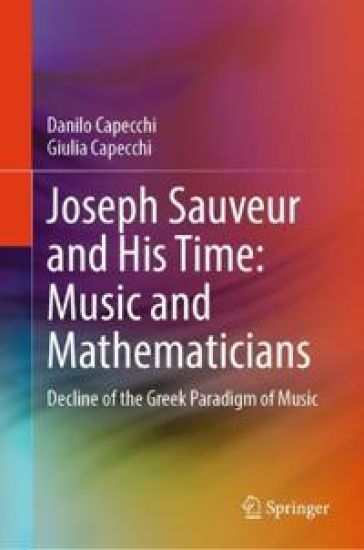
Joseph Sauveur and his Time: Music and Mathematicians

Joseph Sauveur and his Time: Music and Mathematicians

Danilo Capecchi; Giulia Capecchi

Springer Nature Switzerland AG
2026
sidottu
This book focuses on the shift in the perception of music by educated classes, from the Greek view as an essentially rational enterprise to the modern view as an essentially artistic enterprise. One of the main parties responsible for the decline of the Greek view was Joseph Sauveur. Although historians universally acknowledge his foundational contributions to the evolution of music, there is a paucity of comprehensive scholarship on his life and work. This book aims to address this gap. A mathematician contemporary of Newton and Leibniz, Sauveur was admitted to the Acad mie des sciences of Paris in 1696. He then began seeking to establish the science of sound on an equal footing with optics, claiming that it could no longer be considered a branch of music. He proposed the name acoustics, which was perhaps not entirely new. To better understand Sauveur's role in abandoning the Greek view, this paper briefly examines the evolution of music. First, it looks at ancient Greece, where the view originated. Then, it examines the early scientific era, when the shift in view began. Finally, the paper explains Helmholtz's contributions to the development of modern acoustics, which built upon Sauveur's work.
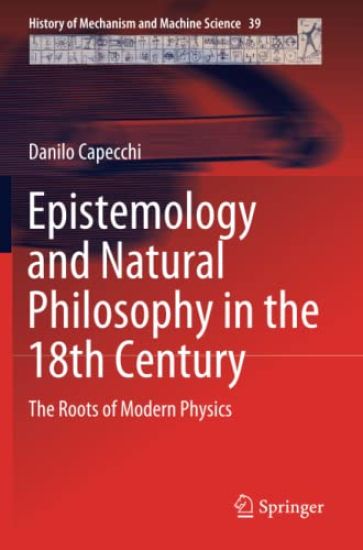
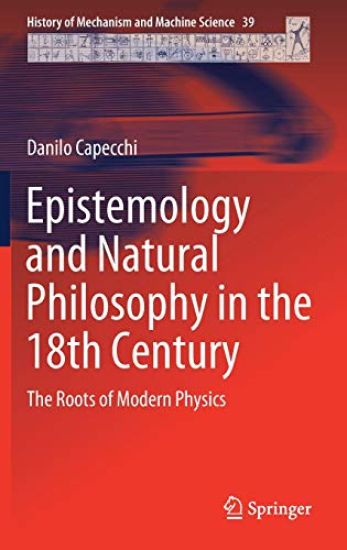
Epistemology and Natural Philosophy in the 18th Century

Epistemology and Natural Philosophy in the 18th Century

Danilo Capecchi

Springer Nature Switzerland AG
2021
nidottu
This book documents the process of transformation from natural philosophy, which was considered the most important of the sciences until the early modern era, into modern disciplines such as mathematics, physics, natural history, chemistry, medicine and engineering. It focuses on the 18th century, which has often been considered uninteresting for the history of science, representing the transition from the age of genius and the birth of modern science (the 17th century) to the age of prodigious development in the 19th century. Yet the 18th century, the century of Enlightenment, as will be demonstrated here, was in fact characterized by substantial ferment and novelty. To make the text more accessible, little emphasis has been placed on the precise genesis of the various concepts and methods developed in scientific enterprises, except when doing so was necessary to make them clear. For the sake of simplicity, in several situations reference is made to the authors who are famous today, such as Newton, the Bernoullis, Euler, d’Alembert, Lagrange, Lambert, Volta et al. – not necessarily because they were the most creative and original minds, but mainly because their writings represent a synthesis of contemporary and past studies. The above names should, therefore, be considered more labels of a period than references to real historical characters.
Epistemology and Natural Philosophy in the 18th Century
This book documents the process of transformation from natural philosophy, which was considered the most important of the sciences until the early modern era, into modern disciplines such as mathematics, physics, natural history, chemistry, medicine and engineering. It focuses on the 18th century, which has often been considered uninteresting for the history of science, representing the transition from the age of genius and the birth of modern science (the 17th century) to the age of prodigious development in the 19th century. Yet the 18th century, the century of Enlightenment, as will be demonstrated here, was in fact characterized by substantial ferment and novelty. To make the text more accessible, little emphasis has been placed on the precise genesis of the various concepts and methods developed in scientific enterprises, except when doing so was necessary to make them clear. For the sake of simplicity, in several situations reference is made to the authors who are famous today, such as Newton, the Bernoullis, Euler, d’Alembert, Lagrange, Lambert, Volta et al. – not necessarily because they were the most creative and original minds, but mainly because their writings represent a synthesis of contemporary and past studies. The above names should, therefore, be considered more labels of a period than references to real historical characters.
The Path to Post-Galilean Epistemology

The Path to Post-Galilean Epistemology

Danilo Capecchi

Springer International Publishing AG
2018
nidottu
This book casts new light on the process that in the sixteenth and seventeenth centuries led to a profound transformation in the study of nature with the emergence of mechanistic philosophy, the new mixed mathematics, and the establishment of the experimental approach. It is argued that modern European science originated from Hellenistic mathematics not so much because of rediscovery of the latter but rather because its “applied” components, namely mechanics, optics, harmonics, and astronomy, and their methodologies continued to be transmitted throughout the Middle Ages without serious interruption. Furthermore, it is proposed that these “applied” components played a role in their entirety; thus, for example, “new” mechanics derived not only from “old” mechanics but also from harmonics, optics, and astronomy. Unlike other texts on the subject, the role of mathematicians is stressed over that of philosophers of nature and the focus is particularly on epistemological aspects. In exploring Galilean and post-Galilean epistemology, attention is paid to the contributions of Galileo’s disciples and also the impact of his enemies. The book will appeal to both historians of science and scientists.
The Path to Post-Galilean Epistemology

The Path to Post-Galilean Epistemology

Danilo Capecchi

Springer International Publishing AG
2017
sidottu
This book casts new light on the process that in the sixteenth and seventeenth centuries led to a profound transformation in the study of nature with the emergence of mechanistic philosophy, the new mixed mathematics, and the establishment of the experimental approach. It is argued that modern European science originated from Hellenistic mathematics not so much because of rediscovery of the latter but rather because its “applied” components, namely mechanics, optics, harmonics, and astronomy, and their methodologies continued to be transmitted throughout the Middle Ages without serious interruption. Furthermore, it is proposed that these “applied” components played a role in their entirety; thus, for example, “new” mechanics derived not only from “old” mechanics but also from harmonics, optics, and astronomy. Unlike other texts on the subject, the role of mathematicians is stressed over that of philosophers of nature and the focus is particularly on epistemological aspects. In exploring Galilean and post-Galilean epistemology, attention is paid to the contributions of Galileo’s disciples and also the impact of his enemies. The book will appeal to both historians of science and scientists.
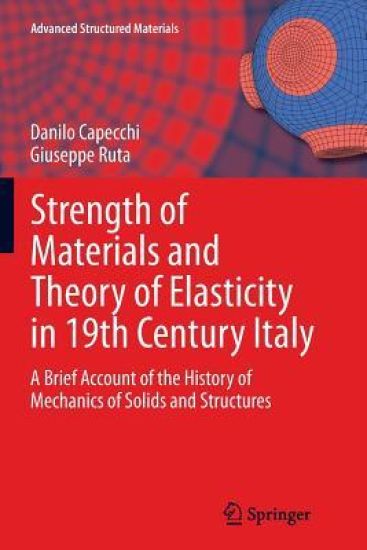
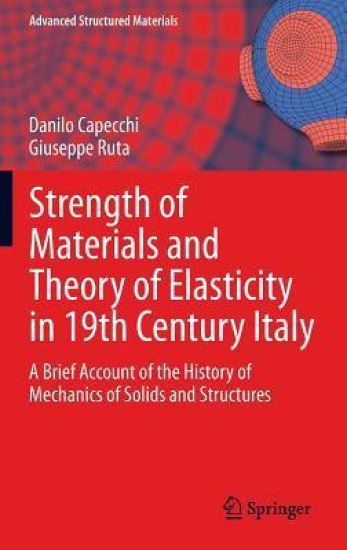
Strength of Materials and Theory of Elasticity in 19th Century Italy

Strength of Materials and Theory of Elasticity in 19th Century Italy

Danilo Capecchi; Giuseppe Ruta

Springer International Publishing AG
2016
nidottu
This book examines the theoretical foundations underpinning the field of strength of materials/theory of elasticity, beginning from the origins of the modern theory of elasticity. While the focus is on the advances made within Italy during the nineteenth century, these achievements are framed within the overall European context. The vital contributions of Italian mathematicians, mathematical physicists and engineers in respect of the theory of elasticity, continuum mechanics, structural mechanics, the principle of least work and graphical methods in engineering are carefully explained and discussed. The book represents a work of historical research that primarily comprises original contributions and summaries of work published in journals. It is directed at those graduates in engineering, but also in architecture, who wish to achieve a more global and critical view of the discipline and will also be invaluable for all scholars of the history of mechanics.
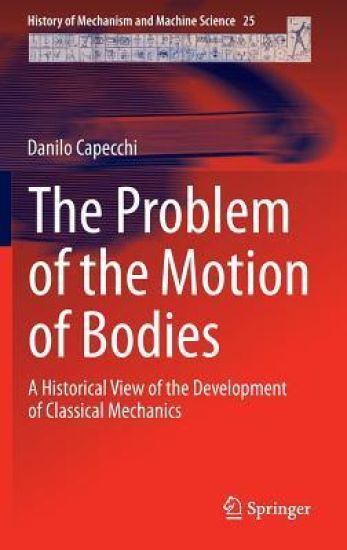
The Problem of the Motion of Bodies

The Problem of the Motion of Bodies

Danilo Capecchi

Springer International Publishing AG
2016
nidottu
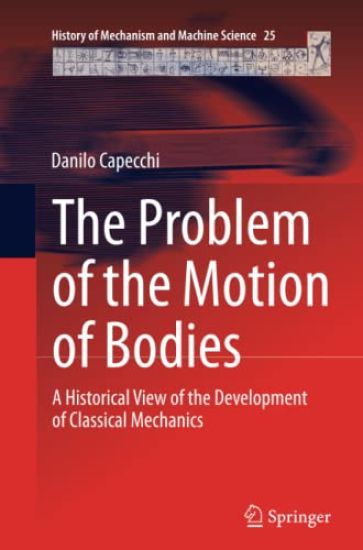
This book focuses on the way in which the problem of the motion of bodies has been viewed and approached over the course of human history. It is not another traditional history of mechanics but rather aims to enable the reader to fully understand the deeper ideas that inspired men, first in attempting to understand the mechanisms of motion and then in formulating theories with predictive as well as explanatory value. Given this objective, certain parts of the history of mechanics are neglected, such as fluid mechanics, statics and astronomy after Newton. On the other hand, due attention is paid, for example, to the history of thermodynamics, which has its own particular point of view on motion. Inspired in part by historical epistemology, the book examines the various views and theories of a given historical period (synchronic analysis) and then makes comparisons between different periods (diachronic analysis). In each period, one or two of the most meaningful contributions are selected for particular attention, instead of presenting a long inventory of scientific achievements.
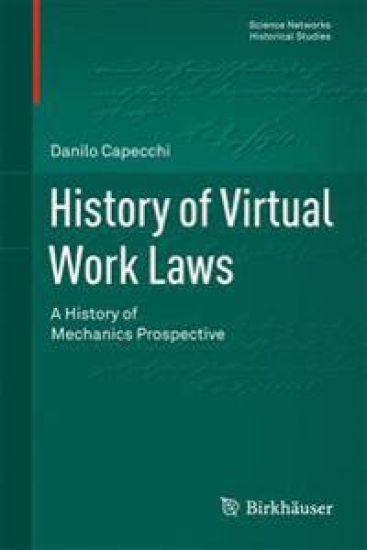
History of Virtual Work Laws

History of Virtual Work Laws

Danilo Capecchi

Springer Verlag
2016
nidottu
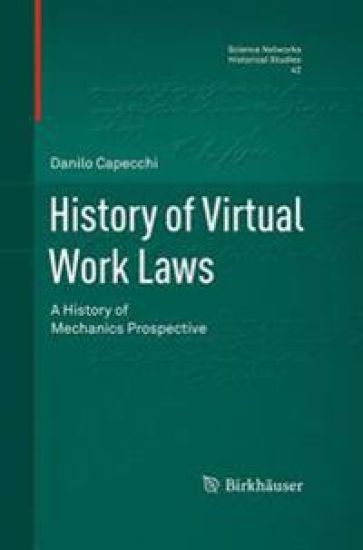
The book presents a history of classical mechanics by focusing on issues of equilibrium. The historical point of view adopted here restricts attention to cases where the effectiveness of forces is assessed on the basis of the virtual motion of their points of application. For completeness, hints of the alternative approach are also referred, the Archimedean for ancient mechanics and the Newtonian for modern mechanics. The laws resulting from consideration of virtual motions are named laws of virtual work. The modern formulations of the principle of virtual work are only a particular form of them. The book begins with the first documented formulations of laws of virtual work in the IV century BC in Greece and proceeds to the end of the XIX century AD in Europe. A significant space is devoted to Arabic and Latin mechanics of Middle Ages. With the Renaissance it began to appear slightly different wordings of the laws, which were often proposed as unique principles of statics. The process reached its apex with Bernoulli and Lagrange in the XVIII century. The book ends with some chapters dealing with the discussions that took place in the French school on the role of the Lagrangian version of the law of virtual work and its applications to continuum mechanics.
Tartaglia’s Science of Weights and Mechanics in the Sixteenth Century
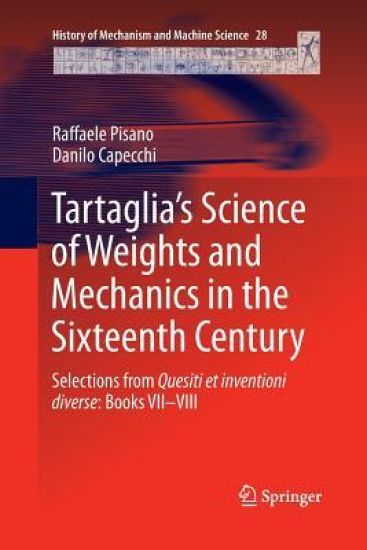
This book presents a historical and scientific analysis as historical epistemology of the science of weights and mechanics in the sixteenth century, particularly as developed by Tartaglia in his Quesiti et inventioni diverse, Book VII and Book VIII (1546; 1554). In the early 16th century mechanics was concerned mainly with what is now called statics and was referred to as the Scientia de ponderibus, generally pursued by two very different approaches. The first was usually referred to as Aristotelian, where the equilibrium of bodies was set as a balance of opposite tendencies to motion. The second, usually referred to as Archimedean, identified statics with centrobarica, the theory of centres of gravity based on symmetry considerations. In between the two traditions the Italian scholar Niccolò Fontana, better known as Tartaglia (1500?–1557), wrote the treatise Quesiti et inventioni diverse (1546). This volume consists of three main parts. In the first, a historical excursus regarding Tartaglia’s lifetime, his scientific production and the Scientia de ponderibus in the Arabic-Islamic culture, and from the Middle Ages to the Renaissance, is presented. Secondly, all the propositions of Books VII and VIII, by relating them with the Problemata mechanica by the Aristotelian school and Iordani opvsculvm de ponderositate by Jordanus de Nemore are examined within the history and historical epistemology of science. The last part is relative to the original texts and critical transcriptions into Italian and Latin and an English translation. This work gathers and re-evaluates the current thinking on this subject. It brings together contributions from two distinguished experts in the history and historical epistemology of science, within the fields of physics, mathematics and engineering. It also gives much-needed insight into the subject from historical and scientific points of view. The volume composition makes for absorbing reading for historians, epistemologists, philosophers and scientists.
Tartaglia’s Science of Weights and Mechanics in the Sixteenth Century
This book presents a historical and scientific analysis as historical epistemology of the science of weights and mechanics in the sixteenth century, particularly as developed by Tartaglia in his Quesiti et inventioni diverse, Book VII and Book VIII (1546; 1554). In the early 16th century mechanics was concerned mainly with what is now called statics and was referred to as the Scientia de ponderibus, generally pursued by two very different approaches. The first was usually referred to as Aristotelian, where the equilibrium of bodies was set as a balance of opposite tendencies to motion. The second, usually referred to as Archimedean, identified statics with centrobarica, the theory of centres of gravity based on symmetry considerations. In between the two traditions the Italian scholar Niccolò Fontana, better known as Tartaglia (1500?–1557), wrote the treatise Quesiti et inventioni diverse (1546). This volume consists of three main parts. In the first, a historical excursus regarding Tartaglia’s lifetime, his scientific production and the Scientia de ponderibus in the Arabic-Islamic culture, and from the Middle Ages to the Renaissance, is presented. Secondly, all the propositions of Books VII and VIII, by relating them with the Problemata mechanica by the Aristotelian school and Iordani opvsculvm de ponderositate by Jordanus de Nemore are examined within the history and historical epistemology of science. The last part is relative to the original texts and critical transcriptions into Italian and Latin and an English translation. This work gathers and re-evaluates the current thinking on this subject. It brings together contributions from two distinguished experts in the history and historical epistemology of science, within the fields of physics, mathematics and engineering. It also gives much-needed insight into the subject from historical and scientific points of view. The volume composition makes for absorbing reading for historians, epistemologists, philosophers and scientists.
Strength of Materials and Theory of Elasticity in 19th Century Italy

Strength of Materials and Theory of Elasticity in 19th Century Italy

Danilo Capecchi; Giuseppe Ruta

Springer International Publishing AG
2014
sidottu
This book examines the theoretical foundations underpinning the field of strength of materials/theory of elasticity, beginning from the origins of the modern theory of elasticity. While the focus is on the advances made within Italy during the nineteenth century, these achievements are framed within the overall European context. The vital contributions of Italian mathematicians, mathematical physicists and engineers in respect of the theory of elasticity, continuum mechanics, structural mechanics, the principle of least work and graphical methods in engineering are carefully explained and discussed. The book represents a work of historical research that primarily comprises original contributions and summaries of work published in journals. It is directed at those graduates in engineering, but also in architecture, who wish to achieve a more global and critical view of the discipline and will also be invaluable for all scholars of the history of mechanics.
The Problem of the Motion of Bodies

The Problem of the Motion of Bodies

Danilo Capecchi

Springer International Publishing AG
2014
sidottu
This book focuses on the way in which the problem of the motion of bodies has been viewed and approached over the course of human history. It is not another traditional history of mechanics but rather aims to enable the reader to fully understand the deeper ideas that inspired men, first in attempting to understand the mechanisms of motion and then in formulating theories with predictive as well as explanatory value. Given this objective, certain parts of the history of mechanics are neglected, such as fluid mechanics, statics and astronomy after Newton. On the other hand, due attention is paid, for example, to the history of thermodynamics, which has its own particular point of view on motion. Inspired in part by historical epistemology, the book examines the various views and theories of a given historical period (synchronic analysis) and then makes comparisons between different periods (diachronic analysis). In each period, one or two of the most meaningful contributions are selected for particular attention, instead of presenting a long inventory of scientific achievements.
History of Virtual Work Laws

History of Virtual Work Laws

Danilo Capecchi

Springer Verlag
2012
sidottu
The book presents a history of classical mechanics by focusing on issues of equilibrium. The historical point of view adopted here restricts attention to cases where the effectiveness of forces is assessed on the basis of the virtual motion of their points of application. For completeness, hints of the alternative approach are also referred, the Archimedean for ancient mechanics and the Newtonian for modern mechanics. The laws resulting from consideration of virtual motions are named laws of virtual work. The modern formulations of the principle of virtual work are only a particular form of them. The book begins with the first documented formulations of laws of virtual work in the IV century BC in Greece and proceeds to the end of the XIX century AD in Europe. A significant space is devoted to Arabic and Latin mechanics of Middle Ages. With the Renaissance it began to appear slightly different wordings of the laws, which were often proposed as unique principles of statics. The process reached its apex with Bernoulli and Lagrange in the XVIII century. The book ends with some chapters dealing with the discussions that took place in the French school on the role of the Lagrangian version of the law of virtual work and its applications to continuum mechanics.
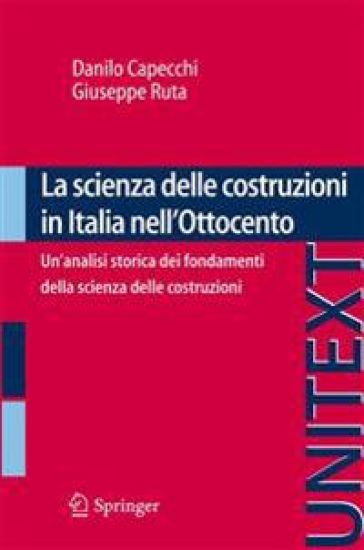
La scienza delle costruzioni in Italia nell'Ottocento

La scienza delle costruzioni in Italia nell'Ottocento

Danilo Capecchi; Giuseppe Ruta

Springer Verlag
2011
nidottu
Il libro tratta dei fondamenti teorici della Scienza delle costruzioni, partendo dalle origini della teoria moderna dell’elasticità. La situazione italiana viene inquadrata in quella europea, esaminando e commentando gli studiosi che hanno avuto un ruolo essenziale per gli sviluppi della meccanica dei corpi continui e delle strutture e delle tecniche di calcolo grafico. Esso è diretto a tutti quei laureati in ingegneria, ma anche in architettura, che vogliano avere una visione più globale e critica della disciplina che hanno studiato per anni. È poi diretto naturalmente agli studiosi di storia della meccanica di qualunque formazione.