Kirjojen hintavertailu – 12 903 742 kirjaa ja 27 kauppaa

Kirjailija

Dariusz Wójcik

Kirjat ja teokset yhdessä paikassa: 6 kirjaa, julkaisuja vuosilta 2007–2024, suosituimpiin kuuluu The Global Stock Market. Vertaile teosten hintoja ja tarkista saatavuus suomalaisista kirjakaupoista.

Nimi esiintyy myös muodoissa: Dariusz Wojcik

6 kirjaa

Kirjojen julkaisuvuodet: 2007–2024.

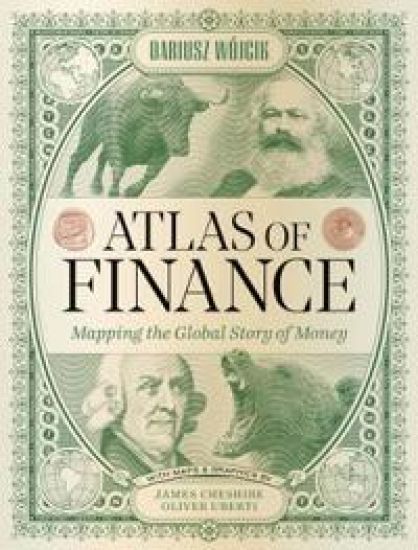
Atlas of Finance

Atlas of Finance

Dariusz Wojcik; Panagiotis Iliopoulos; Stefanos Ioannou; Liam Keenan; Julien Migozzi; Timothy Monteath; Vladimir Pazitka; Morag Torrance; Michael Urban

YALE UNIVERSITY PRESS
2024
sidottu

Halvin toimitettuna 32,60 €

A unique illustrated exploration of the development of finance that combines data from every part of the world and covers five thousand years of history “The book is a lot of fun. Data-fixated readers will enjoy unpicking its main content: a series of elegantly produced maps, graphs and other visualisations. These are eclectic in scope and ambitious in intent.”—Jonathan Guthrie, Financial Times From the emergence of money in the ancient world to today’s interconnected landscape of high-frequency trading and cryptocurrency, the story of finance has always taken place on an international stage. Finance is one of the most globalized and networked of human activities, and one of the most important social technologies ever invented. This volume, the first visually based book dedicated to finance, uses graphics and maps to bring the complex and abstract world of finance down to earth, showing how geography is fundamental for understanding finance, and vice versa. It illuminates the people—including Adam Smith, Karl Marx, and John Maynard Keynes—who have shaped our thinking about global finance; brings to life the ways that place-specific histories, laws, regulations, and institutions influence finance; shows how finance relates to innovation, globalization, and environmental change; and details how finance plays a key part in drawing the landscape of uneven development, inequality, and instability. The Atlas of Finance, with word and image, will change the way you view both your money and your world.
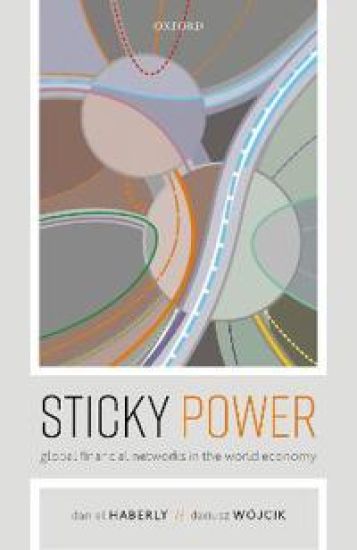
Sticky Power

Sticky Power

Daniel Haberly; Dariusz Wójcik

Oxford University Press
2022
sidottu
This is an open access title available under the terms of a CC BY-NC-ND 4.0 International licence. It is free to read at Oxford Scholarship Online and offered as a free PDF download from OUP and selected open access locations. Although modern civilization revolves around money, the nature of money is paradoxical. It is nothing more than a representation of and medium for decentralized networks of social trust, but its production is controlled by highly centralized networks of firms, places, and governments, and there is never enough of it to go around. Moreover, given that the creation of money, as credit, is based on expectations, money is at its heart an instrument for human agency to change the future. However, the financial systems that produce money are deeply rooted in the past, and perpetuate themselves through history. Sticky Power seeks to deepen our understanding of the paradox of money by introducing a novel conceptual lens, Global Financial Networks, to cast new light on the geography, history, politics, and sociology of finance from the Middle Ages to the global financial crisis and beyond. It shows that the power of finance is inherently sticky: apparently new innovations such as offshore finance actually date back centuries, and global financial networks more broadly have adapted to the rise and fall of empires and the development of new technologies while changing surprisingly little in their basic character, or at most changing very slowly. Haberly and Wójcik argue that a recognition of the mechanics of this durability calls for a new approach to reforming finance--one less reactively focused on regulation, and more proactively focused on building new institutional systems with a long-term sticky power of their own.
The New Oxford Handbook of Economic Geography

The New Oxford Handbook of Economic Geography

Dariusz Wojcik

Oxford University Press
2018
sidottu

Halvin toimitettuna 212,60 €

The first fifteen years of the 21st century have thrown into sharp relief the challenges of growth, equity, stability, and sustainability facing the world economy. In addition, they have exposed the inadequacies of mainstream economics in providing answers to these challenges. This volume gathers over 50 leading scholars from around the world to offer a forward-looking perspective of economic geography to understanding the various building blocks, relationships, and trajectories in the world economy. The perspective is at the same time grounded in theory and in the experiences of particular places. Reviewing state-of-the-art of economic geography, setting agendas, and with illustrations and empirical evidence from all over the world, the book should be an essential reference for students, researchers, as well as strategists and policy makers. Building on the success of the first edition, this volume offers a radically revised, updated, and broader approach to economic geography. With the backdrop of the global financial crisis, finance is investigated in chapters on financial stability, financial innovation, global financial networks, the global map of savings and investments, and financialization. Environmental challenges are addressed in chapters on resource economies, vulnerability of regions to climate change, carbon markets, and energy transitions. Distribution and consumption feature alongside more established topics on the firm, innovation, and work. The handbook also captures the theoretical and conceptual innovations of the last fifteen years, including evolutionary economic geography and the global production networks approach. Addressing the dangers of inequality, instability, and environmental crisis head-on, the volume concludes with strategies for growth and new ways of envisioning the spatiality of economy for the future.
The Global Stock Market

The Global Stock Market

Dariusz Wójcik

Oxford University Press
2012
nidottu
Why do some companies stay out of stock markets? How crucial are stock markets for competition between financial centres? How can local information help investors outperform the market? Whilst mainstream financial economics treats stock markets as consisting of anonymous actors interacting in space, with no consideration of the friction caused by distance or geography, this book offers a comprehensive and up-to-date picture of the global stock market by focusing on the relationships between issuers, investors, and intermediaries, and how these relationships impact on the performance of stock markets and the economy of cities, countries, and the world. The book uses rich data and global case studies to examine the rise of emerging markets, the impact of the global financial crisis, the revolution in the stock exchange business model, and the continued dominance of London and New York as stock market centres. Drawing on economic geography, financial economics, sociology, history, and globalization studies, the book explores the geographical constitution and footprint of stock markets and contributes to the broader debate on the role of stock markets in the global economy. Its conclusions are relevant to investors, companies issuing stocks, exchanges, analysts, investment banks, and policy-makers.
The Global Stock Market

The Global Stock Market

Dariusz Wójcik

Oxford University Press
2011
sidottu
Why do some companies stay out of stock markets? How crucial are stock markets for competition between financial centres? How can local information help investors outperform the market? Whilst mainstream financial economics treats stock markets as consisting of anonymous actors interacting in space, with no consideration of the friction caused by distance or geography, this book offers a comprehensive and up-to-date picture of the global stock market by focusing on the relationships between issuers, investors, and intermediaries, and how these relationships impact on the performance of stock markets and the economy of cities, countries, and the world. The book uses rich data and global case studies to examine the rise of emerging markets, the impact of the global financial crisis, the revolution in the stock exchange business model, and the continued dominance of London and New York as stock market centres. Drawing on economic geography, financial economics, sociology, history, and globalization studies, the book explores the geographical constitution and footprint of stock markets and contributes to the broader debate on the role of stock markets in the global economy. Its conclusions are relevant to investors, companies issuing stocks, exchanges, analysts, investment banks, and policy-makers.
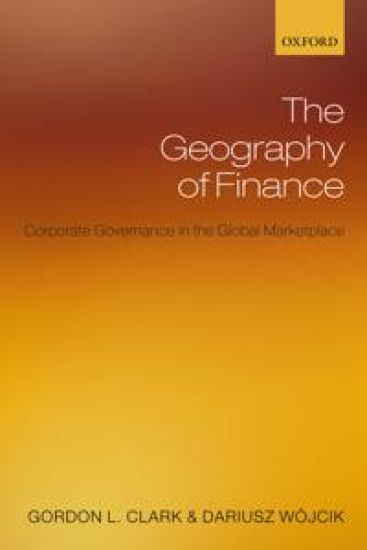
The Geography of Finance

The Geography of Finance

Gordon L. Clark; Dariusz Wójcik

Oxford University Press
2007
sidottu
The Geography of Finance tackles crucial issues regarding the emerging global market for corporate governance. The authors describe and explain the transformation of European corporate governance in the light of the imperatives driving global financial markets, using an innovative analytical framework. The authors chart the response of corporate managers to the interest of global portfolio managers in transparent and accountable modes of corporate governance. In doing so, the authors provide an innovative perspective on a rapidly changing environment; and a challenge to those who ignore the gathering momentum of global financial markets.