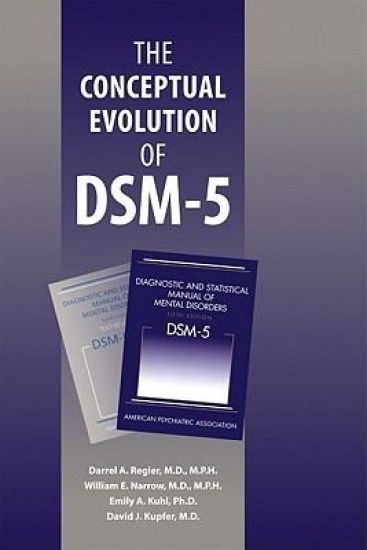
The Conceptual Evolution of DSM-5
Darrel A. Regier; William E. Narrow; Emily A. Kuhl; David J. Kupfer
American Psychiatric Association Publishing
2011
pokkari
There is a need to refine our current psychiatric nosology to produce diagnostic criteria and disorder categories that keep pace with advances in neuroscience while at the same time enhance clinical utility. Furthermore, dimensional aspects of psychiatric disorders require greater recognition so as to improve our understanding of boundaries between disorders and underscore the heterogeneous nature of psychopathology. The Conceptual Evolution of DSM-5 provides a framework for the evolution of the forthcoming diagnostic system in the fifth edition of Diagnostic and Statistical Manual of Mental Disorders (DSM-5), which will help advance clinical practice and facilitate ongoing development of diagnostic criteria. This manual: • Highlights recent progress in our understanding of cross-cutting factors relevant to psychiatric diagnosis and symptom presentation• Includes detailed discussions on the role of factors such as age, gender, culture, and disability in the expression of mental disorders• Provides a review of genetic evidence supporting a cross-cutting approach to nosology• Offers suggestions for integrating cross-cutting factors with DSM-5. The Conceptual Evolution of DSM-5 was written to impart a theoretical context for understanding potential revisions to DSM-5. The authors reevaluate the structure of the current manual and discuss cross-cutting approaches to facilitate clinical practice and refine research approaches that will guide clinical trials, genetics, imaging, and treatment guidelines. The authors provide the following insights: • Detailed descriptions of age-, gender-, and culture-specific aspects relevant to psychiatric diagnosis and the need for sensitivity to these factors when making diagnoses• Discussions on the dimensional aspects of mental disorders, including overlapping symptoms relevant to many or most diagnoses• Consideration of alternative classifications of disorders that recognize disorders sharing validating features• Presentation of neuroscientific and epidemiologic evidence to expand understanding of disorders beyond that of the categorical organization presented in DSM-IV• A review of clinical implications, including how clinicians may shift their conceptualization of previously reified diagnostic criteria and their consequences. As presented to the 99th Annual Meeting of the American Psychopathological Association, The Conceptual Evolution of DSM-5 explores the rapidly changing research base for the understanding of neurodevelopmental, neurocognitive, addictive, and other psychiatric disorders. The contributions in this volume confirm that DSM-5 is intended to be a living document that can accommodate revisions to specific diagnostic areas based on new evidence that is replicable and subject to review. This efficient updating process will help researchers and clinicians keep abreast of the latest protocols for the research, diagnosis, and treatment of mental illness.