Kirjojen hintavertailu – 12 859 824 kirjaa ja 27 kauppaa

Kirjailija

Darrell J. Fasching

Kirjat ja teokset yhdessä paikassa: 6 kirjaa, julkaisuja vuosilta 1993–2021, suosituimpiin kuuluu The Ethical Challenge of Auschwitz and Hiroshima. Vertaile teosten hintoja ja tarkista saatavuus suomalaisista kirjakaupoista.

Nimi esiintyy myös muodoissa: Darrell J Fasching

6 kirjaa

Kirjojen julkaisuvuodet: 1993–2021.

World Religions Today

World Religions Today

John L. Esposito; Darrell J. Fasching; Todd T. Lewis

Oxford University Press
2021
nidottu

Halvin toimitettuna 188,20 €

Revealing the significance of religion in contemporary life, World Religions Today, Seventh Edition, explores major religious traditions--Judaism, Christianity, Islam, Hinduism, Buddhism, South Asian religions, East Asian religions, indigenous religions, and new religions--as dynamic, ongoing forces in the lives of individuals and in the collective experience of modern societies. This unique volume accomplishes two goals: it connects today's religions to their classical beliefs and practices and focuses on how these religions have both radically changed the modern world and been changed by it. The book is enhanced by numerous pedagogical aids--text boxes, timelines, maps, illustrations, discussion questions, a comprehensive glossary of key terms, and suggestions for further reading--and more than 200 photographs.
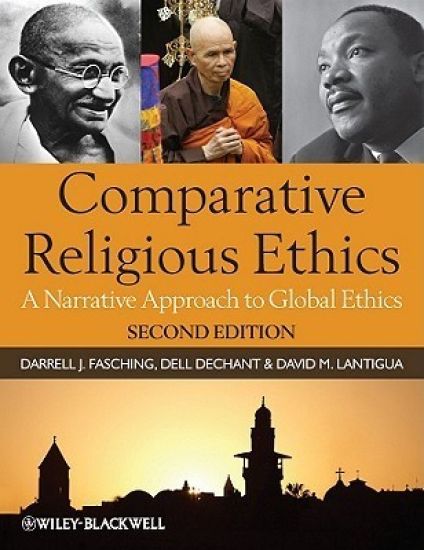
Comparative Religious Ethics

Comparative Religious Ethics

Darrell J. Fasching; Dell deChant; David M. Lantigua

Wiley-Blackwell (an imprint of John Wiley Sons Ltd)
2011
nidottu
This popular textbook has been thoroughly revised and updated to reflect recent global developments, whilst retaining its unique and compelling narrative-style approach. Using ancient stories from diverse religions, it explores a broad range of important and complex moral issues, resulting in a truly reader-friendly and comparative introduction to religious ethics. A thoroughly revised and expanded new edition of this popular textbook, yet retains the unique narrative-style approach which has proved so successful with studentsConsiders the ways in which ancient stories from diverse religions, such as the Bhagavad Gita and the lives of Jesus and Buddha, have provided ethical orientation in the modern worldUpdated to reflect recent discussions on globalization and its influence on cross-cultural and comparative ethics, economic dimensions to ethics, Gandhian traditions, and global ethics in an age of terrorismExpands coverage of Asian religions, quest narratives, the religious and philosophical approach to ethics in the West, and considers Chinese influences on Thich Nhat Hanh’s Zen Buddhism, and Augustine’s ConfessionsAccompanied by an instructor’s manual (coming soon, see www.wiley.com/go/fasching) which shows how to use the book in conjunction with contemporary films
Narrative Theology After Auschwitz

Narrative Theology After Auschwitz

Darrell J. Fasching

Scholars Press
2002
nidottu
Narrative Theology After Auschwitz addresses the pressing question of the failure of Christian ethics during the Holocaust. It's concern is to understand how and why so many Christians and Christian churches either cooperated with the Nazis or stood passively by while six million Jews were slaughtered. The goal is to uproot the propensity of Christians to equate "ethics" with "unquestioning obedience" to authority, and replace it with an Abrahamic chutzpah or audacity to question all authority, even God if necessary, in defense of the dignity of the stranger.
The Ethical Challenge of Auschwitz and Hiroshima

The Ethical Challenge of Auschwitz and Hiroshima

Darrell J. Fasching

State University of New York Press
1993
pokkari
This book addresses the problem of religion, ethics, and public policy in a global technological civilization. It attempts to do what narrative ethicists have said cannot be done-to construct a cross-cultural ethic of human dignity, human rights, and human liberation which respects the diversity of narrative traditions. It seeks to do this without succumbing to either ethical relativism or ethical absolutism. The author confronts directly the dominant narrative of our technological civilization: the Janus-faced myths of "Apocalypse or Utopia." Through this myth, we view technology ambivalently, as both the object of our dread and the source of our hope. The myth thus renders us ethically impotent: the very strength of our literal utopian euphoria sends us careening toward some literal apocalyptic "final solution." The demonic narrative that dominated Auschwitz ("killing in order to heal") is part of this Janus-faced technological mythos that emerged out of Hiroshima. And it is this mythic narrative which underlies and structures much of public policy in our nuclear age. This book proposes a coalition of members of holy communities and secular groups, organized to prevent any future eruptions of the demonic. Its goal is to construct a bridge not only over the abyss between religions, East and West, but also between religious and secular ethics.