Kirjojen hintavertailu – 12 859 824 kirjaa ja 27 kauppaa

Kirjailija

Daveed Gartenstein-Ross

Kirjat ja teokset yhdessä paikassa: 6 kirjaa, julkaisuja vuosilta 2008–2022, suosituimpiin kuuluu Bin Laden's Legacy: Why We're Still Losing the War on Terror. Vertaile teosten hintoja ja tarkista saatavuus suomalaisista kirjakaupoista.

6 kirjaa

Kirjojen julkaisuvuodet: 2008–2022.

Bin Laden's Legacy: Why We're Still Losing the War on Terror

Bin Laden's Legacy: Why We're Still Losing the War on Terror

Daveed Gartenstein-Ross

Trade Paper Press
2011
sidottu
Why al Qaeda is winning its war against the West--and America has been playing right into its handsIn the decade since 9/11, the United States has grown weaker: It has been bogged down by costly wars in Iraq and Afghanistan. It has spent billions of dollars on security to protect air travel and other transport, as well as the homeland more generally. Much of this money has been channeled into efforts that are inefficient by design and highly bureaucratic, a lack of coordination between and among the government and an array of contractors making it difficult to evaluate the return on the enormous investment that we have made in national security. Meanwhile, public morale has been sapped by measures ranging from color-coded terror alerts to full-body hand searches. Now counterterrorism expert Daveed Gartenstein-Ross details the strategic missteps the U. S. has made in the fight against al Qaeda, a group that U. S. planners never really took the time to understand. For this reason, America's responses to the terrorist threat have often unwittingly helped al Qaeda achieve its goals. Gartenstein-Ross's book explains what the country must do now to stem the bleeding. Explains in detail al Qaeda's strategy to sap and undermine the American economy, and shows how the United States played into the terrorist group's hands by expanding the battlefield and setting up an expensive homeland security bureaucracy that has difficulty dealing with a nimble, adaptive foeOutlines how al Qaeda's economic plans have evolved toward an ultimate "strategy of a thousand cuts," which involves smaller yet more frequent attacks against Western societiesShows how the domestic politicization of terrorism has weakened the United States, skewing its priorities and causing it to misallocate counterterrorism resourcesOffers a practical plan for building domestic resiliency against terrorist attacks, and escaping the mistakes that have undermined America's war against its jihadist foesClearly written and powerfully argued by a prominent counterterrorism expert, this book is essential reading for anyone who wants to understand what al Qaeda is really after and how the United States can thwart its goals--or help unwittingly to achieve them.

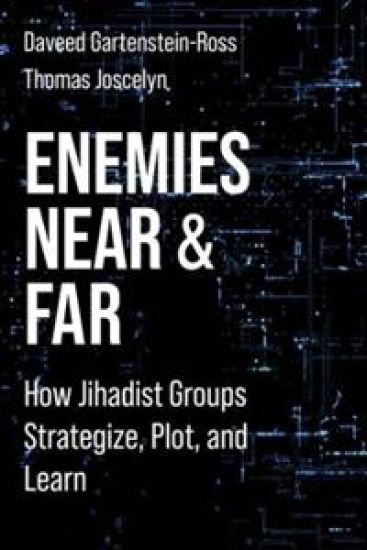
Enemies Near and Far

Enemies Near and Far

Daveed Gartenstein-Ross; Thomas Joscelyn

Columbia University Press
2022
pokkari
Although the United States has prioritized its fight against militant groups for two decades, the transnational jihadist movement has proved surprisingly resilient and adaptable. Many analysts and practitioners have underestimated these militant organizations, viewing them as unsophisticated or unchanging despite the ongoing evolution of their tactics and strategies. In Enemies Near and Far, two internationally recognized experts use newly available documents from al-Qaeda and ISIS to explain how jihadist groups think, grow, and adapt. Daveed Gartenstein-Ross and Thomas Joscelyn recast militant groups as learning organizations, detailing their embrace of strategic, tactical, and technological innovation. Drawing on theories of organizational learning, they provide a sweeping account of these groups’ experimentation over time. Gartenstein-Ross and Joscelyn shed light on militant groups’ most effective strategic and tactical moves, including attacks targeting aircraft and the use of the internet to inspire and direct lone attackers, and they examine jihadists’ ability to shift their strategy based on political context. While militant groups’ initial efforts to upgrade their capabilities often fail, these attempts should generally be understood not as failures but as experiments in service of a learning process—a process that continues until these groups achieve a breakthrough. Providing unprecedented historical and strategic perspective on how jihadist groups learn and evolve, Enemies Near and Far also explores how to anticipate future threats, analyzing how militants are likely to deploy a range of emerging technologies.
Enemies Near and Far

Enemies Near and Far

Daveed Gartenstein-Ross; Thomas Joscelyn

Columbia University Press
2022
sidottu
Although the United States has prioritized its fight against militant groups for two decades, the transnational jihadist movement has proved surprisingly resilient and adaptable. Many analysts and practitioners have underestimated these militant organizations, viewing them as unsophisticated or unchanging despite the ongoing evolution of their tactics and strategies. In Enemies Near and Far, two internationally recognized experts use newly available documents from al-Qaeda and ISIS to explain how jihadist groups think, grow, and adapt. Daveed Gartenstein-Ross and Thomas Joscelyn recast militant groups as learning organizations, detailing their embrace of strategic, tactical, and technological innovation. Drawing on theories of organizational learning, they provide a sweeping account of these groups’ experimentation over time. Gartenstein-Ross and Joscelyn shed light on militant groups’ most effective strategic and tactical moves, including attacks targeting aircraft and the use of the internet to inspire and direct lone attackers, and they examine jihadists’ ability to shift their strategy based on political context. While militant groups’ initial efforts to upgrade their capabilities often fail, these attempts should generally be understood not as failures but as experiments in service of a learning process—a process that continues until these groups achieve a breakthrough. Providing unprecedented historical and strategic perspective on how jihadist groups learn and evolve, Enemies Near and Far also explores how to anticipate future threats, analyzing how militants are likely to deploy a range of emerging technologies.