Kirjojen hintavertailu – 12 903 725 kirjaa ja 27 kauppaa

Kirjailija

David A. Wilson

Kirjat ja teokset yhdessä paikassa: 28 kirjaa, julkaisuja vuosilta 1988–2026, suosituimpiin kuuluu Irish Nationalism in Canada. Vertaile teosten hintoja ja tarkista saatavuus suomalaisista kirjakaupoista.

Nimi esiintyy myös muodoissa: David A Wilson

28 kirjaa

Kirjojen julkaisuvuodet: 1988–2026.

Irish and Scottish Encounters with Indigenous Peoples

Irish and Scottish Encounters with Indigenous Peoples

Graeme Morton; David A. Wilson

McGill-Queen's University Press
2013
sidottu
The expansion of the British Empire during the eighteenth and nineteenth centuries created the greatest mass migration in human history, in which the Irish and Scots played a central, complex, and controversial role. The essays in this volume explore the diverse encounters Irish and Scottish migrants had with Indigenous peoples in North America and Australasia. The Irish and Scots were among the most active and enthusiastic participants in what one contributor describes as "the greatest single period of land theft, cultural pillage, and casual genocide in world history." At the same time, some settlers attempted to understand Indigenous society rather than destroy it, while others incorporated a romanticized view of Natives into a radical critique of European society, and others still empathized with Natives as fellow victims of imperialism. These essays investigate the extent to which the condition of being Irish and Scottish affected settlers' attitudes to Indigenous peoples, and examine the political, social, religious, cultural, and economic dimensions of their interactions. Presenting a variety of viewpoints, the editors reach the provocative conclusion that the Scottish and Irish origins of settlers were less important in determining attitudes and behaviour than were the specific circumstances in which those settlers found themselves at different times and places in North America, Australia and New Zealand. Contributors include Donald Harman Akenson (Queen's), John Eastlake (College Cork), Marjory Harper (Aberdeen), Andrew Hinson (Toronto), Michele Holmgren (Mount Royal), Kevin Hutchings (Northern British Columbia), Anne Lederman (Royal Conservatory of Music), Patricia A. McCormack (Alberta), Mark G. McGowan (Toronto), Ann McGrath (Australian National), Cian T. McMahon (Nevada), Graeme Morton (Guelph), Michael Newton (Xavier), Padraig O Siadhail (Saint Mary's), Brad Patterson (Victoria University of Wellington), Beverly Soloway (Lakehead), and David A. Wilson (Toronto).
Thomas D'Arcy McGee, Volume 1

Thomas D'Arcy McGee, Volume 1

David A. Wilson

McGill-Queen's University Press
2012
sidottu
A brilliant writer, outstanding orator, and charismatic politician, Thomas D'Arcy McGee is best known for his prominent role in Irish-Canadian politics, his inspirational speeches in support of Canadian Confederation, and his assassination by an Irish revolutionary who accused him of betraying his earlier Irish nationalist principles. Thomas D'Arcy McGee, the first volume in a two-part biography, explores the development of those principles in Ireland and the United States. David Wilson follows McGee from Wexford, Ireland across the Atlantic to Boston, where at nineteen he became the editor of America's leading Irish newspaper, and traces his subsequent involvement with the Young Ireland movement, his reactions to the Famine, and his role in the Rising of 1848. Wilson goes on to examine McGee's experiences as a political refugee in the United States, where his increasing disillusionment with revolutionary Irish nationalism and his opposition to American nativism propelled him towards conservative Catholicism and sent him on a trajectory that ultimately led to Canada - his experiences are the subject of volume 2, Thomas D'Arcy McGee: The Extreme Moderate, 1857-1868.
Managing Information

Managing Information

David A Wilson

Butterworth-Heinemann Ltd
2002
nidottu
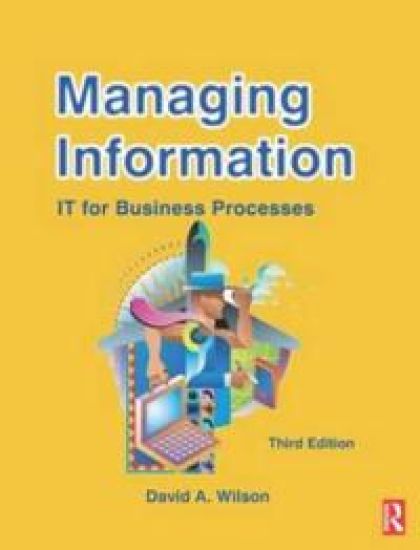
'Managing Information' describes how successful organizations make best use of information and knowledge - the key resources in business. It explains why information technology is essential for the management of business processes, and should be central to any business strategy. This updated edition provides a compelling rationale for organizations to use appropriate systems, and for individuals to acquire the skills to manage and use the systems. It describes how computer systems continue to evolve to meet business needs, and provides examples and exercises to help readers develop their skills. There is a new emphasis on the Internet - how to use it to keep up to date with the latest business issues, and how teams can communicate and collaborate with intranets. All of the most common sub-systems are described and explained, including Enterprise Resource Planning (ERP), Business-to-Business (B2B), Business-to-Consumer (B2C), Supply Chain Management (SCM), Customer Relationship Management (CRM) and Enterprise Application Integration (EAI). The latest developments are described, including services available through the Internet from Application Service Providers (ASP), collaborative commerce and Business Process Management (BPM). There are introductory and more advanced computer exercises to consolidate learning and demonstrate how to acquire, store, organize and present information, using Word, Excel, PowerPoint and Explorer.
Ireland, a Bicycle, and a Tin Whistle

Ireland, a Bicycle, and a Tin Whistle

David A. Wilson

McGill-Queen's University Press
1995
nidottu
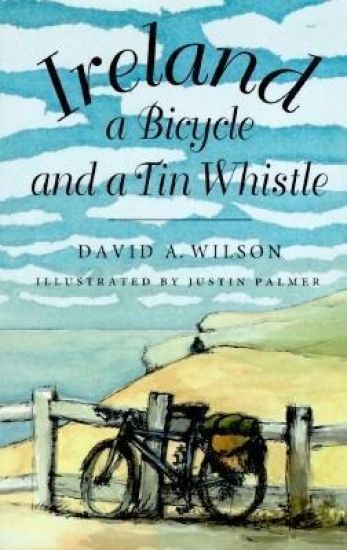
As he travels through the North, Wilson gets beneath the political surface to portray both the tragedy and comedy of everyday life in the Protestant and Catholic communities. Aware of the polarized image that each side has of the other, he emphasizes the importance of finding common ground and of asserting the middle against the extremes. Just as traditional Irish music is characterized by ornamentations and elaborations on a melodic theme, Ireland, a Bicycle, and a Tin Whistle is full of variations and wanderings on the theme of the trip itself. And just as traditional Irish musicians will follow a sad slow air with a lively foot-tapping reel, Wilson's mood ranges from the nostalgic and reflective to the irreverent and mischievous. If there is a lament in one ear, there is a song in the other.
Ireland, a Bicycle, and a Tin Whistle

Ireland, a Bicycle, and a Tin Whistle

David A. Wilson

McGill-Queen's University Press
1995
sidottu
As he travels through the North, Wilson gets beneath the political surface to portray both the tragedy and comedy of everyday life in the Protestant and Catholic communities. Aware of the polarized image that each side has of the other, he emphasizes the importance of finding common ground and of asserting the middle against the extremes. Just as traditional Irish music is characterized by ornamentations and elaborations on a melodic theme, Ireland, a Bicycle, and a Tin Whistle is full of variations and wanderings on the theme of the trip itself. And just as traditional Irish musicians will follow a sad slow air with a lively foot-tapping reel, Wilson's mood ranges from the nostalgic and reflective to the irreverent and mischievous. If there is a lament in one ear, there is a song in the other.
Paine and Cobbett

Paine and Cobbett

David A. Wilson

McGill-Queen's University Press
1988
sidottu
Wilson traces four major themes in the thought of Paine and Cobbett: the relationship between British radical ideas and American revolutionary ideology; the eighteenth-century revolution in rhetorical theory; the effect of the American and French Revolutions on British popular radicalism; and the American attempt to turn the United States into a new "empire of liberty". He challenges the view that Paine created a new literary style for a new audience of artisans and labourers, arguing instead that this style was part of a broader revolution in rhetoric, and discusses the interconnections between Paine's English and American careers. Wilson shows that the tension between the ideal and the real is central to understanding Cobbett. He analyzes Cobbett's American experiences, and examines the role of Paine's writings and the United States in Cobbett's subsequent career as a radical in England. The epilogue returns to the differences and similarities in Paine's and Cobbett's careers, examines their strategies for change, and discusses their ambiguous legacies to the nineteenth and twentieth centuries.