

Kirjailija
David Bakan
Kirjat ja teokset yhdessä paikassa: 6 kirjaa, julkaisuja vuosilta 2010–2026, suosituimpiin kuuluu Sigmund Freud y la tradición Mística Judía. Vertaile teosten hintoja ja tarkista saatavuus suomalaisista kirjakaupoista.
6 kirjaa
Kirjojen julkaisuvuodet: 2010–2026.
Sigmund Freud and the Jewish Mystical Tradition
David Bakan
Martino Fine Books
2024
sidottu
Halvin toimitettuna 35,30 €
Sigmund Freud and the Jewish Mystical Tradition
David Bakan
Martino Fine Books
2024
nidottu
Halvin toimitettuna 26,20 €
Sigmund Freud and the Jewish Mystical Tradition
David Bakan
Literary Licensing, LLC
2011
nidottu
Halvin toimitettuna 41,30 €
A pioneering scholarly investigation into the intersection of personality and cultural history, this study asserts that Freudian psychology is rooted in Judaism -- particularly, in the mysticism of the Kabbalah. It examines how Freud's Jewish heritage contributed, either consciously or unconsciously, to his psychological theories and clarifies the foundations of modern psychoanalysis.
Sigmund Freud and the Jewish Mystical Tradition
David Bakan
Literary Licensing, LLC
2011
sidottu
Halvin toimitettuna 53,90 €
Sigmund Freud and the Jewish Mystical Tradition is a book written by David Bakan that explores the influence of Jewish mysticism on the work of Sigmund Freud, the father of psychoanalysis. The book examines Freud's engagement with Jewish mysticism and Kabbalah, a form of Jewish mysticism that emphasizes the esoteric interpretation of the Torah. Bakan argues that Freud's interest in Jewish mysticism influenced his theories on the human psyche and his understanding of the unconscious mind. The book also explores the historical and cultural context of Freud's engagement with Jewish mysticism, including the rise of anti-Semitism in Europe and the development of Zionism. Bakan draws on a range of primary sources, including Freud's own writings and correspondence, to provide a detailed analysis of Freud's engagement with Jewish mysticism. Sigmund Freud and the Jewish Mystical Tradition is an important contribution to the study of psychoanalysis and Jewish mysticism, and sheds new light on the intellectual and cultural history of the early 20th century. The book is written for scholars and students of psychoanalysis, Jewish studies, and intellectual history, as well as anyone interested in the intersection of religion and psychology. This scarce antiquarian book is a facsimile reprint of the old original and may contain some imperfections such as library marks and notations. Because we believe this work is culturally important, we have made it available as part of our commitment for protecting, preserving, and promoting the world's literature in affordable, high quality, modern editions, that are true to their original work.
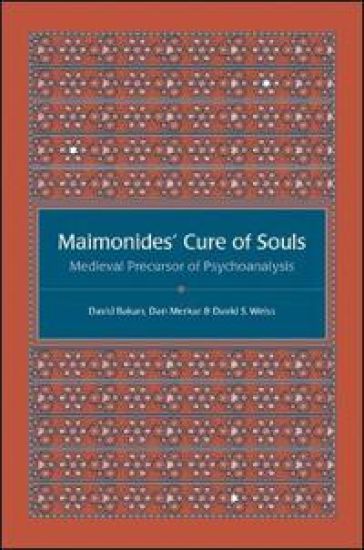
Maimonides' Cure of Souls
David Bakan; Dan Merkur; David S. Weiss
State University of New York Press
2010
pokkari
Explores the unacknowledged psychological element in Maimonides' work, one which prefigures the latter insights of Freud. Is Moses Maimonides an unacknowledged ancestor of the psychoanalytic movement? In this book, David Bakan, Dan Merkur, and David S. Weiss look at the great medieval Jewish philosopher's prescription for the cure of souls and its psychological significance. In the Guide of the Perplexed, Maimonides, who was also a physician, describes the soul's illness: when sinners rationalize evil as good, they limit their capacities to reason, imagine, and behave well, which also produces physical symptoms. The cure depends on repentance in love and fear of God that is attained through philosophical knowledge, the interpretation of dreams and visions, and mystical contemplation. The authors look at the Aristotelian background of Maimonides' psychology, Maimonidean mysticism, his beliefs about prophecy and sexuality, and what is known of Maimonides' client population. A final chapter discusses Maimonides and Freud, noting that many distinctive features of the cure of souls are shared by Freud's original formulation of psychoanalysis. Indeed, the many points of convergence suggest Freud's direct or indirect contact with Maimonides' legacy.