Kirjojen hintavertailu – 12 859 824 kirjaa ja 27 kauppaa

Kirjailija

David Banister

Kirjat ja teokset yhdessä paikassa: 17 kirjaa, julkaisuja vuosilta 1995–2026, suosituimpiin kuuluu The Imperatives of Sustainable Development. Vertaile teosten hintoja ja tarkista saatavuus suomalaisista kirjakaupoista.

17 kirjaa

Kirjojen julkaisuvuodet: 1995–2026.

The Imperatives of Sustainable Development

The Imperatives of Sustainable Development

Erling Holden; Kristin Linnerud; David Banister

TAYLOR FRANCIS LTD
2026
sidottu
Taking the ethical foundations from the seminal UN Report (1987) Our Common Future, this revised and updated second edition builds a model that emphasizes three equally important moral imperatives – satisfying human needs, ensuring social justice, and respecting environmental limits. The model presented identifies sustainability themes and assigns thresholds to them, defining the space within which sustainable development can be achieved wherein it recognises that different countries face different challenges and must follow different pathways. This revised edition has been brought up to date throughout and contains three new chapters exploring the history of the concept, including the status of the UN SDGs, competing indicators and models of sustainable development, and an overview of global and local changes in the six sustainability themes. It is divided into four parts, each contributing to a deeper understanding of what sustainable development is and what is required to achieve it, including an introduction to key arguments, theoretical foundations and competing models, new empirical knowledge discussing how different countries position themselves in relation to sustainable development, and future directions, offering perspectives on how it can be achieved locally and globally. Building on the extensive literature exploring needs, equity, justice, environmental science, ecology, and economics, this book will be essential reading for everyone interested in the future of sustainable development and in the complex environmental and social issues involved.
The Imperatives of Sustainable Development

The Imperatives of Sustainable Development

Erling Holden; Kristin Linnerud; David Banister

TAYLOR FRANCIS LTD
2026
nidottu
Taking the ethical foundations from the seminal UN Report (1987) Our Common Future, this revised and updated second edition builds a model that emphasizes three equally important moral imperatives – satisfying human needs, ensuring social justice, and respecting environmental limits. The model presented identifies sustainability themes and assigns thresholds to them, defining the space within which sustainable development can be achieved wherein it recognises that different countries face different challenges and must follow different pathways. This revised edition has been brought up to date throughout and contains three new chapters exploring the history of the concept, including the status of the UN SDGs, competing indicators and models of sustainable development, and an overview of global and local changes in the six sustainability themes. It is divided into four parts, each contributing to a deeper understanding of what sustainable development is and what is required to achieve it, including an introduction to key arguments, theoretical foundations and competing models, new empirical knowledge discussing how different countries position themselves in relation to sustainable development, and future directions, offering perspectives on how it can be achieved locally and globally. Building on the extensive literature exploring needs, equity, justice, environmental science, ecology, and economics, this book will be essential reading for everyone interested in the future of sustainable development and in the complex environmental and social issues involved.
The Imperatives of Sustainable Development

The Imperatives of Sustainable Development

Erling Holden; Kristin Linnerud; David Banister; Valeria Schwanitz; August Wierling

Routledge
2017
nidottu
Thirty years ago, the UN report Our Common Future placed sustainable development firmly on the international agenda. The Imperatives of Sustainable Development takes the ethical foundations of Our Common Future and builds a model that emphasizes three equally important moral imperatives – satisfying human needs, ensuring social justice, and respecting environmental limits. This model suggests sustainability themes and assigns thresholds to them, thereby defining the space within which sustainable development can be achieved. The authors accept that there is no single pathway to the sustainable development space. Different countries face different challenges and must follow different pathways. This perspective is applied to all countries to determine whether the thresholds of the sustainability themes selected have been met, now and in the past. The authors build on the extensive literature on needs, equity, justice, environmental science, ecology, and economics, and show how the three moral imperatives can guide policymaking. The Imperatives of Sustainable Development synthesizes past reasoning, summarizes the present debate, and provides a clear direction for future thinking. This book will be essential reading for everyone interested in the future of sustainable development and in the complex environmental and social issues involved.
The Imperatives of Sustainable Development

The Imperatives of Sustainable Development

Erling Holden; Kristin Linnerud; David Banister; Valeria Schwanitz; August Wierling

Routledge
2017
sidottu
Thirty years ago, the UN report Our Common Future placed sustainable development firmly on the international agenda. The Imperatives of Sustainable Development takes the ethical foundations of Our Common Future and builds a model that emphasizes three equally important moral imperatives – satisfying human needs, ensuring social justice, and respecting environmental limits. This model suggests sustainability themes and assigns thresholds to them, thereby defining the space within which sustainable development can be achieved. The authors accept that there is no single pathway to the sustainable development space. Different countries face different challenges and must follow different pathways. This perspective is applied to all countries to determine whether the thresholds of the sustainability themes selected have been met, now and in the past. The authors build on the extensive literature on needs, equity, justice, environmental science, ecology, and economics, and show how the three moral imperatives can guide policymaking. The Imperatives of Sustainable Development synthesizes past reasoning, summarizes the present debate, and provides a clear direction for future thinking. This book will be essential reading for everyone interested in the future of sustainable development and in the complex environmental and social issues involved.
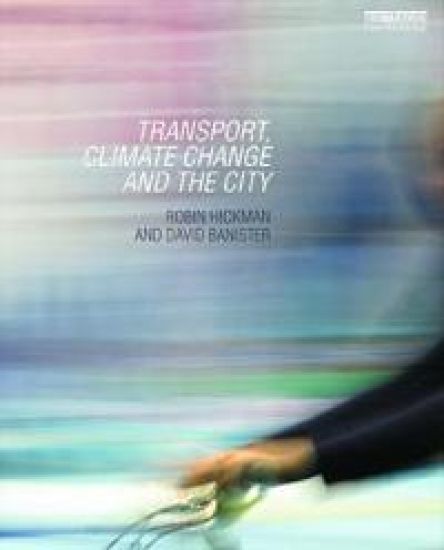
Transport, Climate Change and the City

Transport, Climate Change and the City

Robin Hickman; David Banister

Routledge
2015
nidottu
Sustainable travel behaviours have long been sought after in cities around the world, particularly in industrialised countries, but also increasingly in the emerging cities of Asia, South America and Africa. Progress however appears difficult to make as the private car, still largely fuelled by petrol or diesel, remains the mainstream mode of use. Transport is the key sector where carbon dioxide (CO2) emissions are difficult to reduce. This book seeks to develop achievable low CO2 emission futures for transport in a range of international case studies. The aim is that the scenarios as developed, and the consideration of implementation and transition issues, can help us plan for and achieve attractive future lifestyles at the city level, rather than ‘sleepwalk’ into climate change difficulties, oil scarcity, poor qualities of life, and to continue with the large casualty figures. High fuel prices in the future may mean that parts of our cities and wider regions become redundant and residents suffer from low levels of accessibility. The topic is thus critical, with transport viewed as central to the achievement of the sustainable city and reduced CO2 emissions. The book’s original content and presentation draws on contemporary culture to demonstrate the need for a wider and more transparent debate on future travel behaviours and lifestyles, acceptability and implementability, and the potential for using different means to sell a different but attractive future.
Transport, Climate Change and the City

Transport, Climate Change and the City

Robin Hickman; David Banister

Routledge
2014
sidottu
Sustainable mobility has long been sought after in cities around the world, particularly in industrialised countries, but also increasingly in the emerging cities in Asia. Progress however appears difficult to make as the private car, still largely fuelled by petrol or diesel, remains the mainstream mode of use. Transport is the key sector where carbon dioxide (CO2) emissions seem difficult to reduce. Transport, Climate Change and the City seeks to develop achievable and low transport CO2 emission futures in a range of international case studies, including in London, Oxfordshire, Delhi, Jinan and Auckland. The aim is that the scenarios as developed, and the consideration of implementation and governance issues, can help us plan for and achieve attractive future travel behaviours at the city level. The alternative is to continue with only incremental progress against CO2 reduction targets, to ‘sleepwalk’ into climate change difficulties, oil scarcity, a poor quality of life, and to continue with the high traffic casualty figures. The topic is thus critical, with transport viewed as central to the achievement of the sustainable city and reduced CO2 emissions.
Telematics and Transport Behaviour

Telematics and Transport Behaviour

Peter Nijkamp; Gerard Pepping; David Banister

Springer-Verlag Berlin and Heidelberg GmbH Co. K
2012
nidottu
A major strategy to reduce transport congestion and other social costs of transport is to ensure that travellers make the best decisions, based on real time information. A wide range of technological systems have been developed to provide this information, but little is known about how travellers actually respond to it. This book offers an overview of various transport telematics options and provides an appropriate methodological framework, followed by a presentation of results from actual applications of these telematics systems from a range of European countries in various transport sectors. The empirical results are supplemented by analytical models and geographic information systems representations with a view on generalizing these findings and identifying the key parameters which determine user response.
Transport and Urban Development

Transport and Urban Development

David Banister

Routledge
2011
nidottu
**The 2011 paperback version of this book is an exact reprint of the hardback, originally printed in 1995**The editor and his contributors take an international perspective on the links between land use, development and transport and present the latest thinking, the theory and practice of these links. Authors from six countries - all experts in this area - have been commissioned to write chapters on the theoretical debates and more practical issues, via the use of detailed case studies.
Unsustainable Transport

Unsustainable Transport

David Banister

Routledge
2005
sidottu
This book addresses the links between transport and sustainable urban development, from an analysis of the global picture to issues in transport and energy intensity, public policy and the institutional and organisational constraints on change. The central part of the book explores these links in more detail at city level, covering land use and development, economic measures, and the role that technology can play. The final part looks for inspiration from events in developing countries and the means by which we can move from the unsustainable present to a more sustainable future.
Unsustainable Transport

Unsustainable Transport

David Banister

Routledge
2005
nidottu
This book addresses the links between transport and sustainable urban development, from an analysis of the global picture to issues in transport and energy intensity, public policy and the institutional and organisational constraints on change. The central part of the book explores these links in more detail at city level, covering land use and development, economic measures, and the role that technology can play. The final part looks for inspiration from events in developing countries and the means by which we can move from the unsustainable present to a more sustainable future.
Transport Planning

Transport Planning

David Banister

Routledge
2002
sidottu
Transport is central to many of the current planning and policy debates. Completely revised and restructured, the new edition of Transport Planning describes the evolution of transport policies and planning, linking the past with the contemporary and future debates. It is divided into two main parts. A Retrospective Analysis describes the recent past and how the current situation in research and practice on transport planning has developed. Evidence is taken from Great Britain and the United States, illustrating the similarities in thinking across transport, planning and evaluation. There is a review of the radical policy alternative presented by the market approach to transport provision, and a complementary new chapter on events since 1997, with the difficulties of finding the means to introduce the social market. The first part ends with a discussion on the limitations of transport planning in terms of both its theoretical foundations and of the approaches currently being used. The second part of the book begins with a Comparative Analysis of experience in three European countries (Germany, France and the Netherlands) and the United States. It covers both transport planning and evaluation, where difference approaches have been developed in response to national policy issues and the different cultural and analytical traditions. This experience provides a useful context for interpreting the new agenda in the UK. This is followed by a Prospective Analysis of the key issues facing transport planners in the twenty-first century, including the need to replace existing infrastructure, to build new infrastructure, and to ensure the optimal use of existing infrastructure. All these issues will necessitate different analytical approaches, particularly where new forms of financing are required and as the new political relationships between the state and market are stabilised. Some form of strategic vision is required together with a planning framework within which the market can operate.
Transport Planning

Transport Planning

David Banister

Routledge
2002
nidottu
Transport is central to many of the current planning and policy debates. Completely revised and restructured, the new edition of Transport Planning describes the evolution of transport policies and planning, linking the past with the contemporary and future debates. It is divided into two main parts. A Retrospective Analysis describes the recent past and how the current situation in research and practice on transport planning has developed. Evidence is taken from Great Britain and the United States, illustrating the similarities in thinking across transport, planning and evaluation. There is a review of the radical policy alternative presented by the market approach to transport provision, and a complementary new chapter on events since 1997, with the difficulties of finding the means to introduce the social market. The first part ends with a discussion on the limitations of transport planning in terms of both its theoretical foundations and of the approaches currently being used. The second part of the book begins with a Comparative Analysis of experience in three European countries (Germany, France and the Netherlands) and the United States. It covers both transport planning and evaluation, where difference approaches have been developed in response to national policy issues and the different cultural and analytical traditions. This experience provides a useful context for interpreting the new agenda in the UK. This is followed by a Prospective Analysis of the key issues facing transport planners in the twenty-first century, including the need to replace existing infrastructure, to build new infrastructure, and to ensure the optimal use of existing infrastructure. All these issues will necessitate different analytical approaches, particularly where new forms of financing are required and as the new political relationships between the state and market are stabilised. Some form of strategic vision is required together with a planning framework within which the market can operate.
European Transport Policy and Sustainable Mobility

European Transport Policy and Sustainable Mobility

Jonas Akerman; David Banister; Karl Dreborg; Peter Nijkamp; Ruggero Schleicher-Tappeser; Dominic Stead; Peter Steen

Routledge
2000
sidottu
It is now widely accepted that transport is becoming increasingly unsustainable and that strong policy intervention is required to reduce both the growth in transport demand and the environmental costs of transport. This book challenges conventional approaches to transport by moving away from trend based analysis towards the use of scenarios to identify alternative sustainable transport futures. It both summaries the development of EU transport policy and presents a critique. The policy context is widened to include the global changes taking place in economics, society and technology. It develops new methodologies for policy making for the next 25 years.
European Transport Policy and Sustainable Mobility

European Transport Policy and Sustainable Mobility

Jonas Akerman; David Banister; Karl Dreborg; Peter Nijkamp; Ruggero Schleicher-Tappeser; Dominic Stead; Peter Steen

Routledge
2000
nidottu
It is now widely accepted that transport is becoming increasingly unsustainable and that strong policy intervention is required to reduce both the growth in transport demand and the environmental costs of transport. This book challenges conventional approaches to transport by moving away from trend based analysis towards the use of scenarios to identify alternative sustainable transport futures. It both summaries the development of EU transport policy and presents a critique. The policy context is widened to include the global changes taking place in economics, society and technology. It develops new methodologies for policy making for the next 25 years.
Transport Investment and Economic Development

Transport Investment and Economic Development

David Banister; Joseph Berechman

Routledge
1999
nidottu
A major concern of all decision makers has been to ensure that there are clear benefits from transport investment proposals. The travel time savings are clear, but the wider economic developments have presented enormous difficulty in terms of both theoretical arguments and empirical evidence. This book reviews the history of the debate and argues that the agenda has changed. These issues are presented together with a major analytical investigation of macroeconomic models, evaluation in transport and microeconomic approaches. The final part of the book presents a series of case studies for road, rail and airport investment schemes, particularly focusing on the economic development aspects.
Transport Investment and Economic Development

Transport Investment and Economic Development

David Banister; Joseph Berechman

Routledge
1999
sidottu
A major concern of all decision makers has been to ensure that there are clear benefits from transport investment proposals. The travel time savings are clear, but the wider economic developments have presented enormous difficulty in terms of both theoretical arguments and empirical evidence. This book reviews the history of the debate and argues that the agenda has changed. These issues are presented together with a major analytical investigation of macroeconomic models, evaluation in transport and microeconomic approaches. The final part of the book presents a series of case studies for road, rail and airport investment schemes, particularly focusing on the economic development aspects.
Transport and Urban Development

Transport and Urban Development

David Banister

Spon Press
1995
sidottu
The editor and his contributors take an international perspective on the links between land use, development and transport and present the latest thinking, the theory and practice of these links. Authors from six countries - all experts in this area - have been commissioned to write chapters on the theoretical debates and more practical issues, via the use of detailed case studies.