Kirjojen hintavertailu – 12 859 818 kirjaa ja 27 kauppaa

Kirjailija

David Block

Kirjat ja teokset yhdessä paikassa: 25 kirjaa, julkaisuja vuosilta 2003–2026, suosituimpiin kuuluu Baseball Before We Knew It. Vertaile teosten hintoja ja tarkista saatavuus suomalaisista kirjakaupoista.

25 kirjaa

Kirjojen julkaisuvuodet: 2003–2026.

Baseball Before We Knew It

Baseball Before We Knew It

David Block; Tim Wiles; John Thorn

University of Nebraska Press
2025
pokkari
Winner of the Seymour Medal from the Society for American Baseball Research Winner of the North American Society for Sport History Book Award A Choice Outstanding Academic Title When Baseball before We Knew It was first published in 2005, it shattered many long-held assumptions about the pastime’s origins. No, baseball was not original to America. No, baseball did not come from the English game rounders. Yes, of course, the Doubleday story was in fact a myth, but for the first time its secret backstory had been revealed. Beyond all its myth busting, Baseball before We Knew It traveled back in time to uncover the true roots of the sport, exploring the many antecedent ball games from Britain and elsewhere that contributed bits of themselves to baseball’s evolution. Now, in this twentieth anniversary edition of his classic work, David Block fills in more of baseball’s origin story by summarizing the discoveries and advancements he and his fellow historians have accomplished over the past two decades. Other new contributions also appear for the first time in this 2025 edition, including a new foreword by John Thorn, the official historian of Major League Baseball; an expanded annotated bibliography of books relating to baseball’s origins from before the Civil War; and two new essays from the author. Baseball before We Knew It is a comprehensive, reliable, and readable account of baseball’s history before it became America’s national pastime.

Diagonalism in Online Populist Discourse

Diagonalism in Online Populist Discourse

David Block

TAYLOR FRANCIS LTD
2026
nidottu
In this incisive and timely book, David Block analyses populist discourse and homes in on 'diagonalism' – the subtle migration of left-wing commentators toward right-wing positions on pandemic policies, free speech and immigration. The text provides a vivid insight into today's fractured political arena, where progressive voices are increasingly aligning with far-right narratives. In this post-truth world, we see how emotions trump facts and spectacle dominates substance. The attention economy has transformed political discourse into entertainment, with devastating consequences. More than just academic theory, this book is an urgent warning about how diagonalists provide cover for extremist ideologies while appearing moderate. By exclusively criticizing progressive positions, they unwittingly strengthen the far-right forces already dominating our online spaces. Vital reading for scholars and students of political communication and essential for anyone concerned about the alarming transformation of public discourse in our digital age
Diagonalism in Online Populist Discourse

Diagonalism in Online Populist Discourse

David Block

TAYLOR FRANCIS LTD
2026
sidottu
In this incisive and timely book, David Block analyses populist discourse and homes in on 'diagonalism' – the subtle migration of left-wing commentators toward right-wing positions on pandemic policies, free speech and immigration. The text provides a vivid insight into today's fractured political arena, where progressive voices are increasingly aligning with far-right narratives. In this post-truth world, we see how emotions trump facts and spectacle dominates substance. The attention economy has transformed political discourse into entertainment, with devastating consequences. More than just academic theory, this book is an urgent warning about how diagonalists provide cover for extremist ideologies while appearing moderate. By exclusively criticizing progressive positions, they unwittingly strengthen the far-right forces already dominating our online spaces. Vital reading for scholars and students of political communication and essential for anyone concerned about the alarming transformation of public discourse in our digital age
Interviews in Applied Linguistics

Interviews in Applied Linguistics

David Block

TAYLOR FRANCIS LTD
2023
sidottu
This book is a personal reflection on research interviews. Written as an autobiography, it invites the reader to accompany the author on his personal journey of over three decades of research carried out on a range of topics in a range of contexts. It mixes academic genres, moving back and forth between life-story telling and more standard academic writing. This book has been written with several aims in mind. First, it aims to present the author’s perspective on research interviews, acquired over time, to researchers of all kinds (from novice to experienced). Second, while it contains valuable information about the practice of interviewing, it is written in such a way that it avoids the kind of dry and overly structured presentation style that one finds in textbook-like publications on the topic. Third and finally, this book aims to complement previous publications on interviews (e.g. Cicourel, Briggs, Mishler, Kvale) which have approached the topic from a reflexive, sociolinguistic/linguistic anthropological perspective that frames interviews not as information mining expeditions, but as communicative events and conversations. This unique reflection on research interviews will be of interest to advanced students and researchers in applied linguistics and sociolinguistics and will also be relevant to researchers working in social sciences and humanities disciplines.
Interviews in Applied Linguistics

Interviews in Applied Linguistics

David Block

TAYLOR FRANCIS LTD
2023
nidottu
This book is a personal reflection on research interviews. Written as an autobiography, it invites the reader to accompany the author on his personal journey of over three decades of research carried out on a range of topics in a range of contexts. It mixes academic genres, moving back and forth between life-story telling and more standard academic writing. This book has been written with several aims in mind. First, it aims to present the author’s perspective on research interviews, acquired over time, to researchers of all kinds (from novice to experienced). Second, while it contains valuable information about the practice of interviewing, it is written in such a way that it avoids the kind of dry and overly structured presentation style that one finds in textbook-like publications on the topic. Third and finally, this book aims to complement previous publications on interviews (e.g. Cicourel, Briggs, Mishler, Kvale) which have approached the topic from a reflexive, sociolinguistic/linguistic anthropological perspective that frames interviews not as information mining expeditions, but as communicative events and conversations. This unique reflection on research interviews will be of interest to advanced students and researchers in applied linguistics and sociolinguistics and will also be relevant to researchers working in social sciences and humanities disciplines.
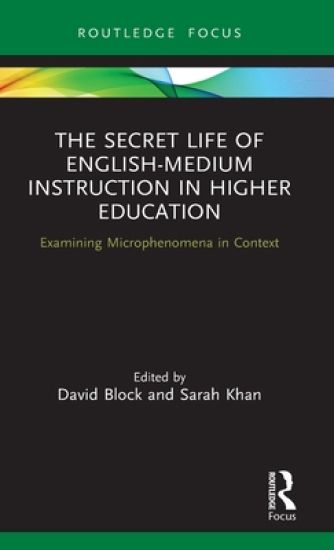
The Secret Life of English-Medium Instruction in Higher Education
This volume explores the inner-workings of English-medium instruction (EMI) in higher education (HE) at two universities. After an introductory chapter that sets the scene and provides an essential background, there are four empirically based chapters that draw on data collected from a range of sources at two universities in Catalonia. This includes interviews, audio/video recordings of classes, audio logs produced by both lecturers and students, policy documents, students’ written work, and student presentation evaluation rubrics. These chapters examine the following issues: (1) the choice of either English or Catalan as the medium of instruction by students and lecturers; (2) how students display ambivalence towards EMI, as well as a general lack of enthusiasm towards and an ironic distance from 'doing education’; (3) how students resist EMI by contravening its English monolingual norm, using their L1s in the classroom; and finally, (4) how EMI lecturers on occasion act as English language teachers despite their continued claims to the contrary. The book ends with a concluding chapter that draws all of the strands together around key themes. This book is written for scholars interested in issues surrounding EMI in HE in general, as well as those EMI in HE practitioners who have adopted a reflective approach to their professional practice and wish to know more about the ins and outs of EMI in HE from multiple perspectives. It is a useful resource for MA and PhD students on applied linguistics programmes in which the roles and uses of English in HE worldwide are deemed to be important and worthy of attention. Additionally, this will be relevant to courses or modules focusing on language policy, as well as curriculum issues more broadly and language teaching practice more specifically.
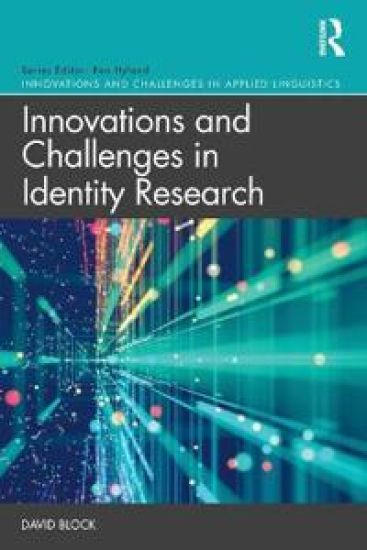
Innovations and Challenges in Identity Research
Innovations and Challenges in Identity Research examines established and emergent issues within identity research. This innovative book adopts a disciplinary transcendent approach, drawing on a range of social science, humanities and human science disciplines on the way to a detailed consideration of: the history of identity as a construct the components of a poststructuralist/social constructivist approach to identity the prospect of a Marxist political economy approach to identity the interrelationship between structure and agency and a model of structuring spheres an expanded version of positioning theory the digital universe as the future of identity research. Leading researcher David Block provides a personal take on this key topic of study in applied linguistics and explains why and how discourse analysis is still a useful means through which we can understand identity today. The book is essential reading for students and academics studying and researching within the area of language and identity.
The Secret Life of English-Medium Instruction in Higher Education
This volume explores the inner-workings of English-medium instruction (EMI) in higher education (HE) at two universities. After an introductory chapter that sets the scene and provides an essential background, there are four empirically based chapters that draw on data collected from a range of sources at two universities in Catalonia. This includes interviews, audio/video recordings of classes, audio logs produced by both lecturers and students, policy documents, students’ written work, and student presentation evaluation rubrics. These chapters examine the following issues: (1) the choice of either English or Catalan as the medium of instruction by students and lecturers; (2) how students display ambivalence towards EMI, as well as a general lack of enthusiasm towards and an ironic distance from 'doing education’; (3) how students resist EMI by contravening its English monolingual norm, using their L1s in the classroom; and finally, (4) how EMI lecturers on occasion act as English language teachers despite their continued claims to the contrary. The book ends with a concluding chapter that draws all of the strands together around key themes. This book is written for scholars interested in issues surrounding EMI in HE in general, as well as those EMI in HE practitioners who have adopted a reflective approach to their professional practice and wish to know more about the ins and outs of EMI in HE from multiple perspectives. It is a useful resource for MA and PhD students on applied linguistics programmes in which the roles and uses of English in HE worldwide are deemed to be important and worthy of attention. Additionally, this will be relevant to courses or modules focusing on language policy, as well as curriculum issues more broadly and language teaching practice more specifically.
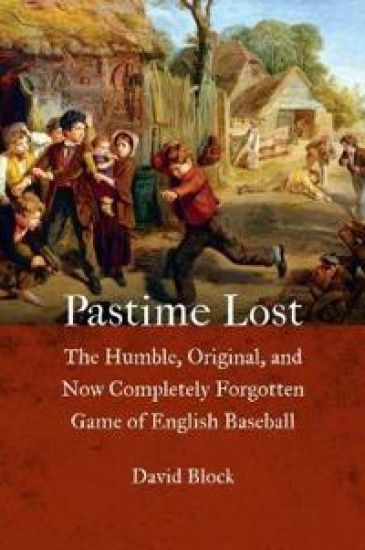
Pastime Lost

Pastime Lost

David Block

University of Nebraska Press
2019
sidottu
Long before baseball became America’s national pastime, English citizens of all ages, genders, and classes of society were playing a game called baseball. It had the same basic elements as modern American baseball, such as pitching and striking the ball, running bases, and fielding, but was played with a soft ball on a smaller playing field and, instead of a bat, the ball was typically struck by the palm of the hand. There is no doubt, however, that this simpler English version of baseball was the original form of the pastime and was the immediate forerunner of its better-known American offspring. Strictly a social game, English baseball was played for nearly two hundred years before fading away at the beginning of the twentieth century. Despite its longevity and its important role in baseball’s evolution, however, today it has been completely forgotten. In Pastime Lost David Block unearths baseball’s buried history and brings it back to life, illustrating how English baseball was embraced by all sectors of English society and exploring some of the personalities, such as Jane Austen and King George III, who played the game in their childhoods. While rigorously documenting his sources, Block also brings a light touch to his story, inviting us to follow him on some of the adventures that led to his most important discoveries.
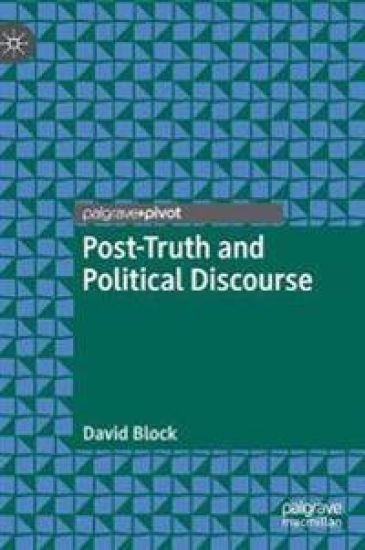
Post-Truth and Political Discourse

Post-Truth and Political Discourse

David Block

Springer Nature Switzerland AG
2018
sidottu
In this book David Block draws on analytical techniques from Critical Discourse Studies to critically investigate truth, truths, the propagation of ignorance and post-truth. Focusing on corrupt discourses and agnotology, he explores the role of anti-intellectualism, emotion and social media in the cultural creation, legitimisation and dissemination of ignorance. While encompassing analysis of discourses on Donald Trump, Brexit, climate change and the Alt-Right, Block furthers our understanding of this global phenomena by providing a revealing analysis of political communications relating to corruption scandals involving the Spanish conservative party. Through an innovative theoretical framework that combines critical discourse and discourse historical approaches with nuanced political analysis, he uncovers the rhetorical means by which esoteric truths and misleading narratives about corruption are created and demonstrates how they become, in their turn, corrupt discourses. This original work offers fresh insights for scholars of Discourse Analysis, Sociolinguistics, Politics, Cultural and Communication Studies, and will also appeal to general readers with an interest in political communication and Spanish politics.
Political Economy and Sociolinguistics

Political Economy and Sociolinguistics

David Block

Bloomsbury Academic
2018
sidottu
Shortlisted for the BAAL Book Prize 2019This book explores how political economy intersects with sociolinguistics, specifically how neoliberalism, inequality and social class mediate language in society issues. After the preface, in which the author sets the scene for the content of the book, Chapter 1 is an extensive, though selective, review of sociolinguistics research which has been framed as political economic in orientation. The chapter concludes that such research generally contains little in the way of thorough and in-depth coverage of the key ideas and conceptual frameworks said to undergird it. With this consideration in mind, Chapters 2, 3 and 4 are organised around in-depth discussions of, respectively, political economy as a general disciplinary frame; neoliberalism as the variegated variety of capitalism dominant in the world today; and stratification, inequality and social class, as phenomena intrinsic to capitalism, which in the neoliberal era have come to the fore as key issues. Drawing directly on the background provide in Chapters 2-4, Chapters 5 and 6 explore two distinct political economy-informed lines of research, on the one hand, the ‘neoliberal citizen’, and on the other hand, ‘discursive class warfare’. The book ends with an epilogue addressing issues arising around political economy in sociolinguistics.
Political Economy and Sociolinguistics

Political Economy and Sociolinguistics

David Block

Bloomsbury Academic
2018
nidottu
Shortlisted for the BAAL Book Prize 2019This book explores how political economy intersects with sociolinguistics, specifically how neoliberalism, inequality and social class mediate language in society issues. After the preface, in which the author sets the scene for the content of the book, Chapter 1 is an extensive, though selective, review of sociolinguistics research which has been framed as political economic in orientation. The chapter concludes that such research generally contains little in the way of thorough and in-depth coverage of the key ideas and conceptual frameworks said to undergird it. With this consideration in mind, Chapters 2, 3 and 4 are organised around in-depth discussions of, respectively, political economy as a general disciplinary frame; neoliberalism as the variegated variety of capitalism dominant in the world today; and stratification, inequality and social class, as phenomena intrinsic to capitalism, which in the neoliberal era have come to the fore as key issues. Drawing directly on the background provide in Chapters 2-4, Chapters 5 and 6 explore two distinct political economy-informed lines of research, on the one hand, the ‘neoliberal citizen’, and on the other hand, ‘discursive class warfare’. The book ends with an epilogue addressing issues arising around political economy in sociolinguistics.
Second Language Identities

Second Language Identities

David Block

Bloomsbury Academic
2014
nidottu
Second Language Identities examines how identity is an issue in different second language learning contexts. It begins with a detailed presentation of what has become a popular approach to identity in the social sciences (including applied linguistics) today, one that is inspired in poststructuralist thought and is associated with the work of authors such as Anthony Giddens, Zygmunt Bauman, Chris Weedon, Judith Butler and Stuart Hall. It then examines how in early SLA research focussing on affective variables, identity was an issue, lurking in the wings but not coming to centre stage. Moving to the present, the book then examines in detail and critiques recent research focussing on identity in three distinct second language learning contexts. These contexts are: (1) adult migration, (2) foreign language classrooms and (3) study abroad programmes. The book concludes with suggestions for future research focussing on identity in second language learning.
Social Class in Applied Linguistics
In this ground breaking new book David Block proposes a new working definition of social class in applied linguistics. Traditionally, research on language and identity has focused on aspects such as race, ethnicity, nationality, gender, religion and sexuality. Political economy, and social class, as an identity inscription, have been undervalued. This book argues that increasing socioeconomic inequality, which has come with the consolidation of neoliberal policies and practices worldwide, requires changes in how we think about identity and proposes that social class should be brought to the fore as a key construct. Social Class in Applied Linguistics begins with an in-depth theoretical discussion of social class before considering the extent to which social class has been a key construct in three general areas of applied linguistics- sociolinguistics, bi/multilingualism and second language acquisition and learning research. Throughout the book, Block suggests ways in which social class might be incorporated into future applied linguistics research. A critical read for postgraduate students and researchers in the areas of applied linguistics, language education and TESOL.
Neoliberalism and Applied Linguistics

Neoliberalism and Applied Linguistics

David Block; John Gray; Marnie Holborow

Routledge
2012
nidottu
This book explores neoliberalism – a view of the world that puts the market at its centre- from the perspective of applied linguistics. Neoliberalism and Applied Linguistics argues that while applied linguistics has become more interdisciplinary in orientation, it has ignored or downplayed the role of political economy, namely the way in which social, political and economic factors relate to one another within the context of a capitalist economy. The authors take the view that engagement with political economy is central to any fully rounded analysis of language and language-related issues in the world today and their collaboration in this volume represents an initial attempt to redress what they perceive to be an imbalance in the field. The book begins with a discussion of neoliberalism and an analysis of the ways in which neoliberal ideology impacts on language. This is followed by a discussion of how globalization and identity have been conceptualised in applied linguistics in ways which have ignored the political centrality of class – a concept which the authors see as integral to their perspective. The book concludes with an analysis of the ways in which neoliberal ideology plays out in two key areas of applied linguistics - language teaching and language teacher education. Neoliberalism and Applied Linguistics is essential reading for advanced undergraduates, postgraduates and researchers in applied linguistics.
Neoliberalism and Applied Linguistics

Neoliberalism and Applied Linguistics

David Block; John Gray; Marnie Holborow

Routledge
2012
sidottu
This book explores neoliberalism – a view of the world that puts the market at its centre- from the perspective of applied linguistics. Neoliberalism and Applied Linguistics argues that while applied linguistics has become more interdisciplinary in orientation, it has ignored or downplayed the role of political economy, namely the way in which social, political and economic factors relate to one another within the context of a capitalist economy. The authors take the view that engagement with political economy is central to any fully rounded analysis of language and language-related issues in the world today and their collaboration in this volume represents an initial attempt to redress what they perceive to be an imbalance in the field. The book begins with a discussion of neoliberalism and an analysis of the ways in which neoliberal ideology impacts on language. This is followed by a discussion of how globalization and identity have been conceptualised in applied linguistics in ways which have ignored the political centrality of class – a concept which the authors see as integral to their perspective. The book concludes with an analysis of the ways in which neoliberal ideology plays out in two key areas of applied linguistics - language teaching and language teacher education. Neoliberalism and Applied Linguistics is essential reading for advanced undergraduates, postgraduates and researchers in applied linguistics.
Second Language Identities

Second Language Identities

David Block

Continuum International Publishing Group Ltd.
2009
nidottu
Second Language Identities examines how identity is an issue in different second language learning contexts. It begins with a detailed presentation of what has become a popular approach to identity in the social sciences (including applied linguistics) today, one that is inspired in poststructuralist thought and is associated with the work of authors such as Anthony Giddens, Zygmunt Bauman, Chris Weedon, Judith Butler and Stuart Hall. It then examines how in early SLA research focussing on affective variables, identity was an issue, lurking in the wings but not coming to the surface. Moving to the present, the book then examines in detail and critiques recent research focussing on identity in three distinct second language learning contexts. These contexts are: (1) adult migration, (2) foreign language classrooms and (3) study abroad programmes. The book concludes with suggestions for future research focussing on identity in second language learning.