Kirjojen hintavertailu – 12 903 725 kirjaa ja 27 kauppaa

Kirjailija

David Butcher

Kirjat ja teokset yhdessä paikassa: 7 kirjaa, julkaisuja vuosilta 2001–2023, suosituimpiin kuuluu The Last Haul. Vertaile teosten hintoja ja tarkista saatavuus suomalaisista kirjakaupoista.

7 kirjaa

Kirjojen julkaisuvuodet: 2001–2023.

Lowestoft, 1550-1750

Lowestoft, 1550-1750

David Butcher

BOYDELL BREWER LTD
2023
pokkari
A detailed history of the town of Lowestoft, its society, economy, and topography. `A superbly researched study.... An excellent addition not only to the history of Suffolk but of early modern society and economy more generally.' Professor RICHARD SMITH, University of Cambridge. Lowestoft has grown from a small urban community to become Suffolk's second largest town; and this book provides a vivid picture of the town and its inhabitants during the early modern period. Making full use of surviving documentation, in particular the parish registers, it begins with an overview of Lowestoft's medieval history, then proceeds to investigate topographical development, demographic features, occupational structure, social geography, house-building and interior décor, wealth and inheritance, maritime pursuits, agriculture, local government, education and literacy, religious affiliation, and urban identity. Wherever possible, the town is set into a national and European context, and its maritime nature fully brought out.
The Photographs of William Rayson Smith Volume II

The Photographs of William Rayson Smith Volume II

David Butcher

Poppyland Publishing
2020
nidottu
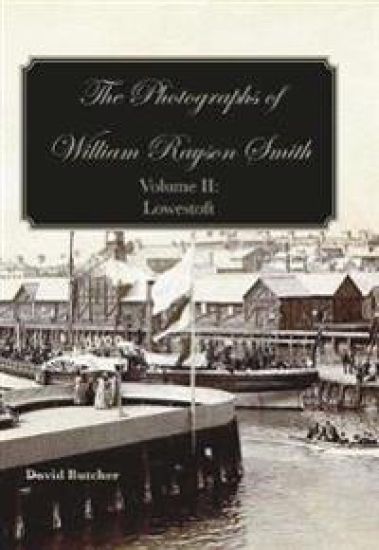
We might also be familiar with the photography of professionals in the 1880s through postcards or collections, but it is rare to come across the work of an amateur photographer whose plate photography captured both everyday and family life in the period. It might be for this reason alone that William Rayson Smith's albums are unique, however, his photographs, nearly all of which have never been seen before, provide us with a special glimpse into the past. William Rayson Smith hardly left East Anglia being baptised in Dickleburgh Church in 1841 and dying only five miles away in Harleston in October 1932. Apart from a decade in Belleville, Canada, where he acquired a taste for the new technology of photography. Purchasing a camera he was to spend much of the late 1880s photographing what he saw around him. The result is a special collection of distinctive photographs covering Norfolk and beyond. This second volume provides around 60 photographs taken while visiting his retired father in Lowestoft. David Butcher brings methodical research into these photographs to bring this unique collection to life.
Medieval Lowestoft

Medieval Lowestoft

David Butcher

The Boydell Press
2016
sidottu
A history of the development of Lowestoft from its origins to the flourishing medieval town it became. A superb piece of local history. Professor Mark Bailey, University of East Anglia. Lowestoft became an increasingly important Suffolk town during the later middle ages. This book traces its history from its Anglo-Saxon origins up until its fully recognisable urban nature in the first half of the sixteenth century. During that time, notable changes occurred in its social, economic and topographical structure, all of which are investigated here;the picture which emerges is one of small beginnings which eventually led (following the township's relocation to a new site) to a position of local pre-eminence. Two important elements in Lowestoft's overall development were its surface geology and coastal location, and due account is taken of these influences. So is its comparative freedom from outside interference in its affairs by having a far-distant, absentee manorial lord. Added to these factors was proximity to the port of Great Yarmouth, whose late medieval difficulties (access to the harbour and effective control of local waters) were very much to Lowestoft's advantage in developing its own maritime activity. From being a mere outlier to the Lothingland hub-manor at the time of Domesday, the town gradually became not only a notable coastal station in local terms, but one which was directly connected with various ports on the continent of Western Europe. For a community of only moderate size, it had broad and wide-ranging associations. Particular attention is paid to the town's magnificent church, and to its fishing industry. David Butcher is a retired Lowestoft schoolteacher and former lecturer in the Continuing Studies Department at the University of East Anglia. He has published widely on the local history of the Lowestoft area.
Smart Management

Smart Management

David Butcher; Martin Clarke

Palgrave Macmillan
2001
nidottu
Politics play a central role in all organisations but to this point they have largely been seen as a negative force. Butcher and Clarke expose this as a misunderstanding and show how political behaviour is entirely endemic to managerial activity and how understanding and managing it can have extremely powerful positive effects. They provide an approach to managing politics by balancing personal and organisational interests and show how the centrality of politics to organisational life make it the ideal place from which to change existing patterns of power and influence. Essential reading for directors and senior managers.