Kirjojen hintavertailu – 12 859 819 kirjaa ja 27 kauppaa

Kirjailija

David C. Colander

Kirjat ja teokset yhdessä paikassa: 10 kirjaa, julkaisuja vuosilta 1991–2019, suosituimpiin kuuluu The Changing Face of Economics. Vertaile teosten hintoja ja tarkista saatavuus suomalaisista kirjakaupoista.

10 kirjaa

Kirjojen julkaisuvuodet: 1991–2019.

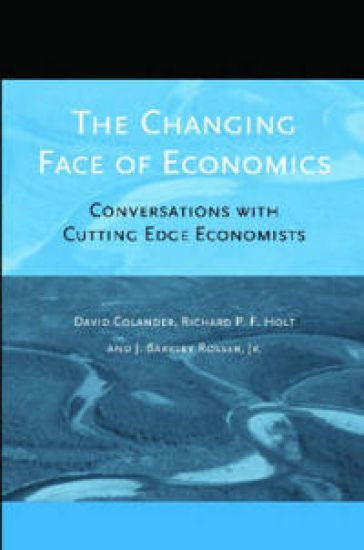
The Changing Face of Economics

The Changing Face of Economics

David C. Colander; Richard P.F. Holt; J.Barkley Rosser

The University of Michigan Press
2004
sidottu
"The Changing Face of Economics" gives the reader a sense of the modern economics profession and how it is changing. The volume does so with a set of nine interviews with cutting edge economists, followed by interviews with two Nobel Prize winners, Paul Samuelson and Kenneth Arrow, reflecting on the changes that are occurring. What results is a clear picture of today's economics--and it is no longer standard neoclassical economics. The interviews and commentary together demonstrate that economics is currently undergoing a fundamental shift in method and is moving away from traditional neoclassical economics into a dynamic set of new methods and approaches. These new approaches include work in behavioral economics, experimental economics, evolutionary game theory and ecological approaches, complexity and nonlinear dynamics, methodological analysis, and agent-based modeling. David E. Colander is Professor of Economics, Middlebury College. J. Barkley Rosser, Jr., is Professor of Economics and Kirby L. Kramer Jr. Professor of Business Administration, James Madison University. Richard P. F. Holt is Professor of Churchill Honors and Economics, Southern Oregon University.
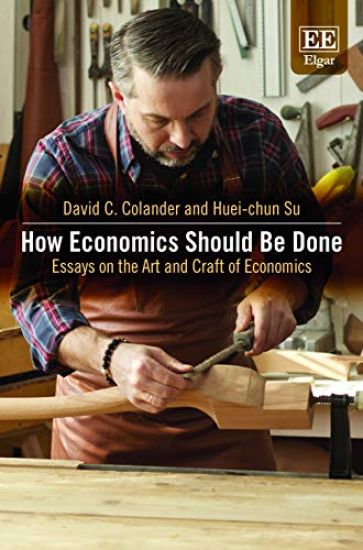
How Economics Should Be Done

How Economics Should Be Done

David C. Colander; Huei-chun Su

Edward Elgar Publishing Ltd
2019
nidottu
David Colander has been writing about economic methodology for over 30 years. His pragmatic approach sees applied policy methodology as rooted in what economists actually do, not in what methodologists say they should do. It sees applied policy methodology as constantly evolving as analytic and computational technology changes, evolving far too fast to be subject to any rigid scientific methodology. That problem is that economists generally think of applied policy analysis as applied science. Colander argues that using a scientific methodology to guide applied policy undermines good policy analysis. Instead, he contends that economists should use a much looser engineering methodology that blends science, heuristics, inescapable moral judgments, and creativity into what he calls the art and craft of economics. Here, Huei-chun Su has selected seventeen of Colander's articles that spell out and capture his arguments at various levels - some formal academic articles dealing with cutting edge methodology, and some more popular articles making the case for his approach. An original introduction and annotated bibliography serve as excellent resources for further exploring his arguments. Clear, well-structured, and written in plain English with little jargon, the book is approachable and suitable for anyone interested in the current and future state of economics and the economics profession. This includes students at any level as well as methodologists, applied economists, historians and critics of modern economics.
How Economics Should Be Done

How Economics Should Be Done

David C. Colander; Huei-chun Su

Edward Elgar Publishing Ltd
2018
sidottu
David Colander has been writing about economic methodology for over 30 years. His pragmatic approach sees applied policy methodology as rooted in what economists actually do, not in what methodologists say they should do. It sees applied policy methodology as constantly evolving as analytic and computational technology changes, evolving far too fast to be subject to any rigid scientific methodology. That problem is that economists generally think of applied policy analysis as applied science. Colander argues that using a scientific methodology to guide applied policy undermines good policy analysis. Instead, he contends that economists should use a much looser engineering methodology that blends science, heuristics, inescapable moral judgments, and creativity into what he calls the art and craft of economics. Here, Huei-chun Su has selected seventeen of Colander's articles that spell out and capture his arguments at various levels - some formal academic articles dealing with cutting edge methodology, and some more popular articles making the case for his approach. An original introduction and annotated bibliography serve as excellent resources for further exploring his arguments. Clear, well-structured, and written in plain English with little jargon, the book is approachable and suitable for anyone interested in the current and future state of economics and the economics profession. This includes students at any level as well as methodologists, applied economists, historians and critics of modern economics.
Social Science

Social Science

Elgin F. Hunt; David C. Colander

Routledge
2017
nidottu
Social Science: An Introduction to the Study of Society 16e approaches social science from a common-sense perspective, rather than from a conventional social science angle. Readers will see how seemingly diverse disciplines intermingle – anthropology and economics, for example. The goal of the book is to teach students critical thought and problem solving skills that will allow them to approach social issues in an unbiased manner. New to this edition are significant updates on: Race and the police More comparison/contrasts of deviance and criminality Alternative pathways in criminal justice new technology such as self-driving cars Gay marriage American political dynasties Refugee and immigration issues in Europe & globally American political dynasties China’s growing power New trade initiatives "States" in the Middle East Nuclear arms control? Expanded web-based ancillaries for students and teachers
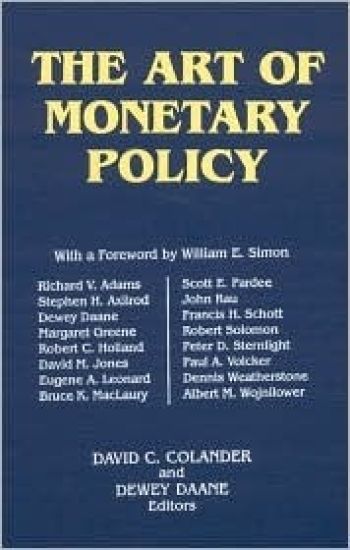
The Art of Monetary Policy

The Art of Monetary Policy

David C. Colander; Dewey Daane

M.E. Sharpe
1994
sidottu
Offering an introduction to the Japanese political system, this book covers the end of the Koizumi era, the brief and troubled premiership of Abe, and the selection of Fukuda as prime minister. It includes material on "bubble" and "post-bubble" economic developments, as well as coverage of health care policy.
The Art of Monetary Policy

The Art of Monetary Policy

David C. Colander; Dewey Daane

M.E. Sharpe
1994
nidottu
Offering an introduction to the Japanese political system, this book covers the end of the Koizumi era, the brief and troubled premiership of Abe, and the selection of Fukuda as prime minister. It includes material on "bubble" and "post-bubble" economic developments, as well as coverage of health care policy.
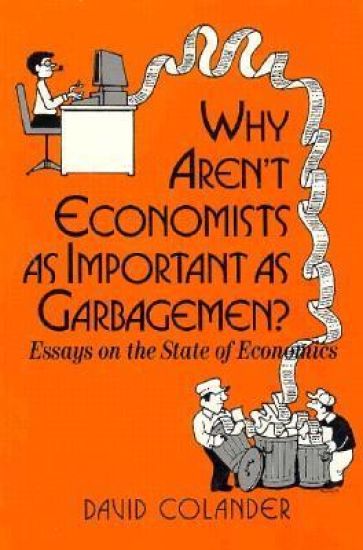
Why aren't Economists as Important as Garbagemen?
This volume, which evolved from a number of conversations with economists includes a collection of essays that have two themes: a positive one and a negative one. The positive theme of the essays is that economic analysis, if kept in perspective, is enormously powerful. It provides a way of uncovering the workings of real-world phenomena that fit the perceptions many people have. The negative theme is that economic analysis is not being kept in perspective by economists, and that loss of perspective means that much of what comes out under the name of economic research has little or no value for society. But even this negative theme has positive overtones in demonstrating the power of economic analysis.