Kirjojen hintavertailu – 12 903 725 kirjaa ja 27 kauppaa

Kirjailija

David C. Leege

Kirjat ja teokset yhdessä paikassa: 3 kirjaa, julkaisuja vuosilta 1993–2002, suosituimpiin kuuluu The Politics of Cultural Differences. Vertaile teosten hintoja ja tarkista saatavuus suomalaisista kirjakaupoista.

3 kirjaa

Kirjojen julkaisuvuodet: 1993–2002.

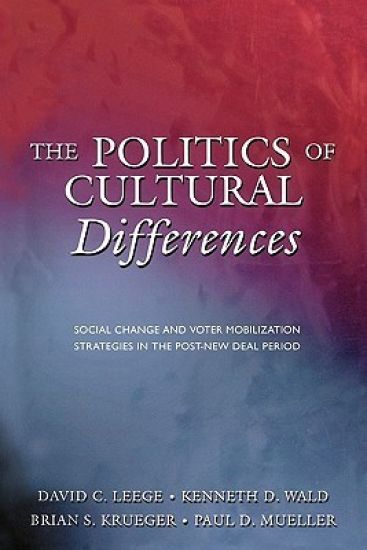
The Politics of Cultural Differences

The Politics of Cultural Differences

David C. Leege; Kenneth D. Wald; Brian S. Krueger; Paul D. Mueller

Princeton University Press
2002
pokkari
How did Republicans manage to hold the White House through much of the past half century even as the Democratic Party held the hearts of most American voters? The authors of this groundbreaking study argue that they did so by doing what Democrats have also excelled at: triggering psychological mechanisms that deepen cultural divisions in the other party's coalition, thereby leading many of its voters either to choose the opposing ticket or to stay home. The Politics of Cultural Differences is the first book to develop and carefully test a general theory of cultural politics in the United States, one that offers a compelling new perspective on America's changing political order and political conflict in the post-New Deal period (1960-1996). David Leege, Kenneth Wald, Brian Krueger, and Paul Mueller move beyond existing scholarship by formulating a theory of campaign strategies that emphasizes cultural conflict regarding patriotism, race, gender, and religion. Drawing on National Election Studies data, they find that Republican politicians deployed powerful symbols (e.g., "tax and spend liberals") to channel targeted voters toward the minority party. And as partisanship approached parity in the 1990s, Democratic leaders proved as adept at deploying their own symbols, such as "a woman's right to choose," to disassemble the Republican coalition. A blend of sophisticated theory and advanced empirical tools, this book lays bare the cultural dimensions of American political life.

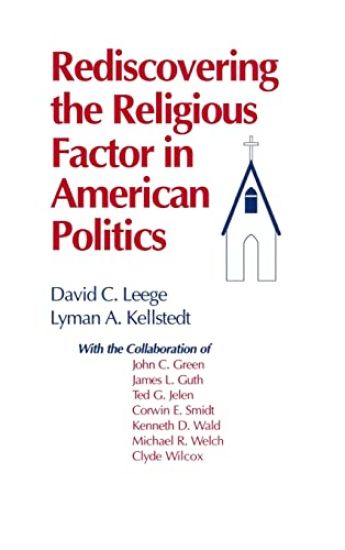
Rediscovering the Religious Factor in American Politics

Rediscovering the Religious Factor in American Politics

David C. Leege; Lyman A. Kellstedt

M.E. Sharpe
1993
nidottu
This text addresses whether and how religion and religious institutions affect American politics. For some time, analysts have argued that the conflicts of the New Deal era rendered cultural differences trivial and placed economic interests at the top of the political agenda. The authors and their collaborators - John C. Green, James L. Guth, Ted G. Jelen, Corwin E. Smidt, Kenneth D. Wald, Michael R. Welch, and Clyde Wilcox - disagree. They find that religious worldviews are still insinuated in American political institutions, and religious institutions still are points of reference. The book profits from the new religiosity measures employed in the 1990 National Election Studies. Part 1 discusses the study of religion in the context of politics. Part II examines religion as a source of group orientation. Part III takes up religious practices and their political ramifications. Part IV does the same for doctrinal and worldview considerations. Part V explores the sources of religious socialisation. In conclusion, Part VI reviews the research on religion and political behaviour and looks ahead to where work should proceed.
Rediscovering the Religious Factor in American Politics

Rediscovering the Religious Factor in American Politics

David C. Leege; Lyman A. Kellstedt

M.E. Sharpe
1993
sidottu
This text addresses whether and how religion and religious institutions affect American politics. For some time, analysts have argued that the conflicts of the New Deal era rendered cultural differences trivial and placed economic interests at the top of the political agenda. The authors and their collaborators - John C. Green, James L. Guth, Ted G. Jelen, Corwin E. Smidt, Kenneth D. Wald, Michael R. Welch, and Clyde Wilcox - disagree. They find that religious worldviews are still insinuated in American political institutions, and religious institutions still are points of reference. The book profits from the new religiosity measures employed in the 1990 National Election Studies. Part 1 discusses the study of religion in the context of politics. Part II examines religion as a source of group orientation. Part III takes up religious practices and their political ramifications. Part IV does the same for doctrinal and worldview considerations. Part V explores the sources of religious socialisation. In conclusion, Part VI reviews the research on religion and political behaviour and looks ahead to where work should proceed.