
Kirjojen hintavertailu – 12 903 725 kirjaa ja 27 kauppaa

Kirjailija

David Canter

Kirjat ja teokset yhdessä paikassa: 23 kirjaa, julkaisuja vuosilta 1999–2026, suosituimpiin kuuluu Football in its Place. Vertaile teosten hintoja ja tarkista saatavuus suomalaisista kirjakaupoista.

23 kirjaa

Kirjojen julkaisuvuodet: 1999–2026.

Rethinking the Psychology of Place

Rethinking the Psychology of Place

David Canter

TAYLOR FRANCIS LTD
2026
sidottu
Rethinking the Psychology of Place presents a new approach to Professor David Canter's 1977 Psychology of Place. Providing a unified Theory of Place relevant to human transactions with buildings, cities and nature, the book weaves together psychological, architectural and social perspectives to demonstrate that place is a dynamic phenomenon emerging from embodied experience, memory and social interactions. Central to this are 'place rules' and 'environmental roles' that mediate how individuals relate to and behave within locations, challenging deterministic notions that design directly causes place experiences. Supported by over 160 illustrations, the book advances a nuanced, human-centred understanding of place an evolving, dynamic nexus of action, meaning and form by: • Examining the home as an emotionally layered construct central to experiences of place • Positioning architecture as a filter of sensory input and a vehicle of symbolic meaning, shaped by cultural templates, architectural styles and building types • Using techniques such as space syntax to illustrate how spatial arrangements facilitate human interactions at both the building and metropolitan scale • Critiquing modernist architecture's abstraction of meaning • Highlighting streets as vital, participatory spaces, while considering how digital culture reshapes how we are present in these environments • Challenging dominant biocentric explanations for the restorative benefits of nature and related explorations of preferences for landscapes and place attachment, offering an alternative that emphasises human agency, culture and context. By integrating concepts such as place attachment, domocentricity and environmental roles, this book will appeal to students and researchers in environmental psychology, architecture, landscape design, urban planning and environmental sociology, as well as the general reader looking to understand our interactions with our surroundings. It is essential reading for anyone interested in the complex relationships between people and their built and natural environments.
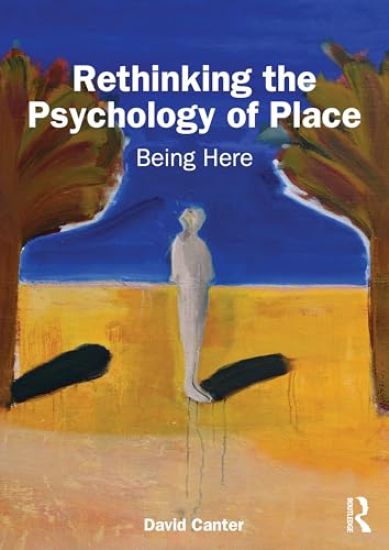
Rethinking the Psychology of Place

Rethinking the Psychology of Place

David Canter

TAYLOR FRANCIS LTD
2026
nidottu
Rethinking the Psychology of Place presents a new approach to Professor David Canter's 1977 Psychology of Place. Providing a unified Theory of Place relevant to human transactions with buildings, cities and nature, the book weaves together psychological, architectural and social perspectives to demonstrate that place is a dynamic phenomenon emerging from embodied experience, memory and social interactions. Central to this are 'place rules' and 'environmental roles' that mediate how individuals relate to and behave within locations, challenging deterministic notions that design directly causes place experiences. Supported by over 160 illustrations, the book advances a nuanced, human-centred understanding of place an evolving, dynamic nexus of action, meaning and form by: • Examining the home as an emotionally layered construct central to experiences of place • Positioning architecture as a filter of sensory input and a vehicle of symbolic meaning, shaped by cultural templates, architectural styles and building types • Using techniques such as space syntax to illustrate how spatial arrangements facilitate human interactions at both the building and metropolitan scale • Critiquing modernist architecture's abstraction of meaning • Highlighting streets as vital, participatory spaces, while considering how digital culture reshapes how we are present in these environments • Challenging dominant biocentric explanations for the restorative benefits of nature and related explorations of preferences for landscapes and place attachment, offering an alternative that emphasises human agency, culture and context. By integrating concepts such as place attachment, domocentricity and environmental roles, this book will appeal to students and researchers in environmental psychology, architecture, landscape design, urban planning and environmental sociology, as well as the general reader looking to understand our interactions with our surroundings. It is essential reading for anyone interested in the complex relationships between people and their built and natural environments.

Geographical Offender Profiling

Geographical Offender Profiling

David Canter; Donna Youngs

Taylor Francis Ltd
2026
sidottu
‘Crime Hot-Spots’ and ‘Repeat Victimisation’ are eye-catching subjects in the wider study of where, and to a lesser extent when, individual criminals choose to commit their crimes. This field of work is now commonly referred to as ‘geographical profiling’ and throws light on the psychology of criminality, as well as offering various forms of support to many aspects of police investigations and the management of crime. This book brings together the disparate research and varied opinions that are relevant to an understanding of criminal spatial activity. Subjects covered include a review of: the historical development of geographical profiling, the concepts and theories that are fundamental to all considerations of human spatial behaviour, the sources of spatial and geographic information on which researchers and police investigators can draw for GOP, how the principles of GOP can be applied in practice, how development and change manifests itself in spatial behaviour and how this impacts on GOP, the computer-based tools available for GOP, recent developments in theory and practice. This book provides a perfect introduction to geographical profiling for graduate students taking courses in forensic and investigative psychology, criminal investigation and police and crime science.
Geographical Offender Profiling

Geographical Offender Profiling

David Canter; Donna Youngs

Taylor Francis Ltd
2026
nidottu
‘Crime Hot-Spots’ and ‘Repeat Victimisation’ are eye-catching subjects in the wider study of where, and to a lesser extent when, individual criminals choose to commit their crimes. This field of work is now commonly referred to as ‘geographical profiling’ and throws light on the psychology of criminality, as well as offering various forms of support to many aspects of police investigations and the management of crime. This book brings together the disparate research and varied opinions that are relevant to an understanding of criminal spatial activity. Subjects covered include a review of: the historical development of geographical profiling, the concepts and theories that are fundamental to all considerations of human spatial behaviour, the sources of spatial and geographic information on which researchers and police investigators can draw for GOP, how the principles of GOP can be applied in practice, how development and change manifests itself in spatial behaviour and how this impacts on GOP, the computer-based tools available for GOP, recent developments in theory and practice. This book provides a perfect introduction to geographical profiling for graduate students taking courses in forensic and investigative psychology, criminal investigation and police and crime science.
Football in its Place

Football in its Place

David Canter; Miriam Comber; David L. Uzzell

TAYLOR FRANCIS LTD
2026
nidottu
In the late 1980s football was in a state of crisis. Falling attendances and a genuine unease among potential spectators about going to live football matches suggested that, without radical changes, the game would soon become a minority spectator sport. Originally published in 1989, reissued now with a new preface, Football in its Place presented a new approach to the problem that concentrates on the spectators’ experience of football and on the places where it is played. This approach recognizes four themes, which relate directly to the spectators’ experience: spectator comfort; the need for effective crowd control; the problems of coping in emergencies; and variations in club cultures. A special chapter on football-related violence shows how this needs to be understood in relation to all of these themes and not treated as a problem in isolation. This was said to be the only way to reverse the spiral that had given rise to hooliganism. Finally, the authors discuss the options for the future on football. They emphasize that football is a recreational activity whose management should be treated as part of the leisure industry. All aspects of the game, its traditions, club variations and heritage, needed to be harnessed if football was again to be Britain’s most popular spectator sport. Today we can see the impact that the points made in this book have contributed to how we continue to watch and enjoy football now.
Readings on the Psychology of Place

Readings on the Psychology of Place

David Canter

TAYLOR FRANCIS LTD
2024
nidottu
In the World Library of Psychologists series, international experts present career-long collections of what they judge to be their most interesting publications – extracts from books, key articles, research findings and practical and theoretical contributions. In this fascinating volume, Professor David Canter refl ects on a career that has earned him an international reputation as one of the U. K.’s most eminent applied social psychologists and a pioneer in the fi eld of environmental psychology, through a selection of papers that illustrate one of the foundational themes of his research career: the psychology of place. Split into four parts, each with a new introduction written by the author, the book provides insights into theories, methods and applications of place psychology. Covering a range of publications from early research in the 1960s up to recent explorations, this volume provides the unfolding research that elaborates this seminal theory, offering rich perspectives on how places gain their significance and meaning. Featuring specially written commentary by the author contextualizing the selections and providing an intimate overview of his career, this collection of key publications offers a unique and compelling insight into decades of ground-breaking work, making it an essential resource for all those engaged or interested in the study of places.
Criminal Psychology

Criminal Psychology

David Rowlands; David Canter

TAYLOR FRANCIS LTD
2024
sidottu
This carefully revised third edition of Criminal Psychology offers a vital, up-to-date account of the wide range of psychological contributions to the understanding of criminals and crime, its investigation, the legal processes of dealing with offenders, and helping victims. The book provides insights into cognitive, developmental, and social theories of a diverse range of crimes, including domestic abuse, burglary, fraud, rape, murder, and terrorism. It also discusses the psychological contributions to policing, criminal investigations, and court processes, and gives consideration to securing reliable testimony and rehabilitation in prisons. The third edition complements the topics established in earlier editions with the addition of current and emerging issues in the study of criminal psychology, including cybercrime, new forms of fraud, and developments in organised crime, as well as the future of crimes and their psychology. The well-illustrated text is packed with pedagogical features that bring this fascinating subject to life, including boxes highlighting key topics, descriptions of research methods, further reading, and suggested essay titles. Offering a comprehensive, accessible, contemporary introduction, the book shows that many aspects of psychology are essential for understanding criminals and their actions, the investigation of crime, and court procedures. This is the ideal text for students across psychology, criminology, socio-legal studies, and law, as well as everyone who wishes to gain an overview of criminal psychology.
Criminal Psychology

Criminal Psychology

David Rowlands; David Canter

TAYLOR FRANCIS LTD
2024
nidottu
This carefully revised third edition of Criminal Psychology offers a vital, up-to-date account of the wide range of psychological contributions to the understanding of criminals and crime, its investigation, the legal processes of dealing with offenders, and helping victims. The book provides insights into cognitive, developmental, and social theories of a diverse range of crimes, including domestic abuse, burglary, fraud, rape, murder, and terrorism. It also discusses the psychological contributions to policing, criminal investigations, and court processes, and gives consideration to securing reliable testimony and rehabilitation in prisons. The third edition complements the topics established in earlier editions with the addition of current and emerging issues in the study of criminal psychology, including cybercrime, new forms of fraud, and developments in organised crime, as well as the future of crimes and their psychology. The well-illustrated text is packed with pedagogical features that bring this fascinating subject to life, including boxes highlighting key topics, descriptions of research methods, further reading, and suggested essay titles. Offering a comprehensive, accessible, contemporary introduction, the book shows that many aspects of psychology are essential for understanding criminals and their actions, the investigation of crime, and court procedures. This is the ideal text for students across psychology, criminology, socio-legal studies, and law, as well as everyone who wishes to gain an overview of criminal psychology.
Criminal Psychology in Action

Criminal Psychology in Action

David Canter

TAYLOR FRANCIS LTD
2024
nidottu
Criminal Psychology in Action provides a practical, hands-on introduction to criminal psychology through unique projects for students, illustrating the many ways research into crimes and criminals can be conducted. It also provides an overview of many individual and social psychological theories of criminality. Drawing on over half a century of experience supervising hundreds of projects at undergraduate, master’s, and doctoral levels, David Canter provides well-grounded and detailed guidance for students of how to conduct a range of relevant and interesting projects designed to engage students directly with empirical research. This includes consideration of the ethical and practical issues of doing research in this area, as well as examples of documents needed for informed consent and submissions to ethical committees. The range of research designs described – laboratory experiments, surveys, case studies and simulations – provide introductions to methodologies relevant to many other areas of research beyond criminal psychology. Both engaging and interactive, this is an invaluable resource for instructors and students from colleges and universities around the world in many different fields, such as psychology, criminology, and socio-legal studies. It will also be of interest to all those who want to know more about the psychology of crime and criminality.
Criminal Psychology in Action

Criminal Psychology in Action

David Canter

TAYLOR FRANCIS LTD
2024
sidottu
Criminal Psychology in Action provides a practical, hands-on introduction to criminal psychology through unique projects for students, illustrating the many ways research into crimes and criminals can be conducted. It also provides an overview of many individual and social psychological theories of criminality. Drawing on over half a century of experience supervising hundreds of projects at undergraduate, master’s, and doctoral levels, David Canter provides well-grounded and detailed guidance for students of how to conduct a range of relevant and interesting projects designed to engage students directly with empirical research. This includes consideration of the ethical and practical issues of doing research in this area, as well as examples of documents needed for informed consent and submissions to ethical committees. The range of research designs described – laboratory experiments, surveys, case studies and simulations – provide introductions to methodologies relevant to many other areas of research beyond criminal psychology. Both engaging and interactive, this is an invaluable resource for instructors and students from colleges and universities around the world in many different fields, such as psychology, criminology, and socio-legal studies. It will also be of interest to all those who want to know more about the psychology of crime and criminality.
Football in its Place

Football in its Place

David Canter; Miriam Comber; David L. Uzzell

TAYLOR FRANCIS LTD
2024
sidottu
In the late 1980s football was in a state of crisis. Falling attendances and a genuine unease among potential spectators about going to live football matches suggested that, without radical changes, the game would soon become a minority spectator sport. Originally published in 1989, reissued now with a new preface, Football in its Place presented a new approach to the problem that concentrates on the spectators’ experience of football and on the places where it is played. This approach recognizes four themes, which relate directly to the spectators’ experience: spectator comfort; the need for effective crowd control; the problems of coping in emergencies; and variations in club cultures. A special chapter on football-related violence shows how this needs to be understood in relation to all of these themes and not treated as a problem in isolation. This was said to be the only way to reverse the spiral that had given rise to hooliganism. Finally, the authors discuss the options for the future on football. They emphasize that football is a recreational activity whose management should be treated as part of the leisure industry. All aspects of the game, its traditions, club variations and heritage, needed to be harnessed if football was again to be Britain’s most popular spectator sport. Today we can see the impact that the points made in this book have contributed to how we continue to watch and enjoy football now.
Criminal Shadows: Inside the Mind of a Serial Killer
What makes a serial killer? How do you spot one? Is there any way of truly knowing? David Canter asked the same questions whilst developing the new science of criminal profiling, a revolutionary approach to violent crime investigations. In this highly acclaimed account, Canter reveals his methods of precisely identifying and locating murderers and rapists: the unconscious behaviours and tell-tale patterns that they always leave behind. These pioneering techniques of building profiles transformed policing, still in use across the world to hunt and capture dangerous psychopaths. Taking us into the heart of some of the most notorious criminal investigations in British history, Canter’s writing is a gripping read for fans of true crime and human psychology.‘Fascinating. A persuasive and thorough contribution to a nascent science’ Mail on Sunday
Readings on the Psychology of Place

Readings on the Psychology of Place

David Canter

TAYLOR FRANCIS LTD
2023
sidottu
In the World Library of Psychologists series, international experts present career-long collections of what they judge to be their most interesting publications – extracts from books, key articles, research findings and practical and theoretical contributions. In this fascinating volume, Professor David Canter refl ects on a career that has earned him an international reputation as one of the U. K.’s most eminent applied social psychologists and a pioneer in the fi eld of environmental psychology, through a selection of papers that illustrate one of the foundational themes of his research career: the psychology of place. Split into four parts, each with a new introduction written by the author, the book provides insights into theories, methods and applications of place psychology. Covering a range of publications from early research in the 1960s up to recent explorations, this volume provides the unfolding research that elaborates this seminal theory, offering rich perspectives on how places gain their significance and meaning. Featuring specially written commentary by the author contextualizing the selections and providing an intimate overview of his career, this collection of key publications offers a unique and compelling insight into decades of ground-breaking work, making it an essential resource for all those engaged or interested in the study of places.
Experiments in Anti-Social Behaviour
For a practical, hands-on approach to learning forensic psychology, Experiments in Anti-Social Behaviour: Ten Studies for Students presents a collection of unique projects for students that illustrate the many ways research into anti-social behaviour can be conducted whilst also highlighting social psychological aspects of criminality. Drawing on over half a century of supervising many hundreds of projects at high school, undergraduate, master's, and doctoral levels, David Canter provides well-grounded and detailed guidance for students on how to execute a range of different research studies through several psychological approaches, including quantitative cognitive studies, qualitative discourse analysis, and social identity theory. After introducing the ethical and practical challenges of studying crime and criminality, Experiments in Anti-Social Behaviour outlines broad approaches to research. This is followed by ten practical studies for students to carry out in order to engage directly with experimental research. These studies cover experiments, surveys, and case studies, and include a controlled examination of how easy it is to forge a signature, descriptions of experiments trying to detect deception, and an exploration of what is involved in linking actions in a serial killer’s crimes to his characteristics. Both engaging and interactive, Experiments in Anti-Social Behaviour is an invaluable resource for instructors and students from colleges and universities around the world in many different fields, such as psychology, criminology, and socio-legal studies. It will also be of interest to all those who want to know more about the psychology of crime and criminality.
Experiments in Anti-Social Behaviour
For a practical, hands-on approach to learning forensic psychology, Experiments in Anti-Social Behaviour: Ten Studies for Students presents a collection of unique projects for students that illustrate the many ways research into anti-social behaviour can be conducted whilst also highlighting social psychological aspects of criminality. Drawing on over half a century of supervising many hundreds of projects at high school, undergraduate, master's, and doctoral levels, David Canter provides well-grounded and detailed guidance for students on how to execute a range of different research studies through several psychological approaches, including quantitative cognitive studies, qualitative discourse analysis, and social identity theory. After introducing the ethical and practical challenges of studying crime and criminality, Experiments in Anti-Social Behaviour outlines broad approaches to research. This is followed by ten practical studies for students to carry out in order to engage directly with experimental research. These studies cover experiments, surveys, and case studies, and include a controlled examination of how easy it is to forge a signature, descriptions of experiments trying to detect deception, and an exploration of what is involved in linking actions in a serial killer’s crimes to his characteristics. Both engaging and interactive, Experiments in Anti-Social Behaviour is an invaluable resource for instructors and students from colleges and universities around the world in many different fields, such as psychology, criminology, and socio-legal studies. It will also be of interest to all those who want to know more about the psychology of crime and criminality.
Profiling in Policy and Practice

Profiling in Policy and Practice

David Canter; Laurence Alison

Routledge
2016
nidottu
'Profilers' and 'Profiling' are now widely discussed, often with almost mythical respect. This is the first volume to cut through the confusions and misunderstandings surrounding this topic to report on detailed, original, scientific research that examines the variations in criminal behaviour from which any 'profile' must be derived. The studies included examine both early approaches to the field and the future problems and potential for an Investigative Psychology approach of offender profiling. This book will be of great value to all those who have been waiting for a scientific, psychological basis to police investigations. It will be read with interest by those who want to get behind the rhetoric and controversy that surrounds 'offender profiling' and require an up to date account of current research and recent discoveries.
Cranks Recipe Book

Cranks Recipe Book

David Canter

Orion (an Imprint of The Orion Publishing Group Ltd )
2013
pokkari

Halvin toimitettuna 16,80 €

THE classic vegetarian cookbook, reissued for a new generation. With helpful notes on techniques, and numerous delicious recipes for soups, starters, salads, dressings, sauces and savouries, not to mention sections devoted to baking, puddings, cereals, preserves, sweetmeats and drinks, the founders of Cranks have put together a book that stands for all that is best in wholefood cuisine. Their aim is to give people the opportunity to experiment with vegetarian food to experience the benefits of a more balanced diet.
Forensic Psychology

Forensic Psychology

David Canter

Oxford University Press
2010
nidottu

Halvin toimitettuna 18,90 €

Lie detection, offender profiling, jury selection, insanity in the law, predicting the risk of re-offending , the minds of serial killers and many other topics that fill news and fiction are all aspects of the rapidly developing area of scientific psychology broadly known as Forensic Psychology. Forensic Psychology: A Very Short Introduction discusses all the aspects of psychology that are relevant to the legal and criminal process as a whole. It includes explanations of criminal behaviour and criminality, including the role of mental disorder in crime, and discusses how forensic psychology contributes to helping investigate the crime and catching the perpetrators. It also explains how psychologists provide guidance to all those involved in civil and criminal court proceedings, including both the police and the accused, and what expert testimony can be provided by a psychologist about the offender at the trial. Finally, David Canter examines how forensic psychology is used, particularly in prisons, to help in the management, treatment and rehabilitation of offenders, once they have been convicted. ABOUT THE SERIES: The Very Short Introductions series from Oxford University Press contains hundreds of titles in almost every subject area. These pocket-sized books are the perfect way to get ahead in a new subject quickly. Our expert authors combine facts, analysis, perspective, new ideas, and enthusiasm to make interesting and challenging topics highly readable.
Principles of Geographical Offender Profiling

Principles of Geographical Offender Profiling

David Canter; Donna Youngs

Ashgate Publishing Limited
2008
nidottu
Geographical Offender Profiling (GOP) is the term that has emerged for the examination of where offences take place and the use of that examination to formulate views on the nature of the offender and where s/he might be based. As such, it has become the cornerstone of 'offender profiling'. By its nature, GOP bridges psychology, geography, criminology and forensic science and is of academic interest to all those disciplines as well as practical significance to police investigators. This book brings together a cross-section of the major papers published in the field that lay out the concepts and foundations of this area - including some widely quoted but difficult to obtain 'classic' papers - with an introduction that puts the papers into an overall context and a concluding extensive bibliography of the publications relevant to this rapidly growing area.
Principles of Geographical Offender Profiling

Principles of Geographical Offender Profiling

David Canter; Donna Youngs

Ashgate Publishing Limited
2008
sidottu
Geographical Offender Profiling (GOP) is the term that has emerged for the examination of where offences take place and the use of that examination to formulate views on the nature of the offender and where s/he might be based. As such, it has become the cornerstone of 'offender profiling'. By its nature, GOP bridges psychology, geography, criminology and forensic science and is of academic interest to all those disciplines as well as practical significance to police investigators. This book brings together a cross-section of the major papers published in the field that lay out the concepts and foundations of this area - including some widely quoted but difficult to obtain 'classic' papers - with an introduction that puts the papers into an overall context and a concluding extensive bibliography of the publications relevant to this rapidly growing area.