

Kirjailija
David Christian
Kirjat ja teokset yhdessä paikassa: 27 kirjaa, julkaisuja vuosilta 1990–2024, suosituimpiin kuuluu Looseleaf for Big History. Vertaile teosten hintoja ja tarkista saatavuus suomalaisista kirjakaupoista.
27 kirjaa
Kirjojen julkaisuvuodet: 1990–2024.
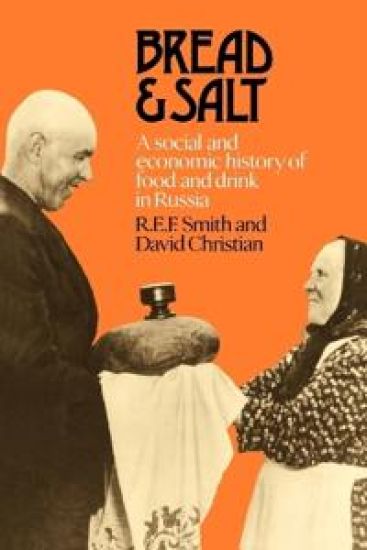
Bread and Salt - a literal translation of the Russian word for hospitality - explores the social and economic implications of eating and drinking in Russia in the thousand years before 1900. Eating and drinking are viewed here as social activities which involves the economics of production, storage and distribution of food stuffs. These activities attract both social controls and state taxation; in this way the everyday process of eating and drinking is linked with the history of Russia. The dominance of grain in the diet throughout the period and the importance of salt, as implied in the title, are dealt with, as are the early Russian beer-drinking fraternities. The relatively late introduction of spirits, in the from of vodka, and it disastrous consequences in social terms are described. Tea and the samovar, also much more a latecomer than is generally realized, did little to diminish excessive drinking. Drinking, in any event, was by no means discourage by the state, since it was a major source of state income. The final section of the book looks at rural diets in the nineteenth century, when some variation and new items, such as the potato, became important. At the same time, peasants depended basically on the grain crop, as they had for thousands of years. Forced by txation to enter the market, afflicted by severe famines towards the end of the century, many peasants ate and drank no better as a result of the modernization of the county.

A great historian can make clear the connections between the first Homo sapiens and today’s version of the species, and a great storyteller can make those connections come alive. David Christian is both, and This Fleeting World: A Short History of Humanity makes the journey - from the earliest foraging era to our own modern era - a fascinating one. Enter This Fleeting World - and give up the preconception that anything old is boring.
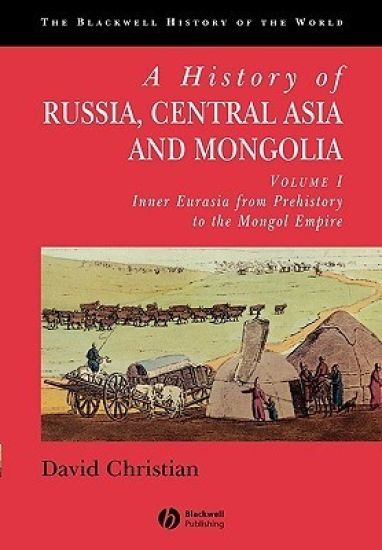
A History of Russia, Central Asia and Mongolia, Volume I
David Christian
JOHN WILEY AND SONS LTD
1998
nidottu
This is a history of Russia, Central Asia and Mongolia from the time of the first inhabitants of the region up to the break up of the Mongol Empire in 1260 AD. Inner Eurasia, as the author defines it, comprises most of the former Soviet Union and Russia's huge territories in Siberia; Russia's former empire in Central Asia; China's central Asian empire; and Mongolia, both the parts within China and those within the Mongolian People's Republic. The author presents Inner Eurasia as a coherent region with an underlying unity in geography and history despite its cultural and ecological variety. This volume, the first of two surveying this region, charts developments from the Old Stone Age, through changes under such peoples as the Scythians, the Huns and the Turks, to the emergence of an identifiable "Rus" - the society from which modern Russia and Ukraine have evolved. The book sets political events in the broadest context of social and economic change, linking evolution to the vast geography of the territories it describes. Together with volume II covering the period up to the present, the work represents the most thorough, up-to-date study of this fascinating and much misunderstood region of the world. The Blackwell History of the World Series The goal of this ambitious series is to provide an accessible source of knowledge about the entire human past, for every curious person in every part of the world. It will comprise some two dozen volumes, of which some provide synoptic views of the history of particular regions while others consider the world as a whole during a particular period of time. The volumes are narrative in form, giving balanced attention to social and cultural history (in the broadest sense) as well as to institutional development and political change. Each provides a systematic account of a very large subject, but they are also both imaginative and interpretative. The Series is intended to be accessible to the widest possible readership, and the accessibility of its volumes is matched by the style of presentation and production.
This is an interpretative history of the Russian Empire and Soviet Union between 1850 and 1991. During this tumultuous period, the countries of this vast area were transformed from traditional, agrarian societies into modern industrial states. Like China, the Soviet Union underwent this transition under the banner of communism. After introductory chapters on traditional Russian history and lifeways, David Christian discusses how these transformations affected both governments and ordinary citizens, what they gained, what they endured, and why the Communist experiment ultimately failed.
This is an interpretative history of the Russian Empire and Soviet Union between 1850 and 1991. During this tumultuous period, the countries of this vast area were transformed from traditional, agrarian societies into modern industrial states. Like China, the Soviet Union underwent this transition under the banner of communism. After introductory chapters on traditional Russian history and lifeways, David Christian discusses how these transformations affected both governments and ordinary citizens, what they gained, what they endured, and why the Communist experiment ultimately failed.
This is a study of the social, economic, and political role of Vodka in nineteenth-century Russia. Since the `Green Serpent' first appeared in sixteenth-century Muscovy, it has played a vital part in Russian life. Vodka became an essential part of Russian working-class celebrations: personal, religious, and commercial. Trade in Vodka redistributed wealth upwards through Russian society over several centuries. Indeed, Russia's status as a great power was underpinned by it: by the nineteenth century, it generated one-third of government revenue - enough to cover most of the costs of the vast army. The dependence on Vodka of both people and state has endured into the Gorbachev era. But despite Vodka's key role in Russian history, and the complex network of corruption associated with it, the subject has been ignored by most historians until now. This study concentrates on an important transitional era in the history of Vodka: the early nineteenth century. During this period, Vodka taxes played the role that salt taxes had played in the ancien régime in France. The abolition of the tax farm in 1863 should be seen as one of the most important of the `Great Reforms' of the 1860s, an era which, in many ways, parallels the glasnost of the 1980s.