Kirjojen hintavertailu – 12 859 829 kirjaa ja 27 kauppaa

Kirjailija

David DeGrazia

Kirjat ja teokset yhdessä paikassa: 16 kirjaa, julkaisuja vuosilta 1996–2026, suosituimpiin kuuluu Investigating Moral Status. Vertaile teosten hintoja ja tarkista saatavuus suomalaisista kirjakaupoista.

16 kirjaa

Kirjojen julkaisuvuodet: 1996–2026.

Investigating Moral Status

Investigating Moral Status

David DeGrazia

Cambridge University Press
2026
nidottu
What sorts of beings have moral status, mattering morally for their own sake? Is tradition right to favor human beings or persons? Are progressive views right to include not only animals but insentient life? Might brain organoids or AI acquire moral status? In this book, David DeGrazia presents a thorough investigation of this topic. After introducing the concept of moral status and seven criteria for evaluating competing accounts, he examines humanism, personhood-based accounts, and progressive alternatives that focus on life, agency, and sentience. He contends that any viable account will have sentience at its core, and sketches three ethical theories that build from this core in distinct ways. He then explores implications for meat-eating, animal research, human-animal chimeras, brain organoids, and AI. His novel and philosophically penetrating exploration will be of strong interest to moral philosophers, scientists, and policymakers.
Investigating Moral Status

Investigating Moral Status

David DeGrazia

Cambridge University Press
2026
sidottu
What sorts of beings have moral status, mattering morally for their own sake? Is tradition right to favor human beings or persons? Are progressive views right to include not only animals but insentient life? Might brain organoids or AI acquire moral status? In this book, David DeGrazia presents a thorough investigation of this topic. After introducing the concept of moral status and seven criteria for evaluating competing accounts, he examines humanism, personhood-based accounts, and progressive alternatives that focus on life, agency, and sentience. He contends that any viable account will have sentience at its core, and sketches three ethical theories that build from this core in distinct ways. He then explores implications for meat-eating, animal research, human-animal chimeras, brain organoids, and AI. His novel and philosophically penetrating exploration will be of strong interest to moral philosophers, scientists, and policymakers.
Dialogues on Gun Control

Dialogues on Gun Control

David DeGrazia

TAYLOR FRANCIS LTD
2023
sidottu
What happens when two intelligent American college students with different attitudes about guns launch into a careful exploration of the ethics of gun policy? What might a European exchange student add to the mix? All three characters in this book are fictional, the creation of author David DeGrazia’s imagination. But their vigorous, respectful conversations over six meetings—well-informed by the latest empirical data and the best available philosophical arguments—shed needed light on the reality of guns in the U. S. today. These dialogues introduce students, professional academics, and others to the American experience with gun violence and gun policy, articulating ethical arguments supporting and opposing substantial gun control, and specific possibilities for reform. They also demonstrate how those who initially disagree about the place of guns in American society can communicate constructively and agree on many ideas. Dialogue 1 distinguishes the legal rights to private gun ownership from the ethics of gun policy and illustrates how the U. S. is an outlier with respect to gun violence, gun ownership, and gun politics. Dialogue 2 explores the overall social consequences of high rates of gun ownership and minimal regulation and enforcement. Then, turning to moral rights, Dialogue 3 probes the subtle relationships among a right to self-defense, its possible foundation(s), and alleged gun rights. Dialogue 4 turns to appeals to various liberties as possible bases for gun rights. Next, Dialogue 5 examines the possibility that various other moral rights—such as a right to a reasonably safe environment—can illuminate gun policy ethics. Finally, Dialogue 6 concludes with a fairly detailed exploration of the shape of morally defensible gun policy in the United States. Key features:Dialogue format provides an engaging and accessible exchange throughout the bookDepth of the ethical analysis refutes those who believe the issues pertaining to guns are simpleUp-to-date references and examples make the book more current than the competition.
Dialogues on Gun Control

Dialogues on Gun Control

David DeGrazia

TAYLOR FRANCIS LTD
2023
nidottu
What happens when two intelligent American college students with different attitudes about guns launch into a careful exploration of the ethics of gun policy? What might a European exchange student add to the mix? All three characters in this book are fictional, the creation of author David DeGrazia’s imagination. But their vigorous, respectful conversations over six meetings—well-informed by the latest empirical data and the best available philosophical arguments—shed needed light on the reality of guns in the U. S. today. These dialogues introduce students, professional academics, and others to the American experience with gun violence and gun policy, articulating ethical arguments supporting and opposing substantial gun control, and specific possibilities for reform. They also demonstrate how those who initially disagree about the place of guns in American society can communicate constructively and agree on many ideas. Dialogue 1 distinguishes the legal rights to private gun ownership from the ethics of gun policy and illustrates how the U. S. is an outlier with respect to gun violence, gun ownership, and gun politics. Dialogue 2 explores the overall social consequences of high rates of gun ownership and minimal regulation and enforcement. Then, turning to moral rights, Dialogue 3 probes the subtle relationships among a right to self-defense, its possible foundation(s), and alleged gun rights. Dialogue 4 turns to appeals to various liberties as possible bases for gun rights. Next, Dialogue 5 examines the possibility that various other moral rights—such as a right to a reasonably safe environment—can illuminate gun policy ethics. Finally, Dialogue 6 concludes with a fairly detailed exploration of the shape of morally defensible gun policy in the United States. Key features:Dialogue format provides an engaging and accessible exchange throughout the bookDepth of the ethical analysis refutes those who believe the issues pertaining to guns are simpleUp-to-date references and examples make the book more current than the competition.
A Theory of Bioethics

A Theory of Bioethics

David DeGrazia; Joseph Millum

Cambridge University Press
2021
sidottu
This volume offers a carefully argued, compelling theory of bioethics while eliciting practical implications for a wide array of issues including medical assistance-in-dying, the right to health care, abortion, animal research, and the definition of death. The authors' dual-value theory features mid-level principles, a distinctive model of moral status, a subjective account of well-being, and a cosmopolitan view of global justice. In addition to ethical theory, the book investigates the nature of harm and autonomous action, personal identity theory, and the 'non-identity problem' associated with many procreative decisions. Readers new to particular topics will benefit from helpful introductions, specialists will appreciate in-depth theoretical explorations and a novel take on various practical issues, and all readers will benefit from the book's original synoptic vision of bioethics. This title is also available as Open Access on Cambridge Core.
A Theory of Bioethics

A Theory of Bioethics

David DeGrazia; Joseph Millum

Cambridge University Press
2021
pokkari
This volume offers a carefully argued, compelling theory of bioethics while eliciting practical implications for a wide array of issues including medical assistance-in-dying, the right to health care, abortion, animal research, and the definition of death. The authors' dual-value theory features mid-level principles, a distinctive model of moral status, a subjective account of well-being, and a cosmopolitan view of global justice. In addition to ethical theory, the book investigates the nature of harm and autonomous action, personal identity theory, and the 'non-identity problem' associated with many procreative decisions. Readers new to particular topics will benefit from helpful introductions, specialists will appreciate in-depth theoretical explorations and a novel take on various practical issues, and all readers will benefit from the book's original synoptic vision of bioethics. This title is also available as Open Access on Cambridge Core.
Principles of Animal Research Ethics

Principles of Animal Research Ethics

Tom L. Beauchamp; David DeGrazia

Oxford University Press Inc
2020
sidottu
This volume is the first to present a framework of general principles for animal research ethics together with an analysis of the principles' meaning and moral requirements. This new framework of six moral principles constitutes a more suitable set of moral guidelines than any currently available, including the influential framework presented in the Principles of Humane Experimental Technique published in 1959 by zoologist and psychologist William M. S. Russell and microbiologist Rex L. Burch. While other accounts have presented specific directives to guide the use of animals in research, Tom L. Beauchamp and David DeGrazia here offer a set of general moral principles that are adequate to the task of evaluating biomedical and behavioral research involving animals today. Their comprehensive framework addresses ethical requirements pertaining to societal benefit-a critical consideration in justifying the harming of animals in research-and features a thorough program of animal welfare protection. In doing so, their principles bridge the gap between the concerns of the research community and the animal-protection community. The book is distinctive in featuring commentaries on the framework of principles by eminent figures in animal research ethics from an array of relevant disciplines: veterinary medicine, biomedical research, biology, zoology, comparative psychology, primatology, law, and bioethics. The seven commentators-Larry Carbone, Frans de Waal, Rebecca Dresser, Joseph Garner, Brian Hare, Margaret Landi, and Julian Savulescu-scrutinize Beauchamp and DeGrazia's principles in terms of both their theoretical cogency and practical implications, evaluating their relevance to the medical and scientific professions. The range of ethical issues encompassed in Principles of Animal Research Ethics will be useful to professionals in the biomedical and behavioral sciences and will also appeal to individuals and scholars interested in bioethics, animal ethics, and applied ethics generally.
Debating Gun Control

Debating Gun Control

David DeGrazia; Lester H. Hunt

Oxford University Press Inc
2016
sidottu
Americans have a deeply ambivalent relationship to guns. The United States leads all nations in rates of private gun ownership, yet stories of gun tragedies frequent the news, spurring calls for tighter gun regulations. The debate tends to be acrimonious and is frequently misinformed and illogical. The central question is the extent to which federal or state governments should regulate gun ownership and use in the interest of public safety. In this volume, David DeGrazia and Lester Hunt examine this policy question primarily from the standpoint of ethics: What would morally defensible gun policy in the United States look like? Hunt's contribution argues that the U. S. Constitution is right to frame the right to possess a firearm as a fundamental human right. The right to arms is in this way like the right to free speech. More precisely, it is like the right to own and possess a cell phone or an internet connection. A government that banned such weapons would be violating the right of citizens to protect themselves. This is a function that governments do not perform: warding off attacks is not the same thing as punishing perpetrators after an attack has happened. Self-protection is a function that citizens must carry out themselves, either by taking passive steps (such as better locks on one's doors) or active ones (such as acquiring a gun and learning to use it safely and effectively). DeGrazia's contribution features a discussion of the Supreme Court cases asserting a constitutional right to bear arms, an analysis of moral rights, and a critique of the strongest arguments for a moral right to private gun ownership. He follows with both a consequentialist case and a rights-based case for moderately extensive gun control, before discussing gun politics and advancing policy suggestions. In debating this important topic, the authors elevate the quality of discussion from the levels that usually prevail in the public arena. DeGrazia and Hunt work in the discipline of academic philosophy, which prizes intellectual honesty, respect for opposing views, command of relevant facts, and rigorous reasoning. They bring the advantages of philosophical analysis to this highly-charged issue in the service of illuminating the strongest possible cases for and against (relatively extensive) gun regulations and whatever common ground may exist between these positions.
Debating Gun Control

Debating Gun Control

David DeGrazia; Lester H. Hunt

Oxford University Press Inc
2016
nidottu
Americans have a deeply ambivalent relationship to guns. The United States leads all nations in rates of private gun ownership, yet stories of gun tragedies frequent the news, spurring calls for tighter gun regulations. The debate tends to be acrimonious and is frequently misinformed and illogical. The central question is the extent to which federal or state governments should regulate gun ownership and use in the interest of public safety. In this volume, David DeGrazia and Lester Hunt examine this policy question primarily from the standpoint of ethics: What would morally defensible gun policy in the United States look like? Hunt's contribution argues that the U. S. Constitution is right to frame the right to possess a firearm as a fundamental human right. The right to arms is in this way like the right to free speech. More precisely, it is like the right to own and possess a cell phone or an internet connection. A government that banned such weapons would be violating the right of citizens to protect themselves. This is a function that governments do not perform: warding off attacks is not the same thing as punishing perpetrators after an attack has happened. Self-protection is a function that citizens must carry out themselves, either by taking passive steps (such as better locks on one's doors) or active ones (such as acquiring a gun and learning to use it safely and effectively). DeGrazia's contribution features a discussion of the Supreme Court cases asserting a constitutional right to bear arms, an analysis of moral rights, and a critique of the strongest arguments for a moral right to private gun ownership. He follows with both a consequentialist case and a rights-based case for moderately extensive gun control, before discussing gun politics and advancing policy suggestions. In debating this important topic, the authors elevate the quality of discussion from the levels that usually prevail in the public arena. DeGrazia and Hunt work in the discipline of academic philosophy, which prizes intellectual honesty, respect for opposing views, command of relevant facts, and rigorous reasoning. They bring the advantages of philosophical analysis to this highly-charged issue in the service of illuminating the strongest possible cases for and against (relatively extensive) gun regulations and whatever common ground may exist between these positions.
Creation Ethics

Creation Ethics

David DeGrazia

Oxford University Press Inc
2014
nidottu
The ethics of creating -- or declining to create -- human beings has been addressed in several contexts: debates over abortion and embryo research; literature on "self-creation"; and discussions of procreative rights and responsibilities, genetic engineering, and future generations. Here, for the first time, is a sustained, scholarly analysis of all of these issues -- a discussion combining breadth of topics with philosophical depth, imagination with current scientific understanding, argumentative rigor with accessibility. The overarching aim of Creation Ethics is to illuminate a broad array of issues connected with reproduction and genetics, through the lens of moral philosophy. With novel frameworks for understanding prenatal moral status and human identity, and exceptional fairness to those holding different views, David DeGrazia sheds new light on the ethics of abortion and embryo research, genetic enhancement and prenatal genetic interventions, procreation and parenting, and decisions that affect the quality of life of future generations. Along the way, he helpfully introduces personal identity theory and value theory as well as such complex topics as moral status, wrongful life, and the "nonidentity problem." The results include a subjective account of human well-being, a standard for responsible procreation and parenting, and a theoretical bridge between consequentialist and nonconsequentialist ethical theories. The upshot is a synoptic, mostly liberal vision of the ethics of creating human beings.
Creation Ethics

Creation Ethics

David DeGrazia

Oxford University Press Inc
2012
sidottu
The ethics of creating-or declining to create-human beings has been addressed in several contexts: debates over abortion and embryo research; literature on "self-creation"; and discussions of procreative rights and responsibilities, genetic engineering, and future generations. Here, for the first time, is a sustained, scholarly analysis of all of these issues-a discussion combining breadth of topics with philosophical depth, imagination with current scientific understanding, argumentative rigor with accessibility. The overarching aim of Creation Ethics is to illuminate a broad array of issues connected with reproduction and genetics, through the lens of moral philosophy. With novel frameworks for understanding prenatal moral status and human identity, and exceptional fairness to those holding different views, David DeGrazia sheds new light on the ethics of abortion and embryo research, genetic enhancement and prenatal genetic interventions, procreation and parenting, and decisions that affect the quality of life of future generations. Along the way, he helpfully introduces personal identity theory and value theory as well as such complex topics as moral status, wrongful life, and the "nonidentity problem." The results include a subjective account of human well-being, a standard for responsible procreation and parenting, and a theoretical bridge between consequentialist and nonconsequentialist ethical theories. The upshot is a synoptic, mostly liberal vision of the ethics of creating human beings. "This is a valuable book on a fascinating topic, written by a major figure in the field. The topic of the ethics of creating people is both practically urgent, as new technologies develop for shaping human offspring, and also of great theoretical importance for ethics and meta-ethics because it engages the deepest issues, including those of moral status, the nature of justice, and identity. DeGrazia has already proved to be an important force in shaping the debate regarding these issues. Anyone writing on this topic will have to address this book head-on. The style is remarkably lucid and almost jargon-free. Given that the book is filled with complex, sustained argumentation, this is quite an accomplishment. This book will be of interest to legal scholars, philosophers working in normative ethics, meta-ethics, and bioethics, and public policy scholars." - Allen Buchanan, James B. Duke Professor of Philosophy, Duke University

Biomedical Ethics

Biomedical Ethics

David DeGrazia; Thomas A. Mappes; Jeffrey Brand- Ballard

McGraw-Hill Companies
2010
nidottu
This best-selling anthology of readings with case studies provides insightful and comprehensive treatment of ethical issues in medicine. Appropriate for courses taught in philosophy departments, bioethics programs, as well as schools of medicine and nursing, the collection covers such provocative topics as biomedical enhancement, clinical trials in developing countries, animal research, physician-assisted suicide, and health care reform. The text's effective pedagogical features include chapter introductions, argument sketches, explanations of medical terms, headnotes, and annotated bibliographies.
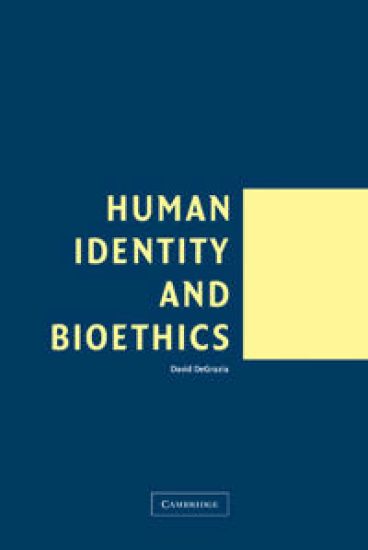
Human Identity and Bioethics

Human Identity and Bioethics

David DeGrazia

Cambridge University Press
2005
sidottu
When philosophers address personal identity, they usually explore numerical identity: what are the criteria for a person's continuing existence? When non-philosophers address personal identity, they often have in mind narrative identity: Which characteristics of a particular person are salient to her self-conception? This book develops accounts of both senses of identity, arguing that both are normatively important, and is unique in its exploration of a range of issues in bioethics through the lens of identity. Defending a biological view of our numerical identity and a framework for understanding narrative identity, DeGrazia investigates various issues for which considerations of identity prove critical: the definition of death; the authority of advance directives in cases of severe dementia; the use of enhancement technologies; prenatal genetic interventions; and certain types of reproductive choices. He demonstrates the power of personal identity theory to illuminate issues in bioethics as they bring philosophical theory to life.
Animal Rights

Animal Rights

David DeGrazia

Oxford University Press
2002
nidottu
Do animals have moral rights? If so, what does this mean? What sorts of mental lives do animals have, and how should we understand welfare? By presenting models for understanding animals' moral status and rights, and examining their mental lives and welfare, David DeGrazia explores the implications for how we should treat animals in connection with our diet, zoos, and research. Animal Rights distinguishes itself by combining intellectual rigour with accessibility, offering a distinct moral voice with a non-polemical tone. ABOUT THE SERIES: The Very Short Introductions series from Oxford University Press contains hundreds of titles in almost every subject area. These pocket-sized books are the perfect way to get ahead in a new subject quickly. Our expert authors combine facts, analysis, perspective, new ideas, and enthusiasm to make interesting and challenging topics highly readable.
Taking Animals Seriously

Taking Animals Seriously

David DeGrazia

Cambridge University Press
1996
sidottu
This book distinguishes itself from much of the polemical literature on these issues by offering the most judicious and well-balanced account yet available of animals’ moral standing, and related questions concerning their minds and welfare. Transcending jejune debates focused on utilitarianism versus rights, the book offers a fresh methodological approach with specific and constructive conclusions about our treatment of animals. David DeGrazia provides the most thorough discussion yet of whether equal consideration should be extended to animals’ interests, and examines the issues of animal minds and animal well-being with an unparalleled combination of philosophical rigor and empirical documentation. His book is an important contribution to the field of animal ethics and will be read with special interest by all philosophers teaching such courses, as well as biologists, those professionally involved with animals, and general readers concerned about animal welfare.
Taking Animals Seriously

Taking Animals Seriously

David DeGrazia

Cambridge University Press
1996
pokkari
This book distinguishes itself from much of the polemical literature on these issues by offering the most judicious and well-balanced account yet available of animals’ moral standing, and related questions concerning their minds and welfare. Transcending jejune debates focused on utilitarianism versus rights, the book offers a fresh methodological approach with specific and constructive conclusions about our treatment of animals. David DeGrazia provides the most thorough discussion yet of whether equal consideration should be extended to animals’ interests, and examines the issues of animal minds and animal well-being with an unparalleled combination of philosophical rigor and empirical documentation. His book is an important contribution to the field of animal ethics and will be read with special interest by all philosophers teaching such courses, as well as biologists, those professionally involved with animals, and general readers concerned about animal welfare.