Kirjailija
David E. Smith
Kirjat ja teokset yhdessä paikassa: 27 kirjaa, julkaisuja vuosilta 1975–2024, suosituimpiin kuuluu First, You Need Pajamas. Vertaile teosten hintoja ja tarkista saatavuus suomalaisista kirjakaupoista.
Nimi esiintyy myös muodoissa: David E Smith
27 kirjaa
Kirjojen julkaisuvuodet: 1975–2024.
Tervetuloa Pohjoismaiden suurimpaan verkkokirjakauppaan! Adlibris kannattaa sananvapautta, ja haluamme edistää kirjallisuuden ja tiedon saatavuutta.
Innovating the Design Process: A Theatre Design Journey
David E. Smith
TAYLOR FRANCIS LTD
2022
sidottu
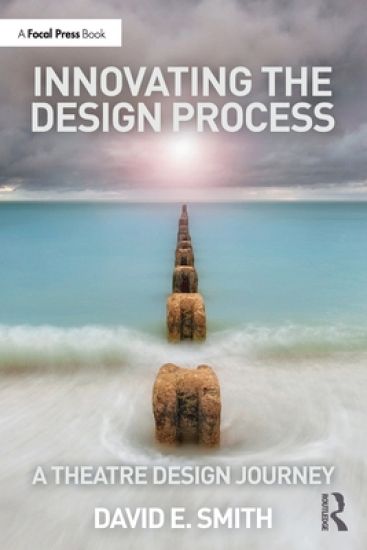
Innovating the Design Process: A Theatre Design Journey explores the process of designing for theatre and details how each part of a designer’s own process, no matter what their design specialization, can be innovated and adapted for a more confident journey and for better outcomes. The book observes and deconstructs the processes used by theatre designers, uncovers and explains the structure and concepts behind those processes and shows how they can be easily reassembled for better results and to meet different situations. It uses innovative real-world practical examples from all the fields of theatre design taken from shows throughout the author’s career. The processes covered in this book are split into two sections – design development and design implementation – with an additional chapter covering design presentations. Written in an engaging and informative style, this text opens up a designer’s ability to innovate within the design process to optimize reproducibility, resilience, personal fit, confidence, collaboration and audience engagement. Innovating the Design Process is a next level book for both MFA theatre design students and early career professionals who wish to develop their craft further. Seasoned professionals will also find within its pages concepts to reinvigorate their own design process. The book includes access to an online guide to using Microsoft Word for Mac to mirror content in two separate documents.
Innovating the Design Process: A Theatre Design Journey
David E. Smith
TAYLOR FRANCIS LTD
2022
nidottu
Innovating the Design Process: A Theatre Design Journey explores the process of designing for theatre and details how each part of a designer’s own process, no matter what their design specialization, can be innovated and adapted for a more confident journey and for better outcomes. The book observes and deconstructs the processes used by theatre designers, uncovers and explains the structure and concepts behind those processes and shows how they can be easily reassembled for better results and to meet different situations. It uses innovative real-world practical examples from all the fields of theatre design taken from shows throughout the author’s career. The processes covered in this book are split into two sections – design development and design implementation – with an additional chapter covering design presentations. Written in an engaging and informative style, this text opens up a designer’s ability to innovate within the design process to optimize reproducibility, resilience, personal fit, confidence, collaboration and audience engagement. Innovating the Design Process is a next level book for both MFA theatre design students and early career professionals who wish to develop their craft further. Seasoned professionals will also find within its pages concepts to reinvigorate their own design process. The book includes access to an online guide to using Microsoft Word for Mac to mirror content in two separate documents.
Canada's Deep Crown
David E. Smith; Christopher McCreery; Jonathan Shanks

University of Toronto Press
2021
pokkari
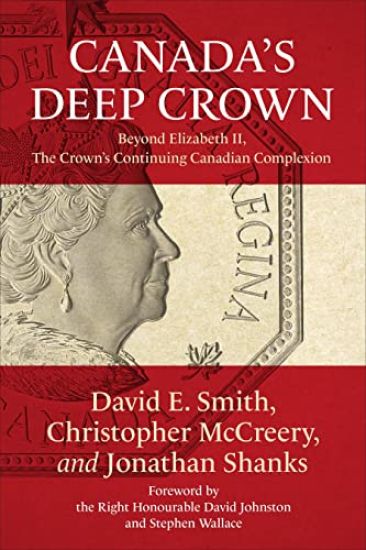
The Crown in Canada has had a profound influence in shaping a country and a constitution that embraces the promotion of political moderation, societal accommodation, adaptable constitutional structures, and pluralistic governing practices. While none of these features themselves originated through legislative or constitutional action, David E. Smith, Christopher McCreery, and Jonathan Shanks propose that all reflect the presence and actions of the Crown. Examining how a constitutional monarchy functions, Canada’s Deep Crown discusses how the legal and institutional abstractions of the Crown vary depending on the circumstances and the context in which it is found. The Crown presents differently depending on who is observing it, who is representing it, and what role it is performing. With a focus on the changes that have taken place over the last fifty years, this book addresses the role of the Crown in dispersing power throughout Canada’s system of government, the function the sovereign, governor general, and lieutenant governors play, and how the demise of the Crown and transition to a new sovereign is likely to unfold.
The Hotel: Occupied Space explores the hotel as both symbol and space through the concept of "occupancy." By examining the various ways in which the hotel is manifested in art, photography, and film, this book offers a timely critique of a crucial modern space. As a site of occupancy, the hotel has provided continued creative inspiration for artists from Monet and Hopper, to genre filmmakers like Hitchcock and Sofia Coppola. While the rich symbolic importance of the hotel means that the visual arts and cinema are especially fruitful, the hotel’s varied structural purposes, as well as its historical and political uses, also provide ample ground for new and timely discussion. In addition to inspiring painters, photographers, and filmmakers, the hotel has played an important role during wartime, and more recently as a site of accommodation for displaced people, whether they be detainees or refugees seeking sanctuary. Shedding light on the diverse ways that the hotel functions as a structure, Robert A. Davidson argues that the hotel is both a fundamental modern space and a constantly adaptable structure, dependent on the circumstances in which it appears and plays a part.
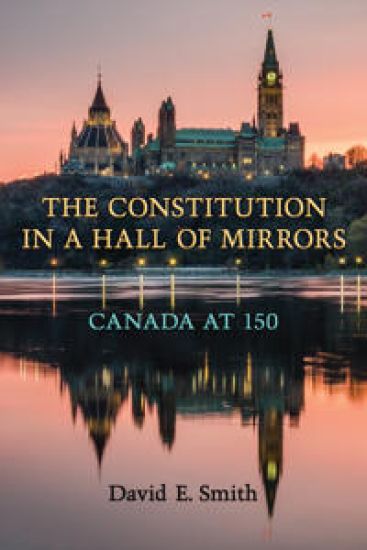
Whether it’s the first-past-the-post electoral system or partisan government appointees to the Senate, Canadians want better representation and accountability from the federal government. Before reforms can be enacted, however, it is important to explore and clarify the relationships among Canada’s three parliamentary institutions: Crown, Senate, and Commons. In The Constitution in a Hall of Mirrors, David E. Smith presents a learned but accessible analysis of the interconnectedness of Canada’s parliamentary institutions. Smith argues that Parliament is a unity comprised of three parts and any reforms made to one branch will, whether intended or not, affect the other branches. Through a timely, nuanced, and comprehensive examination of parliamentary debates, committee reports, legal scholarship, and comparative analysis of developments in the United Kingdom, Smith uncovers the substantial degree of ambiguity that exists among Canadians and their calls for structural and operational reforms. By illuminating the symbiotic relationship between the Crown, Senate, and Commons, The Constitution in a Hall of Mirrors brings government reform closer to reality.
The Canadian Senate in Bicameral Perspective
David E. Smith
University of Toronto Press
2017
pokkari
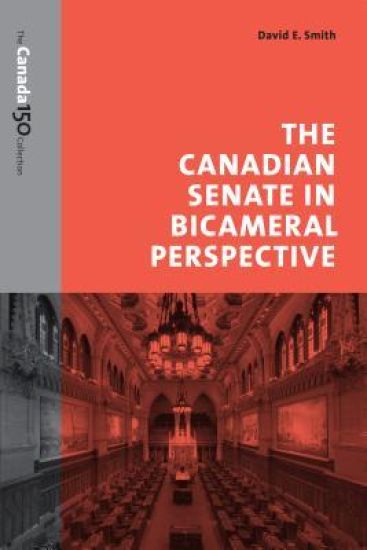
The Canadian Senate in Bicameral Perspective is the first scholarly study of the Senate in over a quarter century and the first analysis of the upper house as one chamber of a bicameral legislature. David E. Smith's aim in this work is to demonstrate the interrelationship of the two chambers and the constraints this relationship poses for Senate reform. He analyses past literature on the Senate and current proposals for reform - such as a Triple-E Senate - and compares Canada's upper chamber with those of Australia, the United States, Germany, and the United Kingdom, noting a revival of interest in Canada and abroad in upper chambers and bicameralism. Drawing on parliamentary debates and committee reports, as well as a range of broad secondary sources, The Canadian Senate in Bicameral Perspective examine the Canadian Senate within the international context, shedding light on its role as a political institution and arguing for a renewed investigation into its future.
True Sports Stories For A Wanna-Be Athlete: Stories For Devotion and Discussion in Your Faith
David E. Smith
Createspace Independent Publishing Platform
2015
nidottu
Always the smallest and usually a last choice David Smith is not what you'd think of as an athlete. Yet, at different points in life David surprised others and sometimes himself through athletic endeavors. David has gathered these sports achievements into a book for inspiration and motivation, complete with an accompanying scripture, a self-examination question, and discussion questions. The book is designed to be used for study, devotion, or worship in an individual or group setting. It has something which will apply to almost any age, either gender and can come in handy for a men's group, a youth group, tweeners, or even children. If you have a situation where you need a quick devotional this book can be used. If you need something to start discussions at youth camp here's a good starter Within the book the author hopes to point out how God can use our abilities even when we think we have no abilities to offer or when others pre-judge us by our outside appearance and stature. God wants each of us to know we have worth and are truly precious as individuals, with God-given yet possibly undiscovered abilities just waiting to be released in sports and all kinds of areas in our lives. Get True Sports Stories for a Wanna-Be Athlete for yourself or someone who is struggling and needs encouragement.
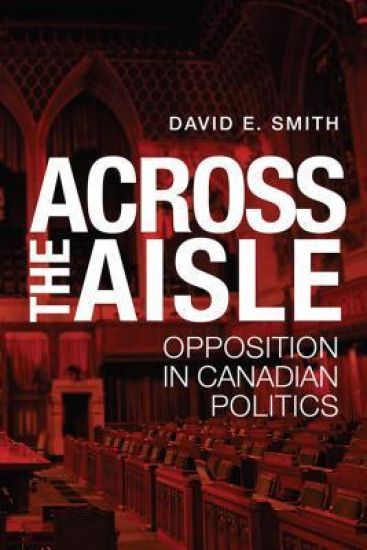
How do parties with official opposition status influence Canadian politics? Across the Aisle is an innovative examination of the theory and practice of opposition in Canada, both in Parliament and in provincial legislatures. Extending from the pre-Confederation era to the present day, it focuses on whether Canada has developed a coherent tradition of parliamentary opposition. David E. Smith argues that Canada has in fact failed to develop such a tradition. He investigates several possible reasons for this failure, including the long dominance of the Liberal party, which arrested the tradition of viewing the opposition as an alternative government; periods of minority government induced by the proliferation of parties; the role of the news media, which have largely displaced Parliament as a forum for commentary on government policy; and, finally, the increasing popularity of calls for direct action in politics. Readers of Across the Aisle will gain a renewed understanding of official opposition that goes beyond Stornoway and shadow cabinets, illuminating both the historical evolution and recent developments of opposition politics in Canada.
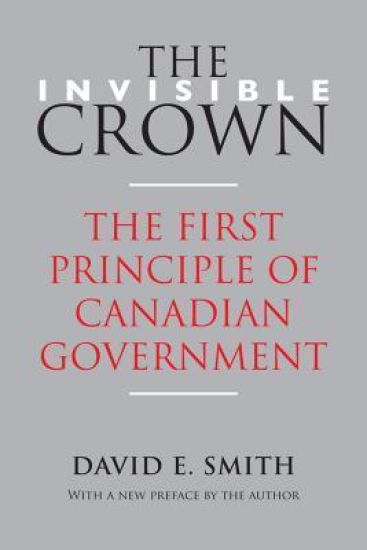
The Crown is not only Canada’s oldest continuing political institution, but also its most pervasive, affecting the operation of Parliament and the legislatures, the executive, the bureaucracy, the courts, and federalism. However, many consider the Crown to be obscure and anachronistic. David E. Smith’s The Invisible Crown was one of the first books to study the role of the Crown in Canada, and remains a significant resource for the unique perspective it offers on the Crown’s place in politics. The Invisible Crown traces Canada’s distinctive form of federalism, with highly autonomous provinces, to the Crown’s influence. Smith concludes that the Crown has greatly affected the development of Canadian politics due to the country’s societal, geographic, and economic conditions. Praised by the Globe and Mail’s Michael Valpy as “a thoroughly lucid, scholarly explanation of how the Canadian constitutional monarchy works,” it is bolstered by a new foreword by the author speaking to recent events involving the Crown and Canadian politics, notably the prorogation of Parliament in 2008.
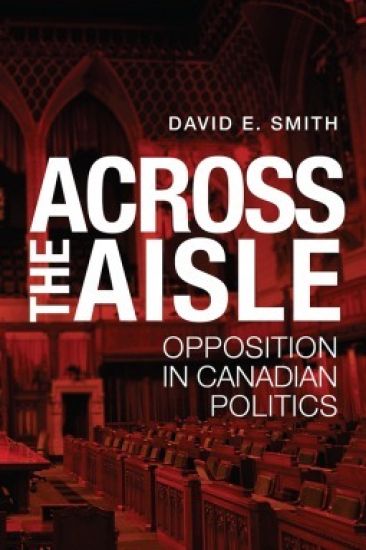
How do parties with official opposition status influence Canadian politics? Across the Aisle is an innovative examination of the theory and practice of opposition in Canada, both in Parliament and in provincial legislatures. Extending from the pre-Confederation era to the present day, it focuses on whether Canada has developed a coherent tradition of parliamentary opposition. David E. Smith argues that Canada has in fact failed to develop such a tradition. He investigates several possible reasons for this failure, including the long dominance of the Liberal party, which arrested the tradition of viewing the opposition as an alternative government; periods of minority government induced by the proliferation of parties; the role of the news media, which have largely displaced Parliament as a forum for commentary on government policy; and, finally, the increasing popularity of calls for direct action in politics. Readers of Across the Aisle will gain a renewed understanding of official opposition that goes beyond Stornoway and shadow cabinets, illuminating both the historical evolution and recent developments of opposition politics in Canada.
The Canadian system of federalism divides the power to govern between the central federal parliament and the provincial and territorial legislative assemblies. In what can be seen as a double federation, power is also divided culturally, between English and French Canada. The divisions of power and responsibility, however, have not remained static since 1867. The federal language regime (1969), for example, reconfigured cultural federalism, generating constitutional tension as governments sought to make institutions more representative of the country's diversity. In Federalism and the Constitution of Canada, award-winning author David E. Smith examines a series of royal commission and task force inquiries, a succession of federal-provincial conferences, and the competing and controversial terms of the Constitution Act of 1982 in order to evaluate both the popular and governmental understanding of federalism. In the process, Smith uncovers the reasons constitutional agreement has historically proved difficult to reach and argues that Canadian federalism 'in practice' has been more successful at accommodating foundational change than may be immediately apparent.
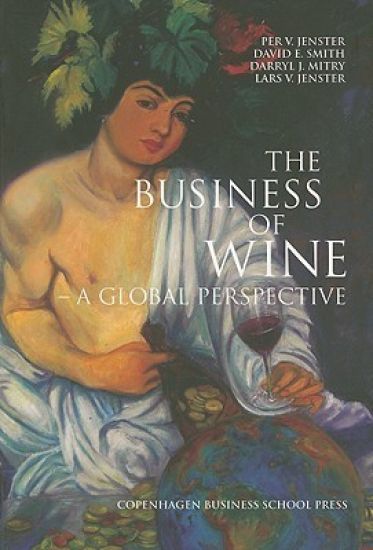
Business of Wine
Per V Jenster; Lars V Jenster; David E Smith; Darryl J Mitry
Copenhagen Business School Press
2008
nidottu
This book is aimed at anyone with an interest in broadening his or her view of wine to encompass some of the fascinating complexities of the business side of this international industry.
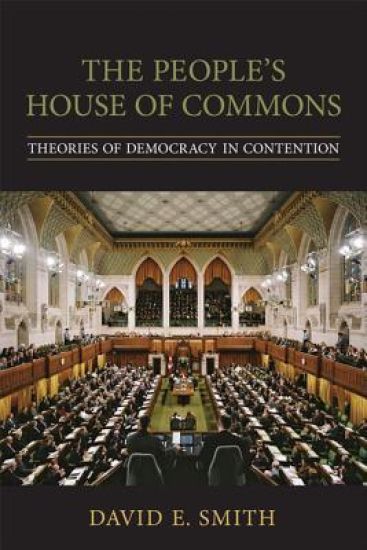
Canada's House of Commons has come under considerable attack in recent years. Many critics have contended that the House has been unresponsive to public opinion, and that its party leaders have too much control, while leaving individual MPs essentially powerless. The House has also faced challenges by the courts since the introduction of the Charter, a powerful bureaucracy equipped with specialized knowledge, and new telecommunications systems that are redefining the transfer of information. Through an examination of academic, judicial, political, and legal commentary, The People's House of Commons explores the role of the House as a public institution. While addressing much of the criticism that has been levelled at the House, David E. Smith considers the competing political models and inherent tensions and their affect on public understanding. Smith maintains that court decisions are transforming the political system from one dominated by parties to one that promotes individual participation. He argues that reforms such as fixed election dates or stronger parliamentary committees have constitutional significance since their implementation would alter the practice of responsible government, which for more than a century has been a party government. A definitive work by one of Canada's foremost experts in the field of political science, The People's House of Commons explores the ramifications of many of the changes currently being proposed to Canada's political system, with particular reference to their affect on prerogative power, parliamentary privilege, party discipline, bicameralism, and the role of the opposition.
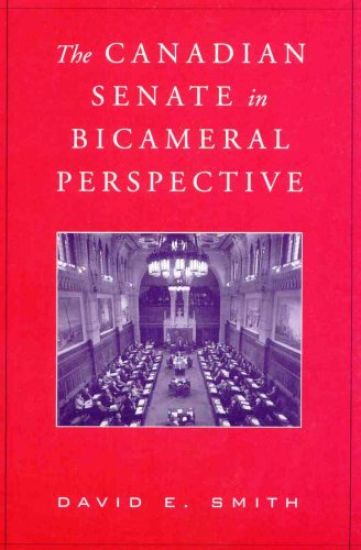
The Canadian Senate in Bicameral Perspective
David E. Smith
University of Toronto Press
2006
pokkari
The Canadian Senate in Bicameral Perspective is the first scholarly study of the Senate in over a quarter century and the first analysis of the upper house as one chamber of a bicameral legislature. David E. Smith's aim in this work is to demonstrate the interrelationship of the two chambers and the constraints this relationship poses for Senate reform. He analyses past literature on the Senate and current proposals for reform - such as a Triple-E Senate - and compares Canada's upper chamber with those of Australia, the United States, Germany, and the United Kingdom, noting a revival of interest in Canada and abroad in upper chambers and bicameralism. Drawing on parliamentary debates and committee reports, as well as a range of broad secondary sources, The Canadian Senate in Bicameral Perspective examine the Canadian Senate within the international context, shedding light on its role as a political institution and arguing for a renewed investigation into its future.
Managing Business Marketing & Sales
Per V Jenster; Michael Hayes.; David E Smith

Copenhagen Business School Press
2005
nidottu
This book offers valuable perspectives on the current state of marketing concepts and techniques, plus managerial perspectives which also can provide guidance for the business success.