Kirjojen hintavertailu – 12 859 818 kirjaa ja 27 kauppaa

Kirjailija

David Eisenbud

Kirjat ja teokset yhdessä paikassa: 12 kirjaa, julkaisuja vuosilta 1986–2025, suosituimpiin kuuluu Commutative Algebra. Vertaile teosten hintoja ja tarkista saatavuus suomalaisista kirjakaupoista.

12 kirjaa

Kirjojen julkaisuvuodet: 1986–2025.

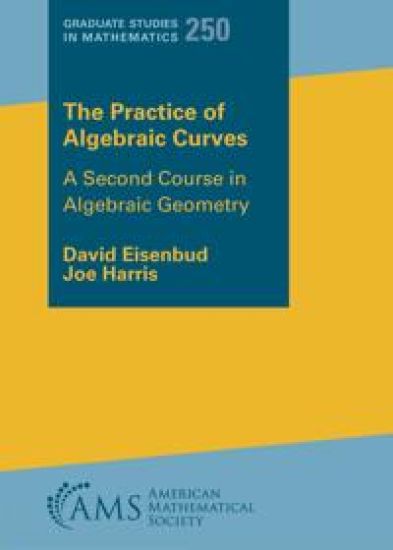
The Practice of Algebraic Curves

The Practice of Algebraic Curves

David Eisenbud; Joe Harris

AMERICAN MATHEMATICAL SOCIETY
2025
nidottu
This textbook provides readers with a working knowledge of the modern theory of complex projective algebraic curves. Also known as compact Riemann surfaces, such curves shaped the development of algebraic geometry itself, making this theory essential background for anyone working in or using this discipline. Examples underpin the presentation throughout, illustrating techniques that range across classical geometric theory, modern commutative algebra, and moduli theory. The book begins with two chapters covering basic ideas, including maps to projective space, invertible sheaves, and the Riemann-Roch theorem. Subsequent chapters alternate between a detailed study of curves up to genus six and more advanced topics such as Jacobians, Hilbert schemes, moduli spaces of curves, Severi varieties, dualizing sheaves, and linkage of curves in 3-space. Three chapters treat the refinements of the Brill-Noether theorem, including applications and a complete proof of the basic result. Two chapters on free resolutions, rational normal scrolls, and canonical curves build context for Green's conjecture. The book culminates in a study of Hilbert schemes of curves through examples. A historical appendix by Jeremy Gray captures the early development of the theory of algebraic curves. Exercises, illustrations, and open problems accompany the text throughout. The Practice of Algebraic Curves offers a masterclass in theory that has become essential in areas ranging from algebraic geometry itself to mathematical physics and other applications. Suitable for students and researchers alike, the text bridges the gap from a first course in algebraic geometry to advanced literature and active research.
The Practice of Algebraic Curves

The Practice of Algebraic Curves

David Eisenbud; Joe Harris

AMERICAN MATHEMATICAL SOCIETY
2025
sidottu
This textbook provides readers with a working knowledge of the modern theory of complex projective algebraic curves. Also known as compact Riemann surfaces, such curves shaped the development of algebraic geometry itself, making this theory essential background for anyone working in or using this discipline. Examples underpin the presentation throughout, illustrating techniques that range across classical geometric theory, modern commutative algebra, and moduli theory. The book begins with two chapters covering basic ideas, including maps to projective space, invertible sheaves, and the Riemann-Roch theorem. Subsequent chapters alternate between a detailed study of curves up to genus six and more advanced topics such as Jacobians, Hilbert schemes, moduli spaces of curves, Severi varieties, dualizing sheaves, and linkage of curves in 3-space. Three chapters treat the refinements of the Brill-Noether theorem, including applications and a complete proof of the basic result. Two chapters on free resolutions, rational normal scrolls, and canonical curves build context for Green's conjecture. The book culminates in a study of Hilbert schemes of curves through examples. A historical appendix by Jeremy Gray captures the early development of the theory of algebraic curves. Exercises, illustrations, and open problems accompany the text throughout. The Practice of Algebraic Curves offers a masterclass in theory that has become essential in areas ranging from algebraic geometry itself to mathematical physics and other applications. Suitable for students and researchers alike, the text bridges the gap from a first course in algebraic geometry to advanced literature and active research.
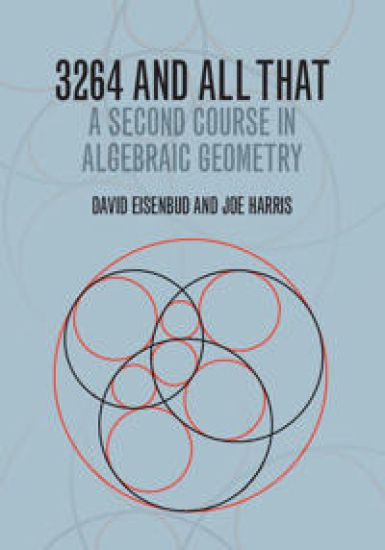
3264 and All That

3264 and All That

David Eisenbud; Joe Harris

Cambridge University Press
2016
sidottu

Halvin toimitettuna 120,80 €

This book can form the basis of a second course in algebraic geometry. As motivation, it takes concrete questions from enumerative geometry and intersection theory, and provides intuition and technique, so that the student develops the ability to solve geometric problems. The authors explain key ideas, including rational equivalence, Chow rings, Schubert calculus and Chern classes, and readers will appreciate the abundant examples, many provided as exercises with solutions available online. Intersection is concerned with the enumeration of solutions of systems of polynomial equations in several variables. It has been an active area of mathematics since the work of Leibniz. Chasles' nineteenth-century calculation that there are 3264 smooth conic plane curves tangent to five given general conics was an important landmark, and was the inspiration behind the title of this book. Such computations were motivation for Poincaré's development of topology, and for many subsequent theories, so that intersection theory is now a central topic of modern mathematics.
3264 and All That

3264 and All That

David Eisenbud; Joe Harris

Cambridge University Press
2016
pokkari

Halvin toimitettuna 59,20 €

This book can form the basis of a second course in algebraic geometry. As motivation, it takes concrete questions from enumerative geometry and intersection theory, and provides intuition and technique, so that the student develops the ability to solve geometric problems. The authors explain key ideas, including rational equivalence, Chow rings, Schubert calculus and Chern classes, and readers will appreciate the abundant examples, many provided as exercises with solutions available online. Intersection is concerned with the enumeration of solutions of systems of polynomial equations in several variables. It has been an active area of mathematics since the work of Leibniz. Chasles' nineteenth-century calculation that there are 3264 smooth conic plane curves tangent to five given general conics was an important landmark, and was the inspiration behind the title of this book. Such computations were motivation for Poincaré's development of topology, and for many subsequent theories, so that intersection theory is now a central topic of modern mathematics.
Minimal Free Resolutions over Complete Intersections

Minimal Free Resolutions over Complete Intersections

David Eisenbud; Irena Peeva

Springer International Publishing AG
2016
nidottu
This book introduces a theory of higher matrix factorizations for regular sequences and uses it to describe the minimal free resolutions of high syzygy modules over complete intersections. Such resolutions have attracted attention ever since the elegant construction of the minimal free resolution of the residue field by Tate in 1957. The theory extends the theory of matrix factorizations of a non-zero divisor, initiated by Eisenbud in 1980, which yields a description of the eventual structure of minimal free resolutions over a hypersurface ring. Matrix factorizations have had many other uses in a wide range of mathematical fields, from singularity theory to mathematical physics.
The Geometry of Syzygies

The Geometry of Syzygies

David Eisenbud

Springer-Verlag New York Inc.
2005
nidottu
Algebraic Geometry often seems very abstract, but in fact it is full of concrete examples and problems. This side of the subject can be approached through the equations of a variety, and the syzygies of these equations are a necessary part of the study. This book is the first textbook-level account of basic examples and techniques in this area. It illustrates the use of syzygies in many concrete geometric considerations, from interpolation to the study of canonical curves. The text has served as a basis for graduate courses by the author at Berkeley, Brandeis, and in Paris. It is also suitable for self-study by a reader who knows a little commutative algebra and algebraic geometry already. As an aid to the reader, the appendices provide summaries of local cohomology and commutative algebra, tying together examples and major results from a wide range of topics.
The Geometry of Syzygies

The Geometry of Syzygies

David Eisenbud

Springer-Verlag New York Inc.
2004
sidottu
Algebraic Geometry often seems very abstract, but in fact it is full of concrete examples and problems. This side of the subject can be approached through the equations of a variety, and the syzygies of these equations are a necessary part of the study. This book is the first textbook-level account of basic examples and techniques in this area. It illustrates the use of syzygies in many concrete geometric considerations, from interpolation to the study of canonical curves. The text has served as a basis for graduate courses by the author at Berkeley, Brandeis, and in Paris. It is also suitable for self-study by a reader who knows a little commutative algebra and algebraic geometry already. As an aid to the reader, the appendices provide summaries of local cohomology and commutative algebra, tying together examples and major results from a wide range of topics.
The Geometry of Schemes

The Geometry of Schemes

David Eisenbud; Joe Harris

Springer-Verlag New York Inc.
2000
nidottu
Grothendieck's beautiful theory of schemes permeates modern algebraic geometry and underlies its applications to number theory, physics, and applied mathematics. This simple account of that theory emphasizes and explains the universal geometric concepts behind the definitions. In the book, concepts are illustrated with fundamental examples, and explicit calculations show how the constructions of scheme theory are carried out in practice.
The Geometry of Schemes

The Geometry of Schemes

David Eisenbud; Joe Harris

Springer-Verlag New York Inc.
2000
sidottu
Grothendieck's beautiful theory of schemes permeates modern algebraic geometry and underlies its applications to number theory, physics, and applied mathematics. This simple account of that theory emphasizes and explains the universal geometric concepts behind the definitions. In the book, concepts are illustrated with fundamental examples, and explicit calculations show how the constructions of scheme theory are carried out in practice.
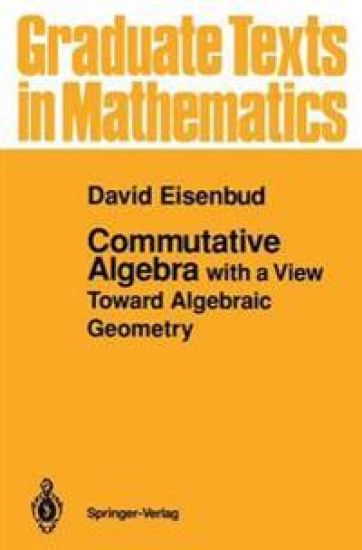
Commutative Algebra

Commutative Algebra

David Eisenbud

Springer-Verlag New York Inc.
1995
sidottu
Commutative Algebra is best understood with knowledge of the geometric ideas that have played a great role in its formation, in short, with a view towards algebraic geometry. The author presents a comprehensive view of commutative algebra, from basics, such as localization and primary decomposition, through dimension theory, differentials, homological methods, free resolutions and duality, emphasizing the origins of the ideas and their connections with other parts of mathematics. Many exercises illustrate and sharpen the theory and extended exercises give the reader an active part in complementing the material presented in the text. One novel feature is a chapter devoted to a quick but thorough treatment of Grobner basis theory and the constructive methods in commutative algebra and algebraic geometry that flow from it. Applications of the theory and even suggestions for computer algebra projects are included. This book will appeal to readers from beginners to advanced students of commutative algebra or algebraic geometry. To help beginners, the essential ideals from algebraic geometry are treated from scratch. Appendices on homological algebra, multilinear algebra and several other useful topics help to make the book relatively self- contained. Novel results and presentations are scattered throughout the text.
Commutative Algebra

Commutative Algebra

David Eisenbud

Springer-Verlag New York Inc.
1995
nidottu
Commutative Algebra is best understood with knowledge of the geometric ideas that have played a great role in its formation, in short, with a view towards algebraic geometry. The author presents a comprehensive view of commutative algebra, from basics, such as localization and primary decomposition, through dimension theory, differentials, homological methods, free resolutions and duality, emphasizing the origins of the ideas and their connections with other parts of mathematics. Many exercises illustrate and sharpen the theory and extended exercises give the reader an active part in complementing the material presented in the text. One novel feature is a chapter devoted to a quick but thorough treatment of Grobner basis theory and the constructive methods in commutative algebra and algebraic geometry that flow from it. Applications of the theory and even suggestions for computer algebra projects are included. This book will appeal to readers from beginners to advanced students of commutative algebra or algebraic geometry. To help beginners, the essential ideals from algebraic geometry are treated from scratch. Appendices on homological algebra, multilinear algebra and several other useful topics help to make the book relatively self- contained. Novel results and presentations are scattered throughout the text.
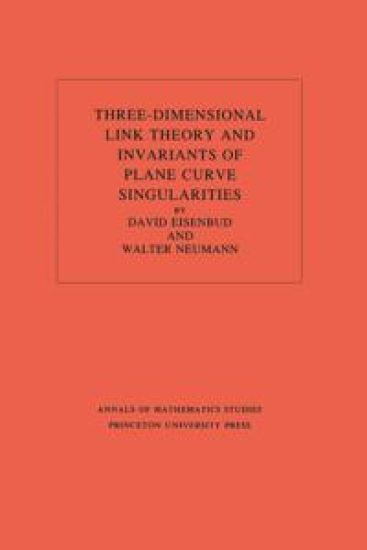
Three-Dimensional Link Theory and Invariants of Plane Curve Singularities

Three-Dimensional Link Theory and Invariants of Plane Curve Singularities

David Eisenbud; Walter D. Neumann

Princeton University Press
1986
pokkari
This book gives a new foundation for the theory of links in 3-space modeled on the modern developmentby Jaco, Shalen, Johannson, Thurston et al. of the theory of 3-manifolds. The basic construction is a method of obtaining any link by "splicing" links of the simplest kinds, namely those whose exteriors are Seifert fibered or hyperbolic. This approach to link theory is particularly attractive since most invariants of links are additive under splicing. Specially distinguished from this viewpoint is the class of links, none of whose splice components is hyperbolic. It includes all links constructed by cabling and connected sums, in particular all links of singularities of complex plane curves. One of the main contributions of this monograph is the calculation of invariants of these classes of links, such as the Alexander polynomials, monodromy, and Seifert forms.