
Kirjojen hintavertailu – 12 859 819 kirjaa ja 27 kauppaa

Kirjailija

David Eltis

Kirjat ja teokset yhdessä paikassa: 5 kirjaa, julkaisuja vuosilta 1987–2025, suosituimpiin kuuluu Economic Growth and the Ending of the Transatlantic Slave Trade. Vertaile teosten hintoja ja tarkista saatavuus suomalaisista kirjakaupoista.

5 kirjaa

Kirjojen julkaisuvuodet: 1987–2025.

Atlantic Cataclysm

Atlantic Cataclysm

David Eltis

Cambridge University Press
2025
sidottu

Halvin toimitettuna 36,20 €

In this comprehensive work, David Eltis offers a two-thousand-year perspective on the trafficking of people, and boldly intervenes in the expansive discussions about slavery in the last half-century. Using new and underexplored data made available by slavevoyages.org, Eltis offers compelling explanations of why the slave trades began and why they ended, and in the process debunks long-held assumptions, including how bilateral rather than triangular voyages were the norm, and how the Portuguese rather than the British were the leading slave traders. Eltis argues that two-thirds of all enslaved people ended up in the Iberian Americas, where exports were most valuable throughout the slave trade era, and not in the Caribbean or the US. Tracing the mass involvement of people in the slave trade business from all parts of the Atlantic World, Eltis also examines the agency of Africans and their experiences in the aftermath of liberation.
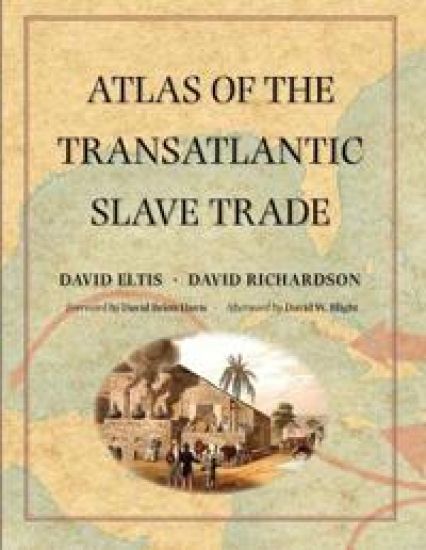
Atlas of the Transatlantic Slave Trade

Atlas of the Transatlantic Slave Trade

David Eltis; David Richardson; David W. Blight; David Brion Davis

Yale University Press
2015
pokkari
A extraordinary work, decades in the making: the first atlas to illustrate the entire scope of the transatlantic slave trade Winner of the Association of American Publishers' 2010 R. R. Hawkins Award and PROSE Award “A monumental chronicle of this historical tragedy.”—Dwight Garner, New York Times Between 1501 and 1867, the transatlantic slave trade claimed an estimated 12.5 million Africans and involved almost every country with an Atlantic coastline. In this extraordinary book, two leading historians have created the first comprehensive, up-to-date atlas on this 350-year history of kidnapping and coercion. It features nearly 200 maps, especially created for the volume, that explore every detail of the African slave traffic to the New World. The atlas is based on an online database (www.slavevoyages.org) with records on nearly 35,000 slaving voyages—roughly 80 percent of all such voyages ever made. Using maps, David Eltis and David Richardson show which nations participated in the slave trade, where the ships involved were outfitted, where the captives boarded ship, and where they were landed in the Americas, as well as the experience of the transatlantic voyage and the geographic dimensions of the eventual abolition of the traffic. Accompanying the maps are illustrations and contemporary literary selections, including poems, letters, and diary entries, intended to enhance readers’ understanding of the human story underlying the trade from its inception to its end. This groundbreaking work provides the fullest possible picture of the extent and inhumanity of one of the largest forced migrations in history.
The Rise of African Slavery in the Americas

The Rise of African Slavery in the Americas

David Eltis

Cambridge University Press
1999
pokkari
Why were the countries with the most developed institutions of individual freedom also the leaders in establishing the most exploitative system of slavery that the world has ever seen? In seeking to provide new answers to this question, The Rise of African Slavery in the Americas examines the development of the English Atlantic slave system between 1650 and 1800. The book outlines a major African role in the evolution of the Atlantic societies before the nineteenth century and argues that the transatlantic slave trade was a result of African strength rather than African weakness. It also addresses changing patterns of group identity to account for the racial basis of slavery in the early modern Atlantic World. Exploring the paradox of the concurrent development of slavery and freedom in the European domains, David Eltis provides a fresh interpretation of this difficult historical problem.
The Rise of African Slavery in the Americas

The Rise of African Slavery in the Americas

David Eltis

Cambridge University Press
1999
sidottu
Why were the countries with the most developed institutions of individual freedom also the leaders in establishing the most exploitative system of slavery that the world has ever seen? In seeking to provide new answers to this question, The Rise of African Slavery in the Americas examines the development of the English Atlantic slave system between 1650 and 1800. The book outlines a major African role in the evolution of the Atlantic societies before the nineteenth century and argues that the transatlantic slave trade was a result of African strength rather than African weakness. It also addresses changing patterns of group identity to account for the racial basis of slavery in the early modern Atlantic World. Exploring the paradox of the concurrent development of slavery and freedom in the European domains, David Eltis provides a fresh interpretation of this difficult historical problem.
Economic Growth and the Ending of the Transatlantic Slave Trade
This study is the first to consider the consequences of Britain's abolition of the Atlantic slave trade for British imperial expansion and the world economy. It argues that the British led the way in ending that trade just when it was beginning to be important for the world economy, when there was a great need for labour around the world, and shows that Britain's control of the slave trade and great reliance on slave labour had played a major role in its empire's rise to world economic dominance. Contesting the view that Britain stood to benefit from the abolition of the slave trade, the author shows that British economic expansion was hindered greatly as a result.