Kirjojen hintavertailu – 12 903 725 kirjaa ja 27 kauppaa

Kirjailija

David Farrugia

Kirjat ja teokset yhdessä paikassa: 8 kirjaa, julkaisuja vuosilta 2015–2026, suosituimpiin kuuluu Vibes as Value. Vertaile teosten hintoja ja tarkista saatavuus suomalaisista kirjakaupoista.

8 kirjaa

Kirjojen julkaisuvuodet: 2015–2026.

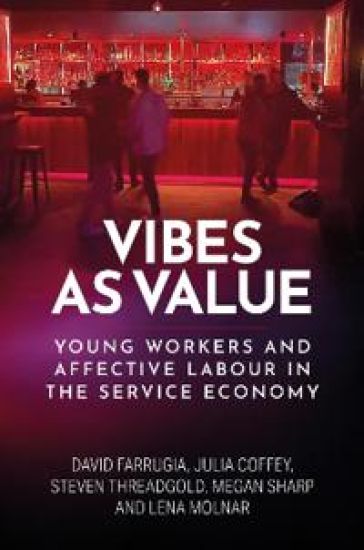
Vibes as Value

Vibes as Value

David Farrugia; Julia Coffey; Steven Threadgold; Megan Sharp; Lena Molnar

MANCHESTER UNIVERSITY PRESS
2026
sidottu
Vibes as value explores the relationship between subjectivity, labour and value in the hospitality industry, and thereby how youth, gender, sexuality, race and social class are embodied and made productive in the service economy. It shows that the key product of hospitality labour is ‘vibes’, or moments of enjoyment and relationality co-produced through exploitative relationships amongst workers and consumers. In the process, the book theorises hospitality as a form of affective labour organised through the normative and structural relations of precarious service work. It shows how identity construction produces value within the highly unequal social terrain of the service economy, and how hospitality labour enacts hierarchies of value extending far beyond the limits of the industry itself.

Neuro-Symbolic AI

Neuro-Symbolic AI

Alexiei Dingli; David Farrugia

PACKT PUBLISHING LIMITED
2023
nidottu
Explore the inner workings of AI along with its limitations and future developments and create your first transparent and trustworthy neuro-symbolic AI system Purchase of the print or Kindle book includes a free PDF eBook Key Features Understand symbolic and statistical techniques through examples and detailed explanations Explore the potential of neuro-symbolic AI for future developments using case studies Discover the benefits of combining symbolic AI with modern neural networks to build transparent and high-performance AI solutions Book DescriptionNeuro-symbolic AI offers the potential to create intelligent systems that possess both the reasoning capabilities of symbolic AI along with the learning capabilities of neural networks. This book provides an overview of AI and its inner mechanics, covering both symbolic and neural network approaches. You’ll begin by exploring the decline of symbolic AI and the recent neural network revolution, as well as their limitations. The book then delves into the importance of building trustworthy and transparent AI solutions using explainable AI techniques. As you advance, you’ll explore the emerging field of neuro-symbolic AI, which combines symbolic AI and modern neural networks to improve performance and transparency. You’ll also learn how to get started with neuro-symbolic AI using Python with the help of practical examples. In addition, the book covers the most promising technologies in the field, providing insights into the future of AI. Upon completing this book, you will acquire a profound comprehension of neuro-symbolic AI and its practical implications. Additionally, you will cultivate the essential abilities to conceptualize, design, and execute neuro-symbolic AI solutions. What you will learn Gain an understanding of the intuition behind neuro-symbolic AI Determine the correct uses that can benefit from neuro-symbolic AI Differentiate between types of explainable AI techniques Think about, design, and implement neuro-symbolic AI solutions Create and fine-tune your first neuro-symbolic AI system Explore the advantages of fusing symbolic AI with modern neural networks in neuro-symbolic AI systems Who this book is forThis book is ideal for data scientists, machine learning engineers, and AI enthusiasts who want to explore the emerging field of neuro-symbolic AI and discover how to build transparent and trustworthy AI solutions. A basic understanding of AI concepts and familiarity with Python programming are needed to make the most of this book.
Youth, Work and the Post-Fordist Self

Youth, Work and the Post-Fordist Self

David Farrugia

Bristol University Press
2022
nidottu
In the past, youth has been seen as a transition into the labour market, but today young people’s identities are increasingly wrapped up in their value as workers. In this book, young people describe the meaning of work in their own words. Drawing on these narratives, the author reveals how their identities are intertwined with the dynamics of labour and value in post-Fordist capitalism and how social inequalities are manifested through the practices and ethics that young people draw upon to cultivate an economically productive self. Illuminating the rapidly changing social conditions that mould youth identities, this book represents a paradigm shift in our understanding of youth and work.
Youth, Work and the Post-Fordist Self

Youth, Work and the Post-Fordist Self

David Farrugia

Bristol University Press
2021
sidottu
In the past, youth has been seen as a transition into the labour market, but today young people’s identities are increasingly wrapped up in their value as workers. In this book, young people describe the meaning of work in their own words. Drawing on these narratives, the author reveals how their identities are intertwined with the dynamics of labour and value in post-Fordist capitalism and how social inequalities are manifested through the practices and ethics that young people draw upon to cultivate an economically productive self. Illuminating the rapidly changing social conditions that mould youth identities, this book represents a paradigm shift in our understanding of youth and work.
Spaces of Youth

Spaces of Youth

David Farrugia

Routledge
2019
nidottu
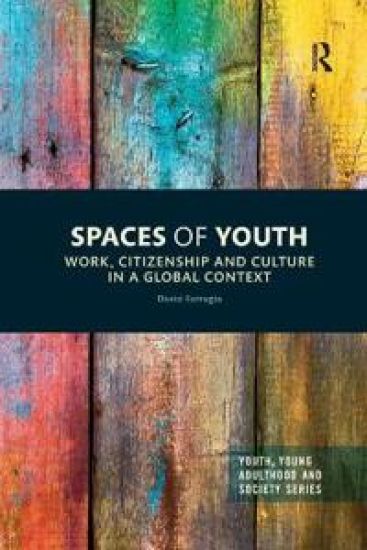
Contemporary young people are situated within a complex and disorienting set of social changes that are reshaping how youth is constructed, governed and experienced across the globe. Historically, it has been taken for granted that youth primarily concerns time, especially with regards to personal and social development. In Spaces of Youth, Farrugia shows that the concept of developmental time has become a regulatory framework that is used to govern aspects of globalisation, including the formation of labour forces and the boundaries of liberal citizenship regimes. Interrogating this context, this volume explores the changes in the social organisation of youth within the spatial dimensions of work, citizenship and popular culture in a global context. Thus, Farrugia establishes a new interdisciplinary research agenda into youth and spatiality, including young people from across the global north and the global south, and which situates young people within the key dynamics of contemporary globalisation in its economic, political and cultural dimensions. An enlightening and timely volume, Spaces of Youth is an important resource for post-graduate and post-doctoral researchers across all social scientific disciplines interested in space, youth, globalisation, work, citizenship and culture.
Spaces of Youth

Spaces of Youth

David Farrugia

Routledge
2017
sidottu
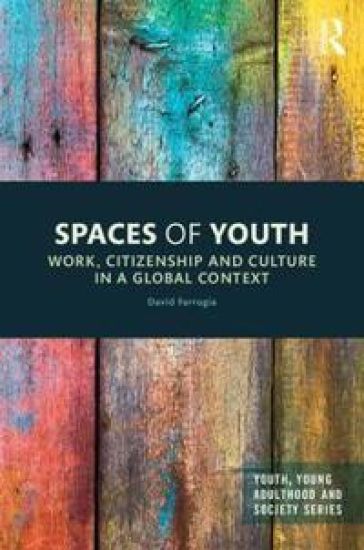
Contemporary young people are situated within a complex and disorienting set of social changes that are reshaping how youth is constructed, governed and experienced across the globe. Historically, it has been taken for granted that youth primarily concerns time, especially with regards to personal and social development. In Spaces of Youth, Farrugia shows that the concept of developmental time has become a regulatory framework that is used to govern aspects of globalisation, including the formation of labour forces and the boundaries of liberal citizenship regimes. Interrogating this context, this volume explores the changes in the social organisation of youth within the spatial dimensions of work, citizenship and popular culture in a global context. Thus, Farrugia establishes a new interdisciplinary research agenda into youth and spatiality, including young people from across the global north and the global south, and which situates young people within the key dynamics of contemporary globalisation in its economic, political and cultural dimensions. An enlightening and timely volume, Spaces of Youth is an important resource for post-graduate and post-doctoral researchers across all social scientific disciplines interested in space, youth, globalisation, work, citizenship and culture.
Youth Homelessness in Late Modernity

Youth Homelessness in Late Modernity

David Farrugia

Springer Verlag, Singapore
2016
nidottu
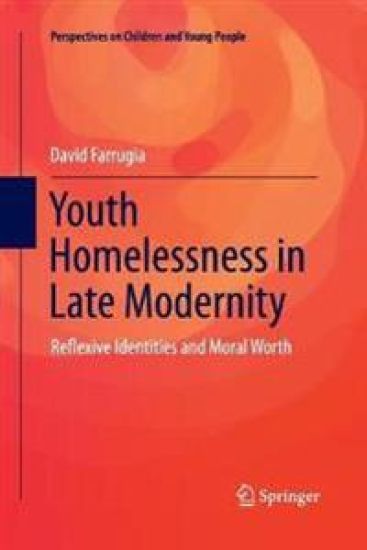
This book explores the identities, embodied experiences, and personal relationships of young people experiencing homelessness, and analyses these in relation to the material and symbolic position that youth homelessness occupies in modern societies. Drawing on empirical research conducted in both urban and rural areas, the book situates young people’s experiences of homelessness within a theoretical framework that connects embodied identities and relationships with processes of social change. The book theorises a ‘symbolic economy of youth homelessness’ that encompasses the subjective, aesthetic, and relational dimensions of homelessness. This theory shows the personal, interpersonal and affective suffering that is caused by the relations of power and privilege that produce contemporary youth homelessness. The book is unique in the way in which it places youth homelessness within the wider contexts of inequality, and social change. Whilst contemporary discussions of youth homelessness understand the topic as a discrete ‘social problem’, this book demonstrates the position that youth homelessness occupies within wider social processes, inequalities, and theoretical debates, addressing theories of social change in late modernity and their relationship to the cultural construction of youth. These theoretical debates are made concrete by means of an exploration of an important form of contemporary inequality: youth homelessness.
Youth Homelessness in Late Modernity

Youth Homelessness in Late Modernity

David Farrugia

Springer Verlag, Singapore
2015
sidottu
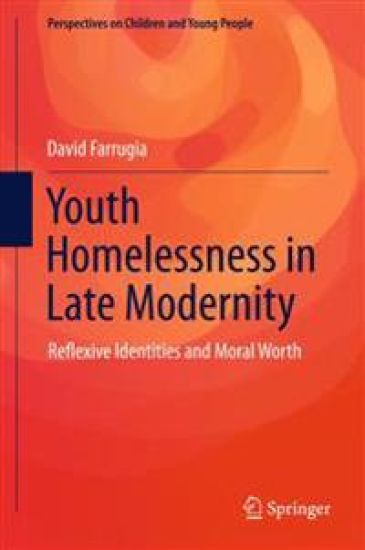
This book explores the identities, embodied experiences, and personal relationships of young people experiencing homelessness, and analyses these in relation to the material and symbolic position that youth homelessness occupies in modern societies. Drawing on empirical research conducted in both urban and rural areas, the book situates young people’s experiences of homelessness within a theoretical framework that connects embodied identities and relationships with processes of social change. The book theorises a ‘symbolic economy of youth homelessness’ that encompasses the subjective, aesthetic, and relational dimensions of homelessness. This theory shows the personal, interpersonal and affective suffering that is caused by the relations of power and privilege that produce contemporary youth homelessness. The book is unique in the way in which it places youth homelessness within the wider contexts of inequality, and social change. Whilst contemporary discussions of youth homelessness understand the topic as a discrete ‘social problem’, this book demonstrates the position that youth homelessness occupies within wider social processes, inequalities, and theoretical debates, addressing theories of social change in late modernity and their relationship to the cultural construction of youth. These theoretical debates are made concrete by means of an exploration of an important form of contemporary inequality: youth homelessness.