Kirjojen hintavertailu – 12 903 724 kirjaa ja 27 kauppaa

Kirjailija

David Forsyth

Kirjat ja teokset yhdessä paikassa: 15 kirjaa, julkaisuja vuosilta 1999–2024, suosituimpiin kuuluu Computer Vision. Vertaile teosten hintoja ja tarkista saatavuus suomalaisista kirjakaupoista.

15 kirjaa

Kirjojen julkaisuvuodet: 1999–2024.

The Amusement Park at Sloan's Lake

The Amusement Park at Sloan's Lake

David Forsyth

ROWMAN LITTLEFIELD
2024
pokkari
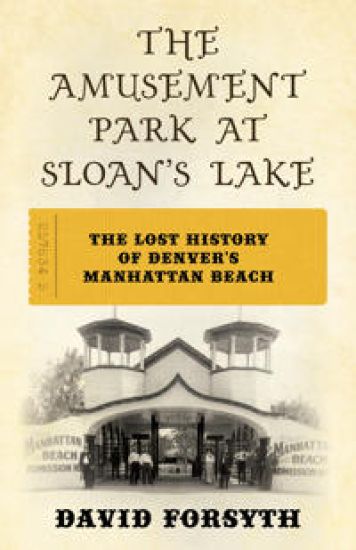
Sloan’s Lake had a long history of entertaining Denver residents with boating, fishing, swimming, and a steamboat canal built in the 1870s. In 1890, Adam Graff and his partners opened a new park on the shore of Sloan’s Lake that would eventually become Manhattan Beach. Originally created as a summer pleasure resort with a highly respected summer theater, boating, fishing, and music, the park quickly expanded to include typical amusement attractions, including Denver’s first roller coaster and merry-go-round. When the concept of the amusement park was created in 1895 with the opening of Sea Lion Park on Coney Island in New York, Manhattan Beach was already a step ahead of rivals Elitch Gardens and Arlington Park. Operating from 1890 to 1914, Manhattan Beach Amusement Park was the first true amusement park in Denver and was enjoyed by residents and visitors for nearly twenty-five years as Denver tried to shake off its image as a dusty cow town from gold mining days and fought to be seen as a sophisticated and well-developed city. Manhattan Beach played an important role in amusement park history in the United States, but its full story has never before been told. Manhattan Beach’s story is an important addition to both Denver and Colorado’s history as it reflects the city’s growth during the late 1800s and early 1900s. The park has also inspired many legends, the most famous of which concerns Roger the Elephant, who arrived at Manhattan Beach in 1891, and his supposed death and burial in a swamp near the park. Much of what has been told about Manhattan Beach in the years since it closed is more myth than fact, as this book demonstrates. After the amusement park closed in 1914, the city of Denver purchased the land and turned it into Sloan’s Lake Park, which continues to be a gathering place for Denverites.
Eben Smith

Eben Smith

David Forsyth

University Press of Colorado
2021
sidottu
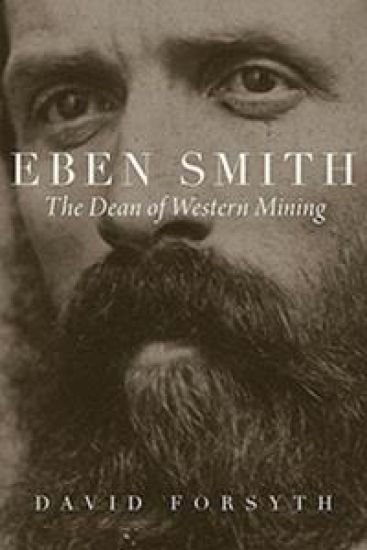
David Forsyth recounts the life of Eben Smith, an integral but little-known figure in Colorado mining history. Smith was one of the many fortune seekers who traveled to California during the gold rush and one of the few who found what he sought. He moved to Colorado in 1860 with business partner Jerome Chaffee and over the next forty-six years was involved in mining in nearly every major camp in the state, from Central City to Cripple Creek, and in the development of mines such as the Bobtail, Little Jonny, and Victor. He was eulogized by the Denver Post and Denver Times as the “dean of mining in Colorado.” The mining teams Smith formed with Chaffee and with industrialist David Moffat were among the most successful and respected in Colorado, and many in the state held Smith in high regard. Yet despite the credit he received during his lifetime for establishing Colorado’s mining industry, Smith has not received much attention from historians, perhaps because he was content to leave public-facing duties to his partners while he concerned himself with managing mine operations. From Smith’s early years and his labor in the mines to his rise to prominence as an investor and developer, Forsyth shows how Smith used the mining and milling knowledge he acquired in California to become a leader in technological innovation in Colorado’s mining industry.
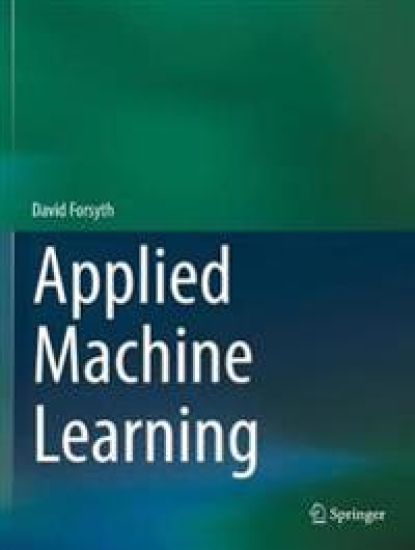
Applied Machine Learning

Applied Machine Learning

David Forsyth

Springer Nature Switzerland AG
2020
nidottu

Halvin toimitettuna 101,70 €

Machine learning methods are now an important tool for scientists, researchers, engineers and students in a wide range of areas. This book is written for people who want to adopt and use the main tools of machine learning, but aren’t necessarily going to want to be machine learning researchers. Intended for students in final year undergraduate or first year graduate computer science programs in machine learning, this textbook is a machine learning toolkit. Applied Machine Learning covers many topics for people who want to use machine learning processes to get things done, with a strong emphasis on using existing tools and packages, rather than writing one’s own code. A companion to the author's Probability and Statistics for Computer Science, this book picks up where the earlier book left off (but also supplies a summary of probability that the reader can use). Emphasizing the usefulness ofstandard machinery from applied statistics, this textbook gives an overview of the major applied areas in learning, including coverage of:• classification using standard machinery (naive bayes; nearest neighbor; SVM)• clustering and vector quantization (largely as in PSCS)• PCA (largely as in PSCS)• variants of PCA (NIPALS; latent semantic analysis; canonical correlation analysis)• linear regression (largely as in PSCS)• generalized linear models including logistic regression• model selection with Lasso, elasticnet• robustness and m-estimators• Markov chains and HMM’s (largely as in PSCS)• EM in fairly gory detail; long experience teaching this suggests one detailed example is required, which students hate; but once they’ve been through that, the next one is easy• simple graphical models (in the variational inference section)• classification with neural networks, with a particular emphasis onimage classification• autoencoding with neural networks• structure learning
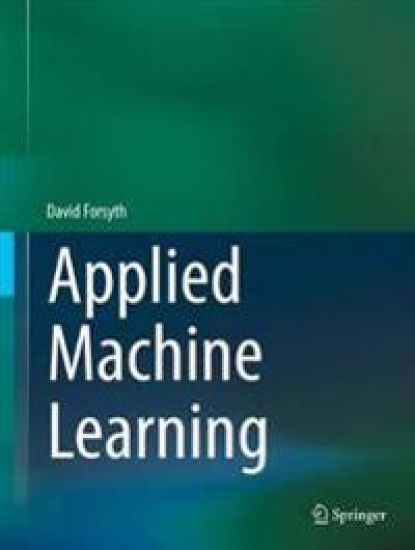
Applied Machine Learning

Applied Machine Learning

David Forsyth

Springer Nature Switzerland AG
2019
sidottu
Machine learning methods are now an important tool for scientists, researchers, engineers and students in a wide range of areas. This book is written for people who want to adopt and use the main tools of machine learning, but aren’t necessarily going to want to be machine learning researchers. Intended for students in final year undergraduate or first year graduate computer science programs in machine learning, this textbook is a machine learning toolkit. Applied Machine Learning covers many topics for people who want to use machine learning processes to get things done, with a strong emphasis on using existing tools and packages, rather than writing one’s own code. A companion to the author's Probability and Statistics for Computer Science, this book picks up where the earlier book left off (but also supplies a summary of probability that the reader can use). Emphasizing the usefulness ofstandard machinery from applied statistics, this textbook gives an overview of the major applied areas in learning, including coverage of:• classification using standard machinery (naive bayes; nearest neighbor; SVM)• clustering and vector quantization (largely as in PSCS)• PCA (largely as in PSCS)• variants of PCA (NIPALS; latent semantic analysis; canonical correlation analysis)• linear regression (largely as in PSCS)• generalized linear models including logistic regression• model selection with Lasso, elasticnet• robustness and m-estimators• Markov chains and HMM’s (largely as in PSCS)• EM in fairly gory detail; long experience teaching this suggests one detailed example is required, which students hate; but once they’ve been through that, the next one is easy• simple graphical models (in the variational inference section)• classification with neural networks, with a particular emphasis onimage classification• autoencoding with neural networks• structure learning
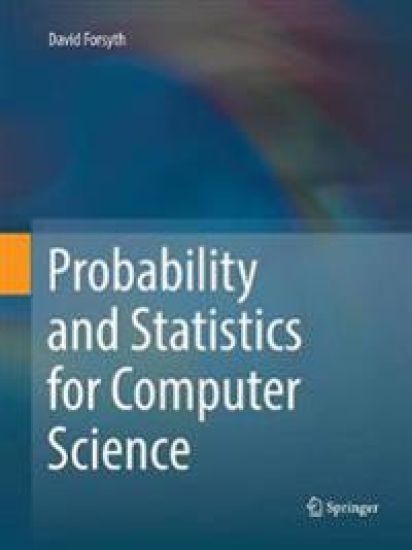
Probability and Statistics for Computer Science

Probability and Statistics for Computer Science

David Forsyth

Springer International Publishing AG
2019
nidottu
This textbook is aimed at computer science undergraduates late in sophomore or early in junior year, supplying a comprehensive background in qualitative and quantitative data analysis, probability, random variables, and statistical methods, including machine learning. With careful treatment of topics that fill the curricular needs for the course, Probability and Statistics for Computer Science features:• A treatment of random variables and expectations dealing primarily with the discrete case.• A practical treatment of simulation, showing how many interesting probabilities and expectations can be extracted, with particular emphasis on Markov chains.• A clear but crisp account of simple point inference strategies (maximum likelihood; Bayesian inference) in simple contexts. This is extended to cover some confidence intervals, samples and populations for random sampling with replacement, and the simplest hypothesis testing.• Achapter dealing with classification, explaining why it’s useful; how to train SVM classifiers with stochastic gradient descent; and how to use implementations of more advanced methods such as random forests and nearest neighbors.• A chapter dealing with regression, explaining how to set up, use and understand linear regression and nearest neighbors regression in practical problems.• A chapter dealing with principal components analysis, developing intuition carefully, and including numerous practical examples. There is a brief description of multivariate scaling via principal coordinate analysis. • A chapter dealing with clustering via agglomerative methods and k-means, showing how to build vector quantized features for complex signals. Illustrated throughout, each main chapter includes many worked examples and other pedagogical elements such as boxed Procedures, Definitions, Useful Facts, and Remember This (short tips). Problems and Programming Exercises are at the end of each chapter, with a summary of what the reader should know. Instructor resources include a full set of model solutions for all problems, and an Instructor's Manual with accompanying presentation slides.
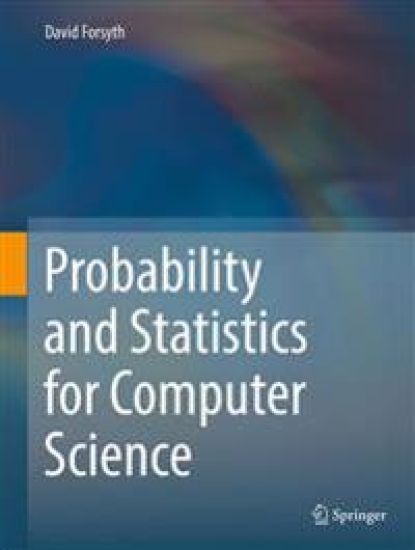
Probability and Statistics for Computer Science

Probability and Statistics for Computer Science

David Forsyth

Springer International Publishing AG
2018
sidottu
This textbook is aimed at computer science undergraduates late in sophomore or early in junior year, supplying a comprehensive background in qualitative and quantitative data analysis, probability, random variables, and statistical methods, including machine learning. With careful treatment of topics that fill the curricular needs for the course, Probability and Statistics for Computer Science features:• A treatment of random variables and expectations dealing primarily with the discrete case.• A practical treatment of simulation, showing how many interesting probabilities and expectations can be extracted, with particular emphasis on Markov chains.• A clear but crisp account of simple point inference strategies (maximum likelihood; Bayesian inference) in simple contexts. This is extended to cover some confidence intervals, samples and populations for random sampling with replacement, and the simplest hypothesis testing.• Achapter dealing with classification, explaining why it’s useful; how to train SVM classifiers with stochastic gradient descent; and how to use implementations of more advanced methods such as random forests and nearest neighbors.• A chapter dealing with regression, explaining how to set up, use and understand linear regression and nearest neighbors regression in practical problems.• A chapter dealing with principal components analysis, developing intuition carefully, and including numerous practical examples. There is a brief description of multivariate scaling via principal coordinate analysis. • A chapter dealing with clustering via agglomerative methods and k-means, showing how to build vector quantized features for complex signals. Illustrated throughout, each main chapter includes many worked examples and other pedagogical elements such as boxed Procedures, Definitions, Useful Facts, and Remember This (short tips). Problems and Programming Exercises are at the end of each chapter, with a summary of what the reader should know. Instructor resources include a full set of model solutions for all problems, and an Instructor's Manual with accompanying presentation slides.
Denver's Lakeside Amusement Park

Denver's Lakeside Amusement Park

David Forsyth

University Press of Colorado
2016
nidottu
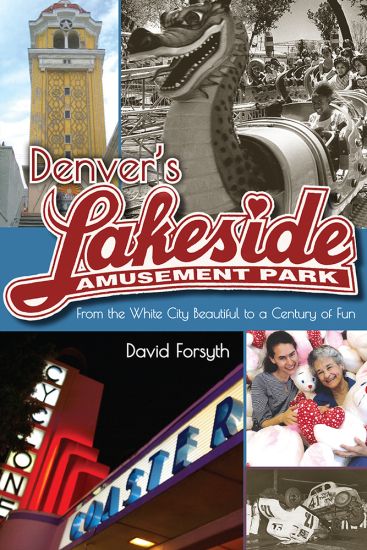
Denver's Lakeside Amusement Park details the history of Lakeside, exploring how it has managed to remain in business for more than a century (something fewer than thirty amusement parks have accomplished) and offers a unique view on larger changes in society and the amusement park industry itself. Once nicknamed White City in part for its glittering display of more than 100,000 lights, the park opened in 1908 in conjunction with Denver's participation in the national City Beautiful movement. It was a park for Denver elites, with fifty different forms of amusement, including the Lakeshore Railway and the Velvet Coaster, a casino, a ballroom, a theater, a skating rink, and avenues decorated with Greek statues. But after metropolitan growth, technological innovation, and cultural shifts in Denver, it began to cater to a working-class demographic as well. Additions of neon and fluorescent lighting, roller coasters like the Wild Chipmunk, attractions like the Fun House and Lakeside Speedway, and rides like the Scrambler, the Spider, and most recently the drop tower Zoom changed the face and feel of Lakeside between 1908 and 2008. The park also has weathered numerous financial and structural difficulties but continues to provide Denverites with affordable, family-friendly amusement today. To tell Lakeside's story, Forsyth makes use of various primary and secondary sources, including Denver newspapers, Denver's official City Beautiful publication Municipal Facts, Billboard magazine, and interviews with people connected to the park throughout its history. Denver's Lakeside Amusement Park is an important addition to Denver history that will appeal to anyone interested in Colorado history, urban history, entertainment history, and popular culture, as well as to amusement park aficionados.
The Technique Of Psycho-Analysis

The Technique Of Psycho-Analysis

David Forsyth

Routledge
2014
nidottu
First Published in 1999. This is Volume VII of a twenty-eight volume library of psychology on Psychoanalysis. This book is an essay on the Technique of Psycho-Analysis initially given as an address to members of the Psycho-neurological Society in London when the author was the Society president.
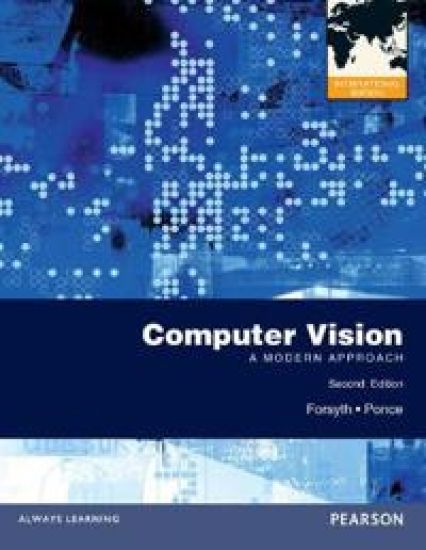
Computer Vision

Computer Vision

David Forsyth; Jean Ponce

Pearson
2012
nidottu
Computer Vision: A Modern Approach, 2e, is appropriate for upper-division undergraduate- and graduate-level courses in computer vision found in departments of Computer Science, Computer Engineering and Electrical Engineering. This textbook provides the most complete treatment of modern computer vision methods by two of the leading authorities in the field. This accessible presentation gives both a general view of the entire computer vision enterprise and also offers sufficient detail for students to be able to build useful applications. Students will learn techniques that have proven to be useful by first-hand experience and a wide range of mathematical methods
Computer Vision: A Modern Approach

Computer Vision: A Modern Approach

David Forsyth; Jean Ponce

Pearson Education Limited
2012
pokkari
Appropriate for upper-division undergraduate and graduate level courses in computer vision found in departments of computer science, computer engineering and electrical engineering, this book offers a treatment of modern computer vision methods.
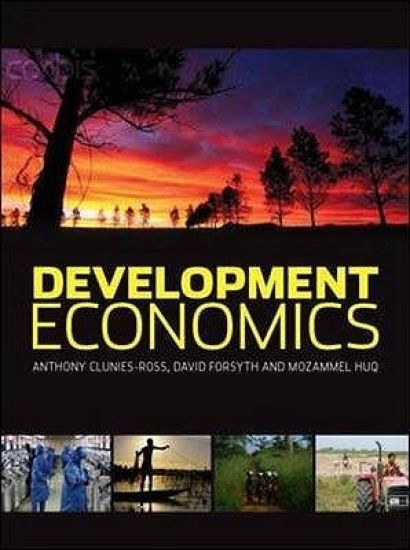
Development Economics

Development Economics

David Forsyth; Mozammel Huq; Anthony Clunies-Ross

McGraw Hill Higher Education
2009
nidottu
Broad beliefs about the economics of ‘developing countries’ and of the development process have changed considerably since the subject became of wide interest in the 1950s; due largely to changes in the world and in the application of economic policies within developing countries. Subjects such as environment, gender, poverty, famine and globalization have come to be of increasingly important public interest. The extreme divergence of experience among regions of the world has also made it more and more questionable whether it even makes sense to think of a single and distinctive ‘economics of developing countries’. This textbook presents a concise and up-to-date examination of the field of development economics, bringing together historical perspectives, current issues and policy implications. Each chapter can be read as a stand-alone unit, or as part of the wider economic debates presented throughout the book.
The Technique Of Psycho-Analysis

The Technique Of Psycho-Analysis

David Forsyth

Routledge
1999
sidottu
First Published in 1999. This is Volume VII of a twenty-eight volume library of psychology on Psychoanalysis. This book is an essay on the Technique of Psycho-Analysis initially given as an address to members of the Psycho-neurological Society in London when the author was the Society president.