Kirjojen hintavertailu – 12 903 725 kirjaa ja 27 kauppaa

Kirjailija

David French

Kirjat ja teokset yhdessä paikassa: 43 kirjaa, julkaisuja vuosilta 1981–2025, suosituimpiin kuuluu Inorganic Geochemistry of Coal. Vertaile teosten hintoja ja tarkista saatavuus suomalaisista kirjakaupoista.

43 kirjaa

Kirjojen julkaisuvuodet: 1981–2025.

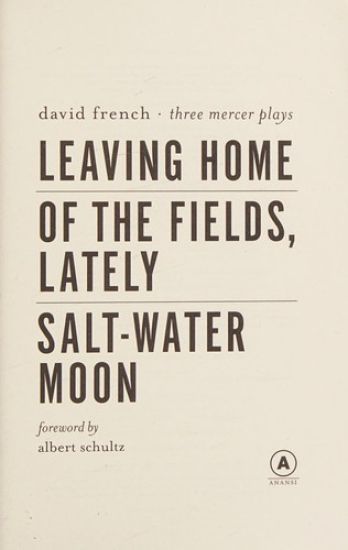
Leaving Home, Of the Fields, Lately, and Salt-Water Moon

Leaving Home, Of the Fields, Lately, and Salt-Water Moon

David French; Albert Schultz

House of Anansi Press Ltd ,Canada
2009
pokkari
David French's award-winning plays Leaving Home, Of the Fields, Lately and Salt-Water Moon are available for the first time in a special one-volume edition, with an introduction by Albert Schultz. Set in the 1950s, Leaving Home tells the story of the Mercers, a Newfoundland family who have emigrated to the mainland and lost all sense of their place in the world. In Of the Fields, Lately, the emotionally charged sequel to Leaving Home, young Ben Mercer returns home after being gone for two years and confronts the family he left behind. Salt-Water Moon was written later than the other two plays but tells the earlier story of the courtship of Jacob and Mary Mercer in Newfoundland. Leaving Home was named one of the "100 Most Influential Canadian Books" by the Literary Review of Canada. Of the Fields, Lately won the Chalmers Award in 1973, and Salt-Water Moon won the Canadian Authors Association Award for Drama, the Dora Mavor Moore Award for Best New Play, and the Hollywood Drama-Logue Critics’ Award.

Military Identities

Military Identities

David French

Oxford University Press
2008
nidottu
The regimental system has been the foundation of the British army for three hundred years. This iconoclastic study shows how it was refashioned in the late nineteenth century, and how it was subsequently and repeatedly reinvented to suit the changing roles that were forced upon the army. Based upon a combination of official papers, private papers and personal reminiscences, and upon research in the National Archives, regimental museums and collections, and other depositories, this book challenges the assumptions of both the exponents and detractors of the system. The author, David French, shows that there was not one, but several, regimental systems and he demonstrates that localised recruiting was usually a failure. Many regiments were never able to draw more than a small proportion of their recruits from their own districts. He shows that regimental loyalties were not a primordial force; regimental authorities had to create them and in the late nineteenth century they manufactured new traditions with gusto, whilst in both World Wars regimental postings quickly broke down and regiments had to take recruits from wherever they could find them. French also argues that the notion that the British army was bad at fighting big battles because the regimental system created a parochial military culture is facile. This is the first book to strip away the myths that have been deliberately manufactured to justify or to condemn the regimental system and to uncover the reality beneath them. It thus illuminates our understanding of the past while simultaneously throwing glaring new light on the still continuing debate over the place of the regimental system in the modern army today.
British Economic and Strategic Planning
The political manoeuvres which brought about the collapse of Britain's last Liberal government in May 1915 have already been the subject of much scholarly debate. This book will attempt to go beyond the arena of strictly party and factional politics and will examine some of the administrative problems the Liberals faced on the home front.
Military Identities

Military Identities

David French

Oxford University Press
2005
sidottu
The regimental system has been the foundation of the British army for three hundred years. This iconoclastic study shows how it was refashioned in the late nineteenth century, and how it was subsequently and repeatedly reinvented to suit the changing roles that were forced upon the army. Based upon a combination of official papers, private papers and personal reminiscences, and upon research in the National Archives, regimental museums and collections, and other depositories, this book challenges the assumptions of both the exponents and detractors of the system. The author, David French, shows that there was not one, but several, regimental systems and he demonstrates that localised recruiting was usually a failure. Many regiments were never able to draw more than a small proportion of their recruits from their own districts. He shows that regimental loyalties were not a primordial force; regimental authorities had to create them and in the late nineteenth century they manufactured new traditions with gusto, whilst in both World Wars regimental postings quickly broke down and regiments had to take recruits from wherever they could find them. French also argues that the notion that the British army was bad at fighting big battles because the regimental system created a parochial military culture is facile. This is the first book to strip away the myths that have been deliberately manufactured to justify or to condemn the regimental system and to uncover the reality beneath them. It thus illuminates our understanding of the past while simultaneously throwing glaring new light on the still continuing debate over the place of the regimental system in the modern army today.
The Riddle of the World

The Riddle of the World

David French

Talonbooks
2003
pokkari
Published for the first time, David French's The Riddle of the World remains a classic of the Canadian stage. Stockbroker Ron and ex-priest Steve are two new singles who get together to console themselves after having been abandoned by their mates. Through a comic series of false starts, disastrous one-night stands, dead-end blind dates and absurd attempts to reconnect with their former lovers, they are forced to come to terms with their fragile natures as men in a world with few signposts of male identity left standing. Initially blaming others for "taking their partners away," Ron fails repeatedly to see and come to terms with his overwhelming possessiveness; while Steve gradually learns to embrace his own new found and deeply sublimated gay sexuality. "The Riddle of the World," a fragment of a poem by Alexander Pope, resonates throughout this arch comedy of manners as it revisits the eternal struggle of the flesh and the spirit on the road to the characters' discovery of the true nature of love. Like all of Pope's characters, Ron and Steve are engaged in a mock battle with the social phantoms of their time, in a "sexual revolution" wherein every higher purpose is unmasked as a conceit of self-interest. Cast of three women and two men.
One Crack Out

One Crack Out

David French

Talonbooks
2003
pokkari
Charlie Evans, a pool shark down on his luck in the bedroom as well as in the pool hall, has two days to pay off a $3,000 debt, or have his legs broken by Bulldog, a psychotic debt collector who also happens to be having an affair with Charlie's wife, Helen. In his desperation to recover both the money and his self-esteem, Charlie gets involved in a series of hustles, pushing the tension to a breathtaking climax. The complicated narrative of the play allows French to build a convincing case for Charlie's humanity--how his actions, devious, frantic and perplexed as they are, spring directly from his need to survive his pathetic circumstance and to maintain his dignity as a survivor. Tired, suspicious, despairing, knowing that the game is no good for him and yet knowing no other game, Charlie plunges into a situation which may mean disaster or salvation, because in Charlie's world of cliche and stereotype, everything comes down to betting on the right thing at the right time. Cast of two women and eight men.
Soldier's Heart

Soldier's Heart

David French

Talonbooks
2002
pokkari
David French's award-winning and ongoing dramatic cycle about the Mercer family, both in their native Newfoundland and later, as participants in the great outport clearances, relocated in Toronto, has become a defining part of Canada's theatrical history. Set in Toronto, the first play, Leaving Home (1972), introduced the family saga's key figure, Jacob Mercer, who appears in all of the plays. Also in this series are Of the Fields, Lately (1973); Salt-Water Moon (1984); and 1949 (1988), which deals with this expatriate family's reaction to Newfoundland's entry into confederation. With Soldier's Heart, French looks back in time at the thoroughly alienated 16-year-old Jacob, standing on a railway platform, his suitcase and one-way ticket away from home in hand. His father Esau, a veteran of the First World War, rushes to the station in a last-ditch effort to persuade his son not to leave. Unable to speak of what had happened in the Great War since his return, Esau begins, in halting and tentative language to tell of his comrades and his brother, their training in Scotland, the agony of Gallipoli, and finally the formative events at the battle of the Somme at Beaumont Hamel. At first defensive in response to his son's probing and impatient questioning, Esau's answers evolve into stories of pride, foolishness, anger, desperation and finally mindless terror, leaving only the image of a man driven by the blind animal instinct to survive. It is this devastating and unsparing account of all that is in a soldier's heart, that finally brings father and son back together.
Leaving Home

Leaving Home

David French

House of Anansi Press Ltd ,Canada
2002
pokkari
David French's first play is a classic in Canadian drama. The first part of what has come to be known as the Mercer Series, Leaving Home tells the story of a Newfoundland family that has emigrated and lost all sense of its place in the world. Leaving Home was named one of the "100 Most Influential Canadian Books" by the Literary Review of Canada.
Raising Churchill's Army

Raising Churchill's Army

David French

Oxford University Press
2001
nidottu
An analysis of the combat capability of the British army during the WWII, exposing the myth that it suffered from poor morale and analyzing its place in the war strategy. The book explores weaknesses and problems, attitudes to technology, and post-1942 improvements.
Raising Churchill's Army

Raising Churchill's Army

David French

Oxford University Press
2000
sidottu
This is the first serious analysis of the combat capability of the British army in the Second World War. It sweeps away the myth that the army suffered from poor morale, and that it only won its battles thorugh the use of 'brute force' and by reverting to the techniques of the First World War. David French analyses the place of the army in British strategy in the interwar period and during the Second World War. He shows that after 1918 the General Staff tried hard to learn the lessons of the First World War, enthusiastically embracing technology as the best way of minimizing future casualties. In the first half of the Second World War the army did suffer from manifold weaknesses, not just in the form of shortages of equipment, but also in the way in which it applied its doctrine. Few soldiers were actively eager to close with the enemy, but the morale of the army never collapsed and its combat capability steadily improved from 1942 onwards. Professor French assesses Montgomery's contributions to the war effort and concludes that most important were his willingness to impose a uniform understanding of doctrine on his subordinates, and to use mechanized firepower in ways quite different from Haig in the First World War.
That Summer

That Summer

David French

Talonbooks
2000
pokkari
It's Memorial Day, 1990, and Margaret Ryan has returned from Vermont to the Ontario cottage country where, thirty-two years before, she had vacationed with her disintegrating family at a lakeside resort. For herself and her sister Daisy, it was a time of awakening, a time of discovery. Both of the girls fall in love with two of the local boys. Daisy, on the lookout for action, cruising the dances at the resort, can't deal with what she initiates, and falls victim to her own confusion and naivete. Not even the neighbour, the eccentric, bourbon-drinking, cigar-smoking Mrs. Crump, who knows all the fairy-tale spells to capture the heart of a lover, can save Daisy from drowning in her own misadventure. At the same time, Margaret, bookish and withdrawn, inhabiting a universe defined by poets and novelists, is seduced in spite of herself. As Margaret, the narrator, watches Maggie, her younger self, relive the innocence and beauty of that summer, the play moves inexorably back to the heartbreak of a headlong surrender to experience, both won and lost in a single day. Cinematic in its feel and pacing, recalling the 1950s genre of Dirty Dancing and My American Cousin, That Summer is a meditation on what endures of fleeting moments over time. Cast of 5 women and 2 men.
The Strategy of the Lloyd George Coalition, 1916-1918
The popular image of the First World War is dominated by two misconceptions. The first holds that the war was an exercise in futility in which incompetent upper class generals callously sacrificed an entire generation of young men to no good purpose. The second holds that the debate about British strategic policy during the First World War was a gladiatorial contest between `brass hats' (generals), and `frock coats' (politicians). Historians, denied access for too long to the contemporary records of the private deliberations of policy-makers, had been forced to follow both interpretations. David French challenges this orthodoxy and suggests that the policy-makers were united in trying to relate strategic policy to a carefully considered set of war aims. His challenging conclusion is that the policy-makers never lost sight of their goal, which was to ensure that Britain fought the war at an acceptable cost and emerged from it with its security enhanced against both its enemies and its allies.
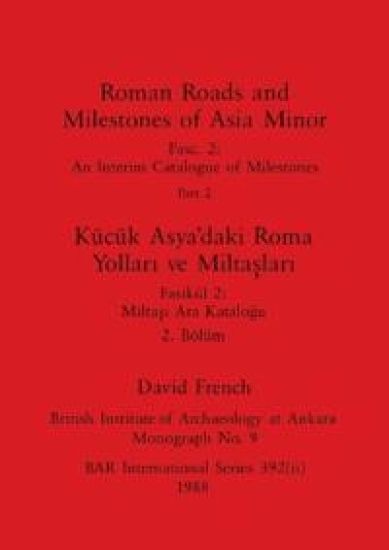
Studies in the History and Topography of Lycia in Memoriam A. S. Hall

Studies in the History and Topography of Lycia in Memoriam A. S. Hall

David French; Alan Hall; Nicholas Milner; Stephen Mitchell

British Institute of Archaeology at Ankara
1994
sidottu
A collection of unpublished papers by Alan Hall, a leading authority on the history and epigraphy of classical Asia Minor, supported by contributions by scholars associated with him. Subjects include the indigenous names of Asia Minor, the festivals of Oenoanda, inscriptions and the topgraphy of Lycia, Phyrgia and Pisidia.
Silver Dagger

Silver Dagger

David French

Talonbooks
1993
pokkari
Steve Marsh is a mystery writer, the protagonist of David French's gripping thriller, Silver Dagger. Soon after his third novel is published, Marsh's wife receives a series of phone calls and letters that threaten to destroy their marriage. Adultery, blackmail, murder, a figure lurking in the rain. All these classic elements of Marsh's fiction soon become part of his life.
Metallurgical Failures in Fossil Fired Boilers

Metallurgical Failures in Fossil Fired Boilers

David French

John Wiley Sons Inc
1993
sidottu
Due to a dramatic increase in the interest and understanding of boiler-tube failure analysis, this edition has been updated and expanded. New features include material on fluid dynamics, heat transfer and stress calculations; remaining life assessment of boilers being used beyond their original design expectations; mechanical engineering aspects of boiler design; more information on fatigue, creep, thermal stress for carbon as well as stainless steels; suggestions to prevent future failures.
Of the Fields, Lately

Of the Fields, Lately

David French

House of Anansi Press Ltd ,Canada
1991
pokkari
A son returns after an absence of two years to find his mother and family friend Wiff trying to sustain his father, Jacob. A heart attack has forced Jacob out of work, and he can't reconcile himself to his frightening situation. The characters all discover something about themselves under this pressure of imminent death.
1949

1949

David French

Talonbooks
1989
pokkari
1949 continues the saga of the Mercer family, enlarged to include the extended family as well as off-stage characters from earlier plays. David French deals with the emotional and political decisions that the characters must come to as Newfoundland joins Confederation on April Fool's Day of 1949. As recent immigrants to Toronto, the members of the Mercer family see this event both as a new future and as a loss of Newfoundland's culture and independence. Cast of 6 women, 6 men and 2 boys.