Kirjojen hintavertailu – 12 903 725 kirjaa ja 27 kauppaa

Kirjailija

David Goldfield

Kirjat ja teokset yhdessä paikassa: 11 kirjaa, julkaisuja vuosilta 1997–2015, suosituimpiin kuuluu The American Journey. Vertaile teosten hintoja ja tarkista saatavuus suomalaisista kirjakaupoista.

11 kirjaa

Kirjojen julkaisuvuodet: 1997–2015.

Confederate Cities

Confederate Cities

David Goldfield

University of Chicago Press
2015
sidottu
When we talk about the Civil War, we often describe it in terms of battles that took place in small towns or in the countryside: Antietam, Gettysburg, Bull Run, and, most tellingly, the Battle of the Wilderness. One reason this picture has persisted is that few urban historians have studied the war, even though cities hosted, enabled, and shaped Southern society as much as they did in the North. Confederate Cities, edited by Andrew L. Slap and Frank Towers, shifts the focus from the agrarian economy that undergirded the South to the cities that served as its political and administrative hubs. The contributors use the lens of the city to examine now-familiar Civil War-era themes, including the scope of the war, secession, gender, emancipation, and war's destruction. This more integrative approach dramatically revises our understanding of slavery's relationship to capitalist economics and cultural modernity. By enabling a more holistic reading of the South, the book speaks to contemporary Civil War scholars and students alike-not least in providing fresh perspectives on a well-studied war.

Confederate Cities

Confederate Cities

David Goldfield

University of Chicago Press
2015
nidottu
When we talk about the Civil War, we often describe it in terms of battles that took place in small towns or in the countryside: Antietam, Gettysburg, Bull Run, and, most tellingly, the Battle of the Wilderness. One reason this picture has persisted is that few urban historians have studied the war, even though cities hosted, enabled, and shaped Southern society as much as they did in the North. Confederate Cities, edited by Andrew L. Slap and Frank Towers, shifts the focus from the agrarian economy that undergirded the South to the cities that served as its political and administrative hubs. The contributors use the lens of the city to examine now-familiar Civil War-era themes, including the scope of the war, secession, gender, emancipation, and war's destruction. This more integrative approach dramatically revises our understanding of slavery's relationship to capitalist economics and cultural modernity. By enabling a more holistic reading of the South, the book speaks to contemporary Civil War scholars and students alike-not least in providing fresh perspectives on a well-studied war.

Still Fighting the Civil War

Still Fighting the Civil War

David Goldfield

Louisiana State University Press
2013
nidottu
In the updated edition of his sweeping narrative on southern history, David Goldfield brings this extensive study into the present with a timely assessment of the unresolved issues surrounding the Civil War's sesquicentennial commemoration. Traversing a hundred and fifty years of memory, Goldfield confronts the remnants of the American Civil War that survive in the hearts of many of the South's residents and in the national news headlines of battle flags, racial injustice, and religious conflicts. Goldfield candidly discusses how and why white southern men fashioned the myths of the Lost Cause and Redemption out of the Civil War and Reconstruction, and how they shaped a religion to canonize the heroes and deify the events of those fateful years. He also recounts how groups of blacks and white women eventually crafted a different, more inclusive version of southern history and how that new vision competed with more traditional perspectives. The battle for southern history, and for the South, continues- in museums, public spaces, books, state legislatures, and the minds of southerners. Given the region's growing economic power and political influence, understanding this war takes on national significance. Through an analysis of ideas of history and memory, religion, race, and gender, Still Fighting the Civil War provides us with a better understanding of the South and one another.
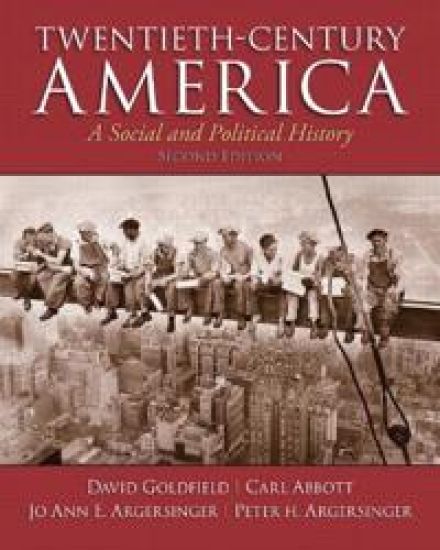
Twentieth-Century America

Twentieth-Century America

David Goldfield; Carl Abbott; Jo Ann Argersinger; Peter Argersinger

Pearson
2013
nidottu
A compelling story of 20th century events and people, including those familiar and unfamiliar to students. The goal of this book is to emphasize what students need to know about America’s past to function best in the society that emerged from the 20th century. The authors accomplish this by using a strong, clear narrative as well as integrating political and social history. Twentieth Century America fits the experiences of particular groups into the broader perspective of the American past while giving voice to minor and major players alike. The text is organized chronologically, so students can understand the sequence of events in history. Upon completing this book readers will be able to: Recall the events and people that shaped 20 th century American history Understand how 20 th century America fits into the whole of American history Apply what they have learned to their own lives
Still Fighting the Civil War

Still Fighting the Civil War

David Goldfield

Louisiana State University Press
2004
nidottu
Newcomers to the South often remark that southerners, at least white southerners, are still fighting the Civil War -- a strange preoccupation considering that the war formally ended more than one hundred and thirty-five years ago and fewer than a third of southerners today can claim an ancestor who actually fought in the conflict. But even if the war is far removed both in time and genealogy, it survives in the hearts of many of the region's residents and often in national newspaper headlines concerning battle flags, racial justice, and religious conflicts. In this sweeping narrative of the South from the Civil War to the present, noted historian David Goldfield contemplates the roots of southern memory and explains how this memory has shaped the modern South both for good and ill. He candidly discusses how and why white southern men fashioned the myths of the Lost Cause and the Redemption out of the Civil War and Reconstruction and how they shaped a religion to canonize the heroes and reify the events of those fated years. Goldfield also recounts how blacks and white women eventually crafted a different, more inclusive version of southern history and how that new vision has competed with more traditional perspectives. As Goldfield shows, the battle for southern history, and for the South, continues -- in museums, public spaces, books, state legislatures, and the minds of southerners. Given the region's growing economic power and political influence, the outcome of this war is more than a historian's preoccupation; it is of national importance. Integrating history and memory, religion, race, and gender, Still Fighting the Civil War will help newcomers, longtime residents, and curious outsiders alike attain a better understanding of the South and each other.
Southern Histories

Southern Histories

David Goldfield

University of Georgia Press
2003
sidottu
In this challenging look at some of the historical forces actively at work in today's South, David Goldfield draws pointed, provocative links between the "Lost Cause" mythology that emerged from the chaos of Confederate defeat, the region's reputation for intolerance, and southern evangelical Protestantism. History, religion, and culture can be so intertwined in the South, notes Goldfield, that changing one's point of view threatens simultaneously one's ancestry, identity, and salvation. As he discusses southern religion in a global age, Goldfield ranges from the deliberations of the Southern Baptist Convention to the banning of Satan from Inglis, Florida, by mayoral proclamation in March 2002. He asks whether southerners' defiance of school-prayer prohibitions is an emboldened tactic of a triumphant theocracy or evidence of an increasingly marginal religion gone public with its anxieties. On the question of who "owns" southern history, Goldfield looks at an array of issues from the Thomas Jefferson-Sally Hemmings controversy to debates over the Confederate flag to the proliferation of African American history museums and monuments in the region. Finally, he recalls his work as a consultant on U. S. Supreme Court cases involving a majority black voting district in North Carolina, as a coauthor of an environmental and economic impact study of offshore drilling in the Gulf of Mexico, and as a mitigating witness in the sentencing phases of six racially polarizing death penalty cases. His contributions, Goldfield hopes, made history more "real" to people in vocations outside of academia. The sesquicentennial of the Civil War in 2011 looms large for Goldfield. If we can commemorate the war and celebrate southern distinctiveness without being exclusionary, then the anniversary can be an occasion for reconciliation. In any case, he says, the South is rapidly changing, and whoever clings to a selective view of its history risks being left behind.
Urban Growth in the Age of Sectionalism

Urban Growth in the Age of Sectionalism

David Goldfield

Louisiana State University Press
1999
nidottu
The urban growth of Virginia during the decade and a half before the Civil War has been an unjustly neglected subject in American history. With this authoritative book David Goldfield fills a long-standing gap in historical scholarship by providing much new information and a fresh perspective on urban development in the Old Dominion during the turbulent antebellum years. According to Goldfield's interpretation, the urbanization of Virginia was prompted, in part, by the response of the state's leaders to the sectionalism that increasingly influenced prewar southern ideas. Caught up in the intense competition for western trade and commerce, Virginia's urbanizers dreamed of railroads and canals flung across the continent and bringing the wealth of the West into the Old Dominion. To realize these heroic visions, the state's entrepreneurs planned railroad networks, invested in manufacturing, and sought to establish trade with Europe. Lynchburg and Petersburg became centers for tobacco manufacturing, the ports of Alexandria and Norfolk saw a resurgence of shipping activity, and Richmond developed flour-milling and iron-manufacturing industries. Local governments, labor systems, and the cities themselves expanded to accommodate urban growth, embracing the farmer as a partner in the urban economy. Finally, a distinct urban consciousness developed to provide an intellectual framework for the urbanization process. Despite the unprecedented growth of Virginia's cities, however, their dreams of economic independence remained unfulfilled. By 1861 the state was more economically dependent on its northern rivals than it had ever been before. As the state reluctantly seceded from the Union, the subject of urban economic growth elicited sharp debate at the secession convention. Urban Virginia would have to wait until the ""New South"" years to renew the dreams of economic independence.
Region, Race and Cities

Region, Race and Cities

David Goldfield

Louisiana State University Press
1997
nidottu
For more than twenty-five years David Goldfield has interpreted southern urban history for audiences ranging from museumgoers to academics. His love affair with the discipline dates from its birth in the late sixties, and he has been among its primary nurturers ever since. Goldfield's approach is as unconventional as the South itself, relying heavily on works in other fields, and southern novels especially, to explain the region's diversity and distinctiveness. A solicitous citizen as well as theoretician, Goldfield strives to apply his knowledge and perspective to improving today's urban communities. Region, Race, and Cities presents eleven of his best essays, three unseen till now, in one volume, providing an overview of the evolution of southern urban history into a vibrant and legitimate branch of southern history. Goldfield's grasp is extensive. He discusses the economic importance of the South's antebellum towns, the impact of World War II on southern cities, voting rights and black political power, issues of urban policy and quality of life, the survival of southern identity, and much more. Two principles formulated early in his career continue to guide his thinking: first, the importance of southern cities and their similarity to other urban locales in the country, possibly throughout the world; and second, the intimate interactions between the South's cities and the region as a whole. Goldfield's catching enthusiasm for southern urban history, for the South, pervades this important work of scholarship. In the face of tremendous change, despite skyscrapers, subdivisions, and shopping malls, both city and region, Goldfield declares, have a resilience that defies homogenization and superficial analysis.