Kirjojen hintavertailu – 12 903 725 kirjaa ja 27 kauppaa

Kirjailija

David Gries

Kirjat ja teokset yhdessä paikassa: 4 kirjaa, julkaisuja vuosilta 1987–2010, suosituimpiin kuuluu Multimedia Introduction to Programming Using Java. Vertaile teosten hintoja ja tarkista saatavuus suomalaisista kirjakaupoista.

4 kirjaa

Kirjojen julkaisuvuodet: 1987–2010.

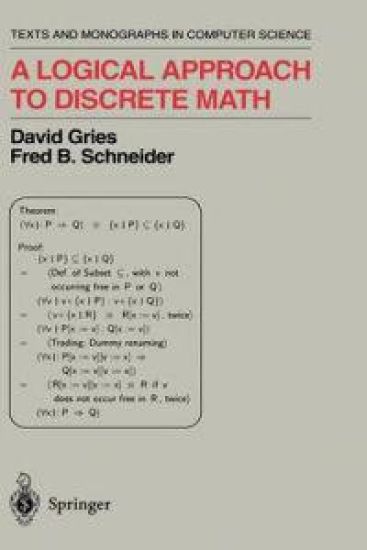
A Logical Approach to Discrete Math

A Logical Approach to Discrete Math

David Gries; Fred B. Schneider

Springer-Verlag New York Inc.
2010
nidottu
This text attempts to change the way we teach logic to beginning students. Instead of teaching logic as a subject in isolation, we regard it as a basic tool and show how to use it. We strive to give students a skill in the propo­ sitional and predicate calculi and then to exercise that skill thoroughly in applications that arise in computer science and discrete mathematics. We are not logicians, but programming methodologists, and this text reflects that perspective. We are among the first generation of scientists who are more interested in using logic than in studying it. With this text, we hope to empower further generations of computer scientists and math­ ematicians to become serious users of logic. Logic is the glue Logic is the glue that binds together methods of reasoning, in all domains. The traditional proof methods -for example, proof by assumption, con­ tradiction, mutual implication, and induction- have their basis in formal logic. Thus, whether proofs are to be presented formally or informally, a study of logic can provide understanding.
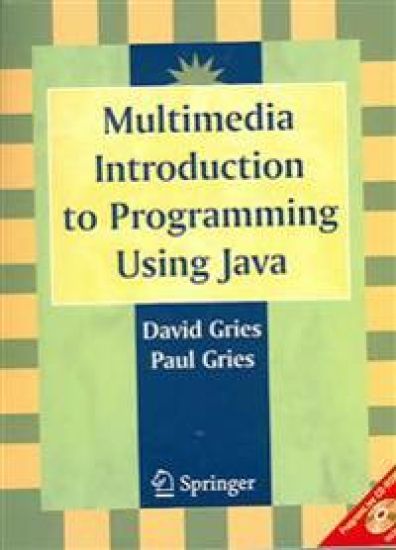
Multimedia Introduction to Programming Using Java

Multimedia Introduction to Programming Using Java

David Gries; Paul Gries

Springer-Verlag New York Inc.
2004
nidottu
Although vital to modern software development, Java and object-oriented programming can pose significant challenges to newcomers. This text, unique in both scope and approach and accompanied by interactive content that you may find on extras.springer.com, addresses that learning curve by providing a careful, classroom-tested presentation of Java -- from the fundamentals of variables, types, and expressions to procedural concepts like loops and sophisticated object-oriented ideas. Multimedia Introduction to Programming Using Java anchors its pedagogy in the program ProgramLive that you may find at extras.springer.com, a complete multimedia module in itself. Containing over 250 recorded lectures with synchronized animation, ProgramLive allows users to see, first-hand and in real time, processes like stepwise refinement of algorithms, development of loops, execution of method calls and associated changes to the call stack, and much more. The zip file also includes all programs from the book, 35 guided instruction sets for closed lab sessions, and a 70-page hyperlinked glossary. Additional key features of this work:Provides clear and accessible treatment of all aspects of a first course, along with more advanced topics such as recursion, exceptions, interfaces, inner classes, and GUIs. Introduces objects and classes early in the exposition, rendering object-oriented programming intuitive and natural. Develops programs, rather than simply showcasing them. Supports all concepts through complementary lectures on the zip-file featured on extras.springer.com. Contains numerous self-help exercises that encourage readers to practice programming. Emphasizes rigor and accuracy through user-friendly exposition and a flexible organizational style. With its comprehensive appendices and bibliography, systematic approach, and helpful interactive programs onextras.springer.com, this exciting work provides the key tools they needed for successful object-oriented programming. It is ideal for use at the undergraduate and graduate beginning level, whether in the classroom or for distance learning; furthermore, the text will also be a valuable self-study resource or reference volume in any programmer’s library.
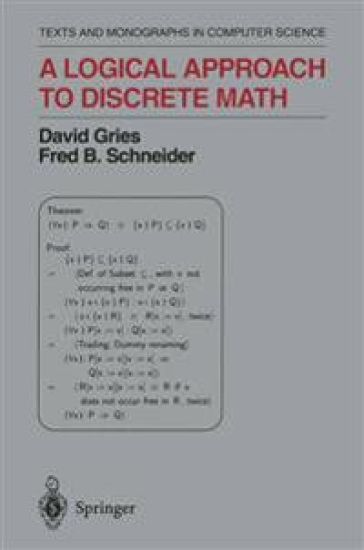
A Logical Approach to Discrete Math

A Logical Approach to Discrete Math

David Gries; Fred B. Schneider

Springer-Verlag New York Inc.
1993
sidottu
This text attempts to change the way we teach logic to beginning students. Instead of teaching logic as a subject in isolation, we regard it as a basic tool and show how to use it. We strive to give students a skill in the propo­ sitional and predicate calculi and then to exercise that skill thoroughly in applications that arise in computer science and discrete mathematics. We are not logicians, but programming methodologists, and this text reflects that perspective. We are among the first generation of scientists who are more interested in using logic than in studying it. With this text, we hope to empower further generations of computer scientists and math­ ematicians to become serious users of logic. Logic is the glue Logic is the glue that binds together methods of reasoning, in all domains. The traditional proof methods -for example, proof by assumption, con­ tradiction, mutual implication, and induction- have their basis in formal logic. Thus, whether proofs are to be presented formally or informally, a study of logic can provide understanding.