

Kirjailija
David Hansen
Kirjat ja teokset yhdessä paikassa: 16 kirjaa, julkaisuja vuosilta 1997–2026, suosituimpiin kuuluu Connected Care. Vertaile teosten hintoja ja tarkista saatavuus suomalaisista kirjakaupoista.
16 kirjaa
Kirjojen julkaisuvuodet: 1997–2026.
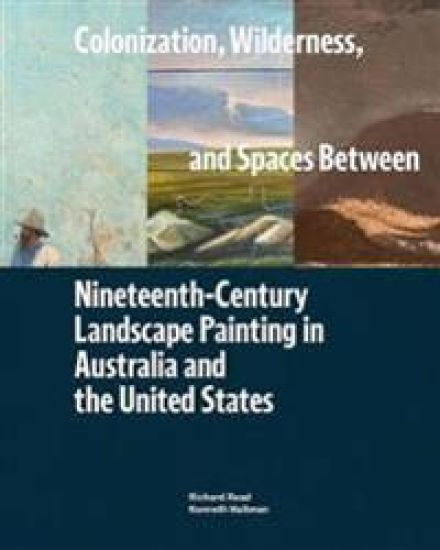
Colonization, Wilderness, and Spaces Between
Peter John Brownlee; David Peters Corbett; Rachael Z. DeLue; Kenneth Haltman; David Hansen; Elizabeth Hutchinson; Alan Michelson; Christopher Pease; Ruth Pullin; Richard Read; Catherine Speck
Terra Foundation for the Arts,U.S.
2020
nidottu
This volume of essays frames a comparative history of landscape painting in Australia and the United States through recent considerations of the Anthropocene, arguing that careful and deep analysis of specific nineteenth-century artworks reveals issues of environmental concern both past and present. Carefully drawn from two symposia held at the Art Gallery of Western Australia in Perth in 2016 and at the Ian Potter Museum of Art, University of Melbourne the following year, the volume includes eight essays and a conversation between artists. Colonization, Wilderness, and Spaces Between brings together the fresh insights of scholars and artists from Australia, the United Kingdom, and the United States and provides a resource for thinking critically about the historical, imperial, and environmental information that can be gleaned from looking closely at landscape paintings.

This book discusses the economic models and quantitative research involved in merger control forecasts and the relationship between antitrust law and economics. Analyzing qualitative and quantitative models within forecasts of merger control, the book applies the framework of antitrust law. This book proposes that economic modelling, econometrics application and juridical application of antitrust law go hand in hand. Discussing the question of an economically rational application and enforcement of antitrust and merger control law, the book covers both the basic concepts and theory behind economic model forecasts, as well as the application of merger control law. It also takes a closer look at legal control options for competition authorities when making a forecast decision and the associated problems of applying the law to this. The book will be of interest to researchers in the field of antitrust law, competition law, economics and corporate law.

This book discusses the economic models and quantitative research involved in merger control forecasts and the relationship between antitrust law and economics. Analyzing qualitative and quantitative models within forecasts of merger control, the book applies the framework of antitrust law. This book proposes that economic modelling, econometrics application and juridical application of antitrust law go hand in hand. Discussing the question of an economically rational application and enforcement of antitrust and merger control law, the book covers both the basic concepts and theory behind economic model forecasts, as well as the application of merger control law. It also takes a closer look at legal control options for competition authorities when making a forecast decision and the associated problems of applying the law to this. The book will be of interest to researchers in the field of antitrust law, competition law, economics and corporate law.


On $p$-Adic $L$-Functions for Hilbert Modular Forms
John Bergdall; David Hansen
AMERICAN MATHEMATICAL SOCIETY
2024
nidottu
The Memoirs of the AMS is devoted to the publication of new research in all areas of pure and applied mathematics. The Memoirs is designed particularly to publish long papers of groups of cognate papers in book form, and is under the supervision of the Editorial Committee of the AMS journal Transactions of the American Mathematical Society. All papers are peer-reviewed.

Teaching from an Ethical Center
Cara E. Furman; David Hansen
Harvard Educational Publishing Group
2024
nidottu
A methodology for using philosophy to guide teaching preparation and practice. In Teaching from an Ethical Center, Cara E. Furman proposes a process for bringing philosophical inquiry into teacher education and adopting it as a centering tool to enrich teaching practice and help teachers act justly. Under Furman's thoughtful guidance, both experienced and preservice teachers will find that engagement with philosophy can be a useful means of clarifying for themselves the educational ethics, values, and pedagogy that guide their work. Using firsthand accounts, recommended resources, and thought exercises, Furman prompts readers to explore the many benefits for both educators and their students of the act of reading and making sense of philosophical texts and thinking philosophically through daily dilemmas. Furman encourages teachers to engage in philosophical reflection as part of their professional preparation as well as their in-classroom practice. She illustrates how the focus on core values that emerges from this practice can be applied to everyday teaching dilemmas such as student behavior concerns and conflict management. Offering tips for adapting activities to different audiences, she shows how student participation in such inquiry supports hermeneutics, cultivates student voice, and helps build a culture of trust and interdependence through classroom collaboration. Filled with practical wisdom, this insightful work advances philosophical inquiry as a foundation for an inclusive education. Furman's tools and methods offer continuous opportunities for reflection and affirmation, enhancing educators’ ability to adapt to new challenges and, when necessary, to resist.
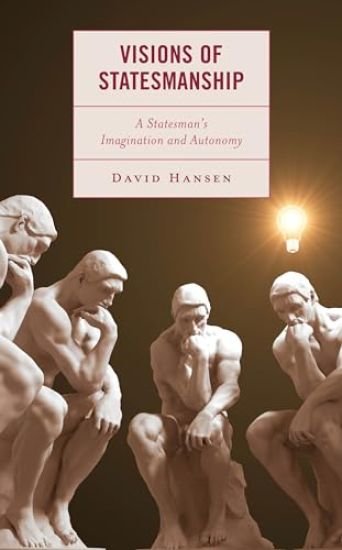
In Visions of Statesmanship: A Statesman’s Imagination and Autonomy, David Hansen provides a critical examination of the figure of the statesman as it has been presented in the philosophical reflections of three key thinkers: Plato, Yannis Markrygiannis, and Cornelius Castoriadis. In the course of the analysis, the chapters broadly investigate and assess the complex reception history that obtains among this particular configuration of intellectual history by offering authors, activists and texts linked to critical, political, and social theory in German, French, and Anglo-American contexts. The focus falls on the imagination (variously conceived) and notions of autonomy, and how these ideals potentially confront specific conditions of political and social reality. What emerges across the millennia, is an episodic account of dialectical encounters between freedom and unfreedom, how philosophical endeavors discern alternatives that raise consciousness of societal possibilities that challenge realities with the aim of changing practices of domination, oppression, and exploitation. Rather than regard intellectual and literary labor as ideological reflections of the material base, Hansen considers to what extent these free works of the imagination offer concrete visions that would increase justice, communal harmony, and global peace historical contingencies and limitations.

This second monograph represents circumstances and projects which have occurred beyond the span of David Hansen's original monograph. Through sketches, diagrams, rendering, photographs and narratives, this book portrays the criteria and conceptual thinking that was primary in finding an inclusive architectural solution for a diverse selection of projects. Though, Hansen has always attempted to create a comprehensive matrix of interrelated design criteria on his client's vision, site, context, sustainability, climate, culture and tradition, some issues must be weighted above others. And sometimes, a story must be told that is inexorably tied to the essence of the land or building. These commentaries can even provide deeper meaning than the determinants of the building themselves.
Teaching is a complex and challenging endeavor. Teachers are continually faced with difficult choices in which competing values are set in tension with one another. The interests of all students, and of other groups and constituencies, can rarely be served at the same time. Different educational goals, each desirable in and of itself, often place i

The Vulnerable Pastor – How Human Limitations Empower Our Ministry
Mandy Smith; David Hansen
Inter-Varsity Press,US
2015
nidottu
Missio Alliance Essential Reading List Hearts Minds Bookstore's Best Books ProdigalThought.net's Top Reads Englewood Review of Books Best Books Leadership Journal's Best Ministry Books of the Year Often as pastors we feel like we need to project strength and competency in order to minister effectively. That's why we go to conferences and emulate the latest superstars. But we know we can never live up to those images. Deep down, we know our own limitations, our weaknesses, our faults. We fear that if people knew who we really are, we'd be disqualified from ministry. Not so. Mandy Smith unpacks the biblical paradox that God's strength is revealed through our human weakness. Transparently describing her pastoral journey, Smith shows how vulnerability shapes ministry, through our spiritual practices and relationships, influencing our preaching, teaching and even the nuts and bolts of the daily schedule. Understanding our human constraints makes our ministry more sustainable and guards us against disillusionment and burnout. We don't have to have it all together. Recognizing our weakness makes us rely on God, so our weakness can become a ministry resource. God has called you to lead not as a demigod, but as a human, so the world can see that the church is a place for humans like them.

Leading us well beyond the niceties of self - help literature, Montana pastor David Hansen gives us a rare look at the actual pastorate - the one that emerges without your permission in the midst of life and ministry. In this revised and expanded edition, Hansen expands on his view of the pastor as a ''parable of Jesus'' and adds a new postlude.

The Art of Pastoring – Ministry Without All the Answers
David Hansen
Inter-Varsity Press,US
2012
nidottu
Named one of the Top Ten Books by the Academy of Parish Clergy Hundreds of books, tapes, workshops and seminars promise to answer these impossible questions. Some offer a set of practical guidelines; others suggest a system or pattern to follow. Some stress various ministry functions; others feature case studies as models of success or failure. Some are helpful. Others are not. But in The Art of Pastoring, David Hansen turns pastoral self-help programs on their heads. He tackles the perennial questions from within his own experience. From the Inside Out Hansen's fresh, bold narrative grows from nearly a decade of ministry. He draws you into his life and into the lives of Florence-Victor Parish in the mountains of Montana, including unforgettable encounters with unforgettable people--a stubborn pioneer woman who still chops her own firewood though she's blind and 90 years old, a championship rodeo cowboy who was baptized in his boots, and many more. Hansen's goal is to help you discover "that pastoral ministry is a life, not a technology . . . [that] life as a pastor is far more than the sum of the tasks I carry out. It is a call from God that involves my whole life." From Calling to Living Parable Every pastor has encountered those who struggle to hear God's voice in a hospital room, who reach for Jesus in the sacraments. No systematic answers can meet their deep, eternal needs. What can touch them, Hansen contends, is a life itself, a life lived as a parable of Jesus. "As a parable of Jesus Christ," Hansen writes, "I deliver something to the parishioner that I am not, and in the process I deliver the parishioner into the hands of God." It is this knack for getting to the heart of things that makes The Art of Pastoring valuable for pastors in any setting--rural, suburban or urban. Parachurch workers, missionaries, church leaders and ministry volunteers will also find inspiration here. In this significantly revised new edition, Hansen includes new insights into his view of pastorate as parable and adds a new postlude in which he comes clean on his "constant attempts to leave the ministry."

Winner of the 2013 American Educational Studies Association's 2013 Critics Choice Award! Teachers the world over are seeking creative ways to respond to the problems and possibilities generated by globalization. Many of them work with children and youth from increasingly varied backgrounds, with diverse needs and capabilities. Others work with homogeneous populations and yet are aware that their students will encounter many cultural changes in their lifetimes. All struggle with the contemporary conditions of teaching: endless top-down measures to manipulate what they do, rapid economic turns and inequality in supportive resources that affect their lives and those of their students, a torrent of media stimuli that distract educational focus, and growth as well as shifts in population. In The Teacher and the World, David T. Hansen provides teachers with a way to reconstruct their philosophies of education in light of these conditions. He describes an orientation toward education that can help them to address both the challenges and opportunities thrown their way by a globalized world. Hansen builds his approach around cosmopolitanism, an ancient idea with an ever-present and ever-beautiful meaning for educators. The idea pivots around educating for what the author calls reflective openness to new people and new ideas, and reflective loyalty toward local values, interests, and commitments. The book shows how this orientation applies to teachers at all levels of the system, from primary through university. Hansen deploys many examples to illustrate how its core value, a balance of reflective openness to the new and reflective loyalty to the known, can be cultivated while teaching different subjects in different kinds of settings. The author draws widely on the work of educators, scholars in the humanities and social sciences, novelists, artists, travellers and others from both the present and past, as well as from around the world. These diverse figures illuminate the promise in a cosmopolitan outlook on education in our time. In this pioneering book, Hansen has provided teachers, heads of school, teacher educators, researchers, and policy-makers a generative way to respond creatively to the pressure and the promise of a globalizing world.
Winner of the 2013 American Educational Studies Association's 2013 Critics Choice Award! Teachers the world over are seeking creative ways to respond to the problems and possibilities generated by globalization. Many of them work with children and youth from increasingly varied backgrounds, with diverse needs and capabilities. Others work with homogeneous populations and yet are aware that their students will encounter many cultural changes in their lifetimes. All struggle with the contemporary conditions of teaching: endless top-down measures to manipulate what they do, rapid economic turns and inequality in supportive resources that affect their lives and those of their students, a torrent of media stimuli that distract educational focus, and growth as well as shifts in population. In The Teacher and the World, David T. Hansen provides teachers with a way to reconstruct their philosophies of education in light of these conditions. He describes an orientation toward education that can help them to address both the challenges and opportunities thrown their way by a globalized world. Hansen builds his approach around cosmopolitanism, an ancient idea with an ever-present and ever-beautiful meaning for educators. The idea pivots around educating for what the author calls reflective openness to new people and new ideas, and reflective loyalty toward local values, interests, and commitments. The book shows how this orientation applies to teachers at all levels of the system, from primary through university. Hansen deploys many examples to illustrate how its core value, a balance of reflective openness to the new and reflective loyalty to the known, can be cultivated while teaching different subjects in different kinds of settings. The author draws widely on the work of educators, scholars in the humanities and social sciences, novelists, artists, travellers and others from both the present and past, as well as from around the world. These diverse figures illuminate the promise in a cosmopolitan outlook on education in our time. In this pioneering book, Hansen has provided teachers, heads of school, teacher educators, researchers, and policy-makers a generative way to respond creatively to the pressure and the promise of a globalizing world.
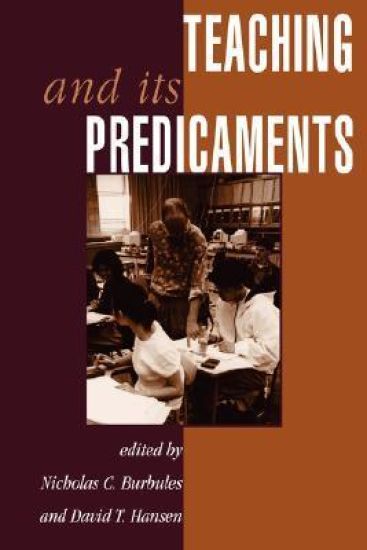
Teaching is a complex and challenging endeavor. Teachers are continually faced with difficult choices in which competing values are set in tension with one another. The interests of all students, and of other groups and constituencies, can rarely be served at the same time. Different educational goals, each desirable in and of itself, often place incompatible demands on teachers, especially in light of the limited resources and time available to most of them. Of course, teaching does have its satisfactions and fulfillments, but increasingly those rewards must be sought in the context of challenges that reflect the competing expectations society places upon educators. These essays tackle important aspects of the complex, often conflicted contexts of teaching. Each chapter focuses on a different aspect of teaching, offering candid analysis of the difficulties and trade-offs inherent in teaching practice, while suggesting ways to productively address a given conflict. Together, the chapters speak honestly to the realities and challenges of teaching, without downplaying the ideals that draw teachers into education in the first place.