Kirjailija
David Hargreaves
Kirjat ja teokset yhdessä paikassa: 16 kirjaa, julkaisuja vuosilta 1991–2021, suosituimpiin kuuluu As We Were: The First World War. Vertaile teosten hintoja ja tarkista saatavuus suomalaisista kirjakaupoista.
16 kirjaa
Kirjojen julkaisuvuodet: 1991–2021.
This first book of original poetry by David Hargreaves in inspired by and steeped in his deep study of Nepal, its culture and its poetry. Lush and allusive, tuned to a background in translating Nepal Bhasa poetry, RUNNING OUT OF WORDS FOR AFTERWARDS gives voice to cycles of desire, loss, and renewal. Like the many rivers that flow through this book, David Hargreaves' poems, in various turns, can be urgent, expansive, unpredictable, or calm, conveying the reader through landscapes both mystical and mundane, through illusions of selfhood, and the struggles of language to accept its own limitations. Poetry. Asian & Asian American Studies.

As We Were: The First World War
David Hargreaves; Margaret-Louise O'Keeffe
Whitefox Publishing Ltd
2021
muu
Fought between 1914 and 1918, World War One - The Great War - was the most titanic and devastating conflict the world had yet seen. Detailing the course of the war week-by-week and the intimate accounts and experiences of soldiers and civilians alike, As We Were offers insight like no other into a war that impacted generations the world over.
Dominic da Silva, in his late fifties, has terminal cancer. This diagnosis prompts him to return to the diaries he kept from his boarding school years into his early thirties. These notebooks conjure lost tableaux of Britain in the 1960s, 70s and early 80s: with the emotional repression and genteel rural poverty of his youth, through to upbeat accounts of later joyful excess and profound friendship. Dominic has the chameleon qualities of the true survivor: by the age of thirty, he has carved out a promising career and is married to a wealthy young lawyer, herself the very epitome of upward mobility. But he’s cursed, it seems, by wanting everything to which he’s supremely ill-suited. A quarter of a century later, it all looks very different. His has, in many ways, been a thwarted existence, and Dominic’s diaries chart his lurching journey towards self-recognition – from grand house parties to a hostel for the homeless, from an apparently perfect life to arrest and ignominy. Under the Table is a powerful homage to truth and friendship – and a recognition of the toughness upon which both depend.
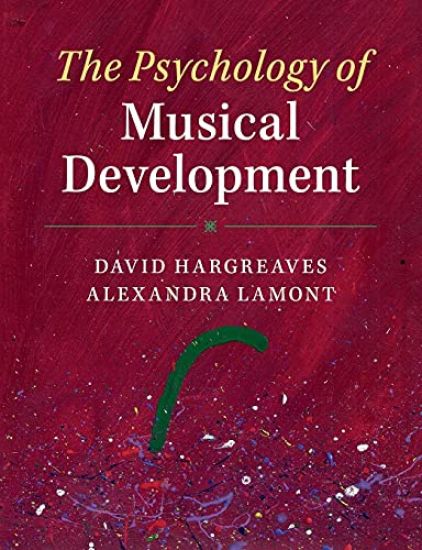
The Psychology of Musical Development
David Hargreaves; Alexandra Lamont
Cambridge University Press
2017
pokkari
The Psychology of Musical Development provides an up-to-date and comprehensive account of the latest theory, empirical research and applications in the study of musical development, an important and emerging field of music psychology. After considering how people now engage with music in the digital world, and reviewing current advances in developmental and music psychology, Hargreaves and Lamont compare ten major theoretical approaches in this field - including cognitive stage models and neuroscientific, ecological and social cognitive approaches - and assess how successfully each of these deals with five critical theoretical issues. Individual chapters deal next with cognition, perception and learning; social development; environmental influences on ability, achievement and motivation; identity, personality and lifestyle; affect and emotion; and well-being and health. With an emphasis on practical applications throughout, this book will be essential reading for students and scholars of music psychology, developmental psychology, music education and music therapy.
The Psychology of Musical Development
David Hargreaves; Alexandra Lamont
Cambridge University Press
2017
sidottu
The Psychology of Musical Development provides an up-to-date and comprehensive account of the latest theory, empirical research and applications in the study of musical development, an important and emerging field of music psychology. After considering how people now engage with music in the digital world, and reviewing current advances in developmental and music psychology, Hargreaves and Lamont compare ten major theoretical approaches in this field - including cognitive stage models and neuroscientific, ecological and social cognitive approaches - and assess how successfully each of these deals with five critical theoretical issues. Individual chapters deal next with cognition, perception and learning; social development; environmental influences on ability, achievement and motivation; identity, personality and lifestyle; affect and emotion; and well-being and health. With an emphasis on practical applications throughout, this book will be essential reading for students and scholars of music psychology, developmental psychology, music education and music therapy.
Disaffection From School (RLE Edu M)
David Hargreaves; Stephen Hester; Frank Mellor
Routledge
2014
nidottu
A large number of pupils are, or are liable to become, disaffected with their schooling. In this comprehensive account of the problem, Ken Reid suggests that school can and should do much more to prevent and overcome disaffected behaviour, as manifested by such factors as absenteeism, disruption and underachievement. The book covers disruptive behaviour in its broader context and examines the search for an explanation within schools themselves. Formal and multidisciplinary approaches to the problem are also fully treated. The author has drawn on his considerable school and research experience and the book is well illustrated with examples and case histories. Ken Reid argues that questions about attitudes and approaches in teaching and in pastoral care provoke a continued challenge, and stresses that if such questions are not faced squarely the long-germ prognosis for secondary education in Britain may be bleak. Teachers in training and all those involved in the education and welfare of difficult or disadvantaged children, especially teachers, heads and social workers, will find Disaffection from School both challenging in its analysis and helpful in its suggestions.
By 1982 the ambitious claims made for newly established comprehensive schools were being put to the test. How effectively does the comprehensive meet the needs of all young people? Do urban, working-class students enjoy more success than in the secondary modern schools? Are they more engaged in their learning with higher self-esteem? This volume discusses these questions and examines issues of social mobility and cohesion, curriculum, the balance between academic and vocational education, the place of exams in the educational system and the influence of independent schools. The author asks whether a more decentralised system of self-governing schools improve the education service – a timely question which along with the other issues examined is as relevant and challenging today as when the book was originally published in 1982.
Deviance in Classrooms (RLE Edu M)
David Hargreaves; Stephen Hester; Frank Mellor
Routledge
2014
nidottu
When originally published this book reported the first major application of ‘labelling theory’ to deviance in classrooms. The authors explore the nature of classroom rules, show how they constitute a pervasive feature of the classroom, and examine the ways in which teachers use these rules as grounds for imputing ‘deviance’ to pupils. A theory of social typing is developed to show how teachers come to define certain pupils as deviant persons such as ‘troublemakers’ and several case-studies are used to document this analysis. Finally, the teachers’ reactions to disruptive classroom conduct are examined as complex strategic attempts at social control in the classroom. The book has a double focus on deviance theory and the process of teaching.
Deviance in Classrooms (RLE Edu M)
David Hargreaves; Stephen Hester; Frank Mellor
Routledge
2011
sidottu
When originally published this book reported the first major application of ‘labelling theory’ to deviance in classrooms. The authors explore the nature of classroom rules, show how they constitute a pervasive feature of the classroom, and examine the ways in which teachers use these rules as grounds for imputing ‘deviance’ to pupils. A theory of social typing is developed to show how teachers come to define certain pupils as deviant persons such as ‘troublemakers’ and several case-studies are used to document this analysis. Finally, the teachers’ reactions to disruptive classroom conduct are examined as complex strategic attempts at social control in the classroom. The book has a double focus on deviance theory and the process of teaching.
By 1982 the ambitious claims made for newly established comprehensive schools were being put to the test. How effectively does the comprehensive meet the needs of all young people? Do urban, working-class students enjoy more success than in the secondary modern schools? Are they more engaged in their learning with higher self-esteem? This volume discusses these questions and examines issues of social mobility and cohesion, curriculum, the balance between academic and vocational education, the place of exams in the educational system and the influence of independent schools. The author asks whether a more decentralised system of self-governing schools improve the education service – a timely question which along with the other issues examined is as relevant and challenging today as when the book was originally published in 1982.
Disaffection From School (RLE Edu M)
David Hargreaves; Stephen Hester; Frank Mellor
Routledge
2011
sidottu
A large number of pupils are, or are liable to become, disaffected with their schooling. In this comprehensive account of the problem, Ken Reid suggests that school can and should do much more to prevent and overcome disaffected behaviour, as manifested by such factors as absenteeism, disruption and underachievement. The book covers disruptive behaviour in its broader context and examines the search for an explanation within schools themselves. Formal and multidisciplinary approaches to the problem are also fully treated. The author has drawn on his considerable school and research experience and the book is well illustrated with examples and case histories. Ken Reid argues that questions about attitudes and approaches in teaching and in pastoral care provoke a continued challenge, and stresses that if such questions are not faced squarely the long-germ prognosis for secondary education in Britain may be bleak. Teachers in training and all those involved in the education and welfare of difficult or disadvantaged children, especially teachers, heads and social workers, will find Disaffection from School both challenging in its analysis and helpful in its suggestions.
Drawing on the great wealth of knowledge and experience of education practitioners and theorists, the volumes in the Sociology of Education set of the International library of Sociology explore the very important relationship between education and society. These books became standard texts for actual and intending teachers. Drawing upon comparative material from Israel, France and Germany, titles in this set also discuss the key questions of girls' and special needs education, and the psychology of education.
The Social and Applied Psychology of Music
Adrian North; David Hargreaves
Oxford University Press
2008
nidottu
Music is so ubiquitous that it can be easy to overlook the powerful influence it exerts in so many areas of our lives - from birth, through childhood, to old age. The Social and Applied Psychology of Music is the successor to the bestselling and influential The Social Psychology of Music. It considers the value of music in everyday life, answering some of the perennial questions about music. The book begins with a scene-setting chapter that describes the academic background to the book, before looking at composition and musicianship. It then goes on to look at musical preference. What aspects of music are crucial in determining whether or not you will like it? In chapter 4 the authors consider whether rap and rock are bad for young people, highlighting some of the major moral scandals that have rocked pop music, and asking whether these have become more extreme over time. The following chapter looks at music as a commercial product. How does the structure of the music industry influence CD purchasing, and how does music affect customers in retail and leisure settings like shops and restaurants? The book closes with an examination of music education. How does musical ability develop in children, and how does this relate to more general theories of how intellectual skills develop? Do musical skills develop independently of other abilities? Exceptionally broad in scope, and written in a highly accessible style by the leading researchers in this field, The Social and Applied Psychology of Music will be required reading for anyone seeking an understanding of the role music plays in our lives.
Drawing on the great wealth of knowledge and experience of educational practitioners and theorists, these volumes explore the very important relationship between education and society. Including classic work by David Hargreaves, these books became standard texts for actual and intending teachers. Drawing upon comparative material from Israel, France and Germany, titles in this set also discuss the key questions of girls' and special needs education, and the psychology of education.
Drawing on the great wealth of knowledge and experience of education practitioners and theorists, the volumes in the Sociology of Education set of the International library of Sociology explore the very important relationship between education and society. These books became standard texts for actual and intending teachers. Drawing upon comparative material from Israel, France and Germany, titles in this set also discuss the key questions of girls' and special needs education, and the psychology of education.
This book looks afresh at German unification and the vexed role played by Bismarck. Using exclusively primary source material, it seeks to evaluate more exactly the nature of Bismarck's responsibility in the evolution towards unity, and the role of economic and demographic factors by way of contrast. Beginning with a longer term view of unification between 1815 and 1848, the book seeks to test, and ultimately to challenge, certain key assumptions, by way of a concise but thorough examination of key episodes.