

Kirjailija
David Hitchens
Kirjat ja teokset yhdessä paikassa: 7 kirjaa, julkaisuja vuosilta 1998–2017, suosituimpiin kuuluu Small and Medium Sized Companies in Europe. Vertaile teosten hintoja ja tarkista saatavuus suomalaisista kirjakaupoista.
7 kirjaa
Kirjojen julkaisuvuodet: 1998–2017.


Like word searches, puzzles, cryptograms and coffee? While enjoying your favourite roast, you can brush up on all things coffee. You are safe in the knowledge that your answers are something to do with this wonderful beverage. Great gift idea for coffee lovers
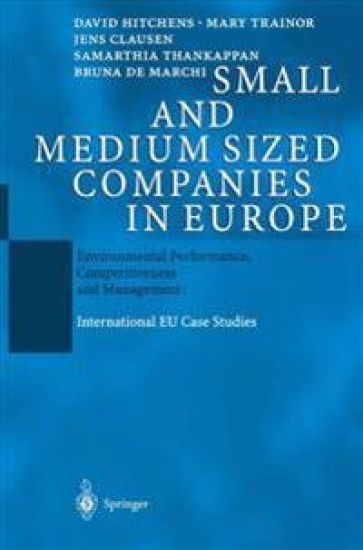
Small and Medium Sized Companies in Europe
David Hitchens; Mary Trainor; Jens Clausen; Samarthia Thankappan; Bruna de Marchi
Springer-Verlag Berlin and Heidelberg GmbH Co. K
2010
nidottu
1. 1 Aims and Objectives The major aim of this research is to identify and weigh the importance of factors that promote and constrain, the adoption of environmental initiatives by small and medium sized enterprises (SMEs). The objective is to inform how policy can overcome obstacles so as to promote the adoption of cleaner technology (includ ing environmentally sensitive products (Oosterhuis et al. 1996)) by industry. Cen tral to the research is the testing of a set of hypotheses, which, inter alia, relate the adoption of cleaner technologies to competitiveness, management culture and the importance of the provision of information. The manufacturing sectors consid ered are those dominated by SMEs where product and process environmental re sponse by the firm is important. Of these sectors, furniture, textile finishing, and fruit and vegetable processing were chosen. More specifically the focus is on European SMEs i. e. those employing less than 250 employees. ' Variations within the EU with respect to environmental regulation are exemplified by a study of firms (and plants) across four member states: Germany, North-east Italy, Republic of Ireland and the United Kingdom. The adoption of clean technologies has been slow and uneven and action has mainly involved good housekeeping. Major changes involving large capital spend ing, or material substitution, process redesign or reformulation have been rela tively rare (OECD 1985, 1995; Ashford 1993). The problem is particularly acute amongst SMEs (and the majority of enterprises are SMEs; e. g.
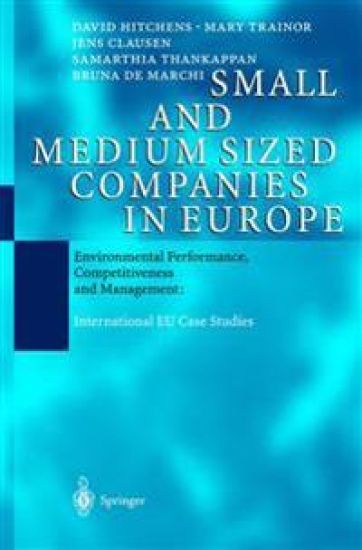
Small and Medium Sized Companies in Europe
David Hitchens; Mary Trainor; Jens Clausen; Samarthia Thankappan; Bruna de Marchi
Springer-Verlag Berlin and Heidelberg GmbH Co. K
2003
sidottu
1. 1 Aims and Objectives The major aim of this research is to identify and weigh the importance of factors that promote and constrain, the adoption of environmental initiatives by small and medium sized enterprises (SMEs). The objective is to inform how policy can overcome obstacles so as to promote the adoption of cleaner technology (includ ing environmentally sensitive products (Oosterhuis et al. 1996)) by industry. Cen tral to the research is the testing of a set of hypotheses, which, inter alia, relate the adoption of cleaner technologies to competitiveness, management culture and the importance of the provision of information. The manufacturing sectors consid ered are those dominated by SMEs where product and process environmental re sponse by the firm is important. Of these sectors, furniture, textile finishing, and fruit and vegetable processing were chosen. More specifically the focus is on European SMEs i. e. those employing less than 250 employees. ' Variations within the EU with respect to environmental regulation are exemplified by a study of firms (and plants) across four member states: Germany, North-east Italy, Republic of Ireland and the United Kingdom. The adoption of clean technologies has been slow and uneven and action has mainly involved good housekeeping. Major changes involving large capital spend ing, or material substitution, process redesign or reformulation have been rela tively rare (OECD 1985, 1995; Ashford 1993). The problem is particularly acute amongst SMEs (and the majority of enterprises are SMEs; e. g.
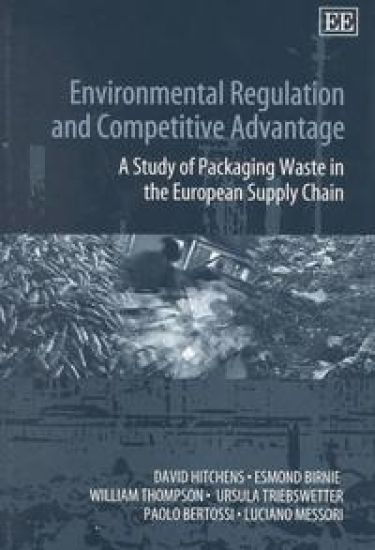
Environmental Regulation and Competitive Advantage
David Hitchens; Esmond Birnie; William Thompson; Ursula Triebswetter; Paolo Bertossi; Luciano Messori
Edward Elgar Publishing Ltd
2000
sidottu
This study focuses in detail on the environmental compliance/competitiveness relationship with respect to the regulation of packaging waste. An important and innovative feature of the study is its emphasis on backward and forward linkages. An entire supply chain is considered: packaging manufacturers and suppliers, food processors and the food retail sector, to study the competitive effects of environmental standards on manufacturing companies and the vertical links and supply responses. A variety of regulatory regimes is represented by including within the study companies from Germany, Italy, the Republic of Ireland and the United Kingdom. While it is of note that the relatively strong regulation in Germany has indeed had effects on company behaviour, there is no evidence that environmental regulations hindered companies from achieving competitive performance. Analyses consider: the response of individual firms to different levels of regulation; the cost of compliance; impact on employment; the influence of the supply chain on environmental and competitive performance; the importance of firm size and ownership; and the impact of regulation on competitiveness, and firm competitiveness on the efficiency of adjustment to regulation.
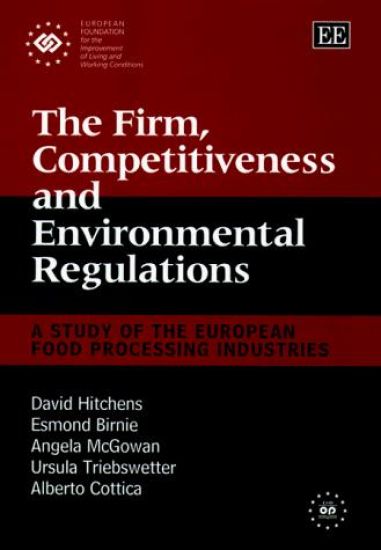
The Firm, Competitiveness and Environmental Regulations
David Hitchens; Esmond Birnie; Angela McGowan; Ursula Triebswetter; Alberto Cottica
Edward Elgar Publishing Ltd
1998
sidottu
Do environmental regulations harm international competitiveness? In answer to this question, this book focuses on the impact of regulatory policies on competitiveness and employment at the firm level. It investigates the trade-off between environmental regulations and competitiveness across countries and regions throughout Europe, using the food processing industry as a case study. The authors compare and contrast the experiences of similar firms across Europe to examine the different costs firms face in applying environmental regulations and the different levels of competitiveness they achieve as a result. The investigation includes a detailed and thorough comparison of the European food processing industries using 67 company case studies. The results show that firms can achieve national or international levels of competitiveness even when they face a relatively unfavourable level of regulatory costs. These important findings will almost certainly have general application to small and medium sized firms in other industries. This book will be welcomed by policymakers, practitioners, researchers and academics interested in industrial economics, environmental management and environmental economics.