Kirjojen hintavertailu – 12 903 724 kirjaa ja 27 kauppaa

Kirjailija

David J. Berghuis

Kirjat ja teokset yhdessä paikassa: 55 kirjaa, julkaisuja vuosilta 1998–2024, suosituimpiin kuuluu The Couples Psychotherapy Treatment Planner, with DSM-5 Updates. Vertaile teosten hintoja ja tarkista saatavuus suomalaisista kirjakaupoista.

55 kirjaa

Kirjojen julkaisuvuodet: 1998–2024.

Evidence-Based Treatment Planning for Depression Workbook

Evidence-Based Treatment Planning for Depression Workbook

David J. Berghuis; Timothy J. Bruce

John Wiley Sons Inc
2011
nidottu
Improve the Quality of Mental Health Care This Companion Workbook to the Evidence-Based Treatment Planning for Depression DVD is designed to be used in conjunction with the DVD, which is focused on teaching mental health professionals about empirically informed treatment for depression. The Workbook reinforces the key points covered in the DVD and helps assess the level of mastery of basic concepts through discussion and test questions. It can be used as part of a self-paced learning tool or as a team collaborative tool. This Companion Workbook includes: Summary highlights of content shown in the DVD Full transcripts of the DVD's vignettes demonstrating cognitive restructuring, behavioral activation, and problem solving Discussion questions Chapter review test questions and answers Empirical support chapter references Clinical resource chapter references Also available: Evidence-Based Treatment Planning for Depression DVD / 978-0-470-41506-1 This DVD offers clear, step-by-step guidance on the process and criteria for diagnosing depression and using empirically supported treatments to inform the treatment planning process. Evidence-Based Treatment Planning for Depression DVD Facilitator's Guide / 978-0-470-54854-7 The Facilitator's Guide assists professionals in leading an educational training session. Other DVDs, Facilitator Guides, and Workbooks in the Evidence-Based Psychotherapy Treatment Planning Video Series: Evidence-Based Psychotherapy Treatment Planning Evidence-Based Treatment Planning for Panic Disorder Evidence-Based Treatment Planning for Social Anxiety Disorder For more information on these and forthcoming titles in the Evidence-Based Psychotherapy Treatment Planning Video Series, visit us on the Web at wiley.com/psychology
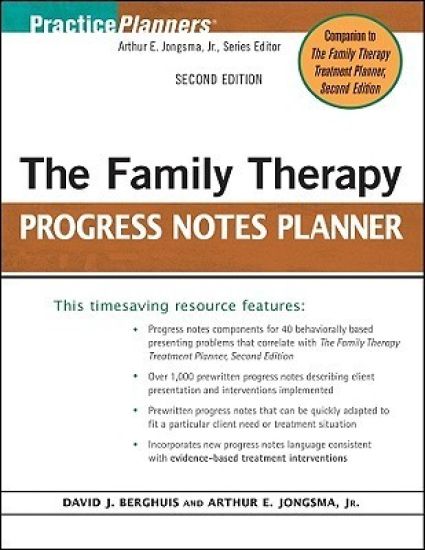
The Family Therapy Progress Notes Planner

The Family Therapy Progress Notes Planner

Arthur E. Jongsma; David J. Berghuis

John Wiley Sons Inc
2010
nidottu
The Bestselling treatment planning system for mental health professionals The Family Therapy Progress Notes Planner, Second Edition contains complete prewritten session and patient presentation descriptions for each behavioral problem in The Family Therapy Treatment Planner, Second Edition. The prewritten progress notes can be easily and quickly adapted to fit a particular client need or treatment situation. Saves you hours of time-consuming paperwork, yet offers the freedom to develop customized progress notes Organized around 40 behaviorally based presenting problems, including family-of-origin interference, depression in family members, divorce, financial conflict, adolescent and parent hostility, friction within blended families, traumatic life events, and dependency issues Features over 1,000 prewritten progress notes (summarizing patient presentation, themes of session, and treatment delivered) Provides an array of treatment approaches that correspond with the behavioral problems and DSM-IV-TRTM diagnostic categories in The Family Therapy Treatment Planner, Second Edition Offers sample progress notes that conform to the requirements of most third-party payors and accrediting agencies, including CARF, The Joint Commission (TJC), COA, and the NCQA Presents new and updated information on the role of evidence-based practice in progress notes writing and the special status of progress notes under HIPAA
Evidence-Based Treatment Planning for Social Anxiety Disorder Workbook

Evidence-Based Treatment Planning for Social Anxiety Disorder Workbook

David J. Berghuis; Timothy J. Bruce

John Wiley Sons Inc
2010
nidottu
This Companion Workbook to the Evidence-Based Treatment Planning for Social Anxiety Disorder DVD is designed to be used in conjunction with the DVD, which is focused on informing mental health professionals about empirically informed treatment for panic disorder. The workbook reinforces the key points covered in the DVD and helps assess the level of mastery of basic concepts through discussion and test questions. It can also be used as part of a self-paced learning tool or as a team collaborative tool. The Companion Workbook includes: Summary highlights of content shown in the DVDFull transcripts of the DVD's vignettes demonstrating cognitive and behavioral coping skills, cognitive restructuring, physical sensation exposure, and situational exposureDiscussion questionsChapter review test questions and answersEmpirical support chapter referencesClinical resource chapter references
Evidence-Based Treatment Planning for Depression Facilitator's Guide

Evidence-Based Treatment Planning for Depression Facilitator's Guide

David J. Berghuis; Timothy J. Bruce

John Wiley Sons Inc
2010
nidottu
This Facilitator’s Guide is designed to help lead an educational training session in empirically informed treatment planning. It is to be used in conjunction with the DVD and Companion Workbook (both sold separately). The guide explains the process of delivering a training session. In this guide you will find in each chapter: Chapter Review Questions and AnswersChapter Review Test Questions and AnswersOptional Discussion Questions with Talking PointsChapter References In appropriate chapters the references are divided into those for "Empirical Support," those for "Clinical Resources," and those for "Bibliotherapy Resources." The Facilitator's Guide has brief summaries of the answers to the chapter review questions. The "Chapter Review Test Questions" section contains "test-style" questions that can be asked of participants or taken by them as a self-test. The Facilitator's Guide contains the answers to these questions, which can then be reviewed. The "For Discussion" section offers a selected discussion topic as well as talking points to help facilitate the discussion. This section is designed to offer facilitators the option of exploring a key concept further should he or she desire. Finally, Chapter Five (“How Do You Integrate ESTs into Treatment Planning?”) contains highlights of the lecture material, summary of treatment plan components, an outline of the EST procedures, transcripts of psychotherapy vignettes that demonstrate ESTs, and critiques of the vignettes. References are also made to homework assignments contained in the Companion Workbook that demonstrate selected therapeutic interventions discussed in the DVD. Appendix A: Explanations of all correct and incorrect answer options
Evidence-Based Treatment Planning for Panic Disorder Workbook

Evidence-Based Treatment Planning for Panic Disorder Workbook

David J. Berghuis; Timothy J. Bruce

John Wiley Sons Inc
2010
nidottu
Improve the Quality of Mental Health Care This Companion Workbook to the Evidence-Based Treatment Planning for Panic Disorder DVD is designed to be used in conjunction with the DVD, which is focused on informing mental health professionals about empirically informed treatment for panic disorder. The Workbook reinforces the key points covered in the DVD and helps assess the level of mastery of basic concepts through discussion and test questions. It can also be used as part of a self-paced learning tool or as a team collaborative tool. This Companion Workbook includes: Summary highlights of content shown in the DVD Full transcripts of the DVD's vignettes demonstrating cognitive and behavioral coping skills, cognitive restructuring, physical sensation exposure, and situational exposure Discussion questions Chapter review test questions and answers Empirical support chapter references Clinical resource chapter references Also available: Evidence-Based Treatment Planning for Panic Disorder DVD / 978-0-470-41793-5 This DVD offers clear, step-by-step guidance on the process and criteria for diagnosing panic disorder and using empirically supported treatments for panic disorder to inform the treatment planning process. Evidence-Based Treatment Planning for Panic Disorder DVD Facilitator's Guide / 978-0-470-54856-1 The Facilitator's Guide assists professionals in leading an educational training session. Other DVDs, Facilitator Guides, and Workbooks in the Evidence-Based Psychotherapy Treatment Planning Video Series: Evidence-Based Psychotherapy Treatment Planning Evidence-Based Treatment Planning for Social Anxiety Disorder Evidence-Based Treatment Planning for Depression For more information on these and forthcoming titles in the Evidence-Based Psychotherapy Treatment Planning Video Series, visit us on the Web at wiley.com/psychology

Evidence-Based Psychotherapy Treatment Planning Workbook

Evidence-Based Psychotherapy Treatment Planning Workbook

David J. Berghuis; Timothy J. Bruce

John Wiley Sons Inc
2010
nidottu
With the need for patients to receive care that is proven effective arises as well the need to train mental health practitioners in the latest in Evidence-Based Practice (EBP). Evidence-Based Psychotherapy Treatment Planning DVD Workbook covers the most common DSM-IV-TR disorders and other presenting problems. This workbook demonstrates the techniques and treatment interventions covered in the DVD (sold separately). Staff are guided in their implementation of the interventions with their clients. Ideal for training mental health professionals at any level.
The Veterans and Active Duty Military Psychotherapy Progress Notes Planner

The Veterans and Active Duty Military Psychotherapy Progress Notes Planner

Arthur E. Jongsma; David J. Berghuis

JOHN WILEY SONS INC
2010
nidottu
The Veterans and Active Duty Military Psychotherapy Progress Notes Planner contains complete prewritten session and patient presentation descriptions for each behavioral problem in The Veterans and Active Duty Military Psychotherapy Treatment Planner. The prewritten progress notes can be easily and quickly adapted to fit a particular client need or treatment situation. Saves you hours of time-consuming paperwork, yet offers the freedom to develop customized progress notes Organized around 39 behaviorally based presenting problems, including nightmares, post- deployment reintegration, combat and operational stress reaction, amputation and/or loss of mobility, adjustment to killing, and depression Features over 1,000 prewritten progress notes (summarizing patient presentation, themes of session, and treatment delivered) Provides an array of treatment approaches that correspond with the behavioral problems and DSM-IV-TR diagnostic categories in The Veterans and Active Duty Military Psychotherapy Treatment Planner Offers sample progress notes that conform to the requirements of most third-party payors and accrediting agencies, including CARF, The Joint Commission (TJC), COA, and the NCQA Presents new and updated information on the role of evidence-based practice in progress notes writing and the special status of progress notes under HIPAA
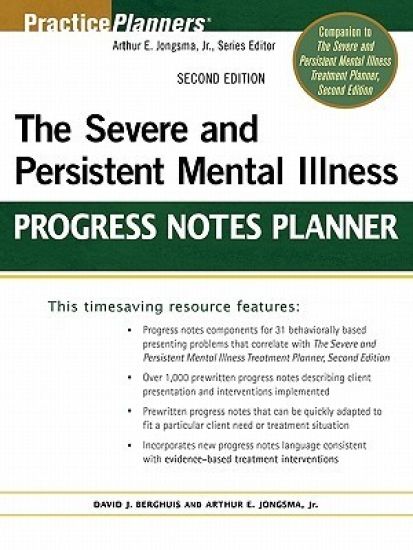
The Severe and Persistent Mental Illness Progress Notes Planner

The Severe and Persistent Mental Illness Progress Notes Planner

David J. Berghuis; Arthur E. Jongsma

John Wiley Sons Inc
2008
nidottu
The flexible format of The Severe and Persistent Mental Illness Progress Notes Planner, 2nd Edition enables you to choose between evidence based and traditional “best practice” treatment approaches for your patients. Fully revised to meet your needs as a mental health professional working in today’s long-term care facilities, this time-saving resource will save you hours of time-consuming paperwork without sacrificing your ability to develop customized progress notes. This guide is organized around 31 behaviorally based issues, from employment problems and family conflicts, to financial needs and homelessness, to intimate relationship conflicts and social anxiety.
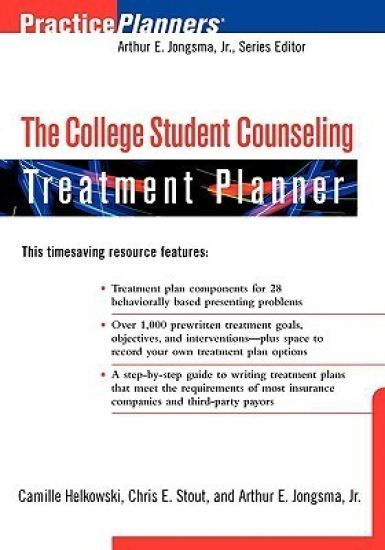
The College Student Counseling Treatment Planner

The College Student Counseling Treatment Planner

Camille Helkowski; Chris E. Stout; David J. Berghuis

John Wiley Sons Inc
2004
nidottu
The College Student Counseling Treatment Planner provides all the elements necessary to quickly and easily develop formal treatment plans that satisfy the demands of HMOs, managed care companies, third-party payors, and state and federal review agencies. *Saves you hours of time-consuming paperwork, yet offers the freedom to develop customized treatment plans for young adult clients *Organized around 28 main presenting problems, from academic performance anxiety and financial stress to depression, suicidal ideation, and chemical dependence *Over 1,000 well-crafted, clear statements describe the behavioral manifestations of each relational problem, long-term goals, short-term objectives, and clinically tested treatment options *Easy-to-use reference format helps locate treatment plan components by behavioral problem or DSM-IV-TR™ diagnosis *Includes a sample treatment plan that conforms to the requirements of most third-party payors and accrediting agencies (including HCFA, JCAHO, and NCQA)
The Speech-Language Pathology Treatment Planner

The Speech-Language Pathology Treatment Planner

Keith Landis; Judith Vander Woude; David J. Berghuis

John Wiley Sons Inc
2004
nidottu
This timesaving resource features: Treatment plan components for 26 speech-language disorders *Over 1,000 prewritten treatment goals, objectives, and interventions—plus space to record your own treatment plan options *A step-by-step guide to writing treatment plans that meet the requirements of most insurance companies and third-party payors PracticePlanners® The Bestselling treatment planning system for mental health professionals The Speech-Language Pathology Treatment Planner provides all the elements necessary to quickly and easily develop formal treatment plans that satisfy the demands of HMOs, managed care companies, and third-party payors. This book helps both the novice and expert speech-language pathologist to identify functional and meaningful strategies for improving a client's communication skills. *Saves you hours of time-consuming paperwork, yet offers the freedom to develop customized treatment plans for adult, child, and adolescent clients *Organized around 26 main speech-language disabilities, from those associated with aphasia and dysarthria to dysphagia, language disorders, alternative and augmentative communication, voice disorders, and others *Over 1,000 well-crafted, clear statements describe the behavioral manifestations of each communication disorder, long-term goals, short-term goals, and clinically tested treatment options *Easy-to-use reference format helps locate treatment plan components by disability *Handy workbook-style format affords plenty of space to record your own customized definitions, goals, objectives, and interventions Additional resources in the PracticePlanners® series: *Homework Planners feature behaviorally based, ready-to-use assignments to speed treatment and keep clients engaged between sessions. *Documentation Sourcebooks provide the forms and records that mental health professionals need to efficiently run their practice. For more information on our PracticePlanners® products, including our full line of Treatment Planners, visit us on the Web at: www.wiley.com/practiceplanners
The Psychopharmacology Treatment Planner

The Psychopharmacology Treatment Planner

David C. Purselle; Charles B. Nemeroff; David J. Berghuis

John Wiley Sons Inc
2003
nidottu
The Psychopharmacology Treatment Planner provides all the elements necessary to quickly and easily develop formal treatment plans that satisfy the demands of HMOs, managed care companies, third-party payors, and state and federal review agencies. *Saves you hours of time-consuming paperwork, yet offers the freedom to develop customized treatment plans for clients whose therapy includes psychotropic drugs *Organized around 28 main presenting problems regularly treated with a combination of psychotropic and psychotherapeutic interventions or treatment modalities, from ADHD, dementia, and substance abuse to antisocial behavior, bipolar disorders, and more *Over 1,000 well-crafted, clear statements describe the behavioral manifestations of each relational problem, long-term goals, short-term objectives, and clinically tested treatment options *Easy-to-use reference format helps locate treatment plan components by behavioral problem or DSM-IV-TR™ diagnosis *Includes a sample treatment plan that conforms to the requirements of most third-party payors and accrediting agencies (including HCFA, JCAHO, and NCQA)
The Special Education Treatment Planner

The Special Education Treatment Planner

Julie A. Winkelstern; David J. Berghuis

John Wiley Sons Inc
2001
nidottu
PracticePlanners® The Bestselling treatment planning system for mental health professionals The Special Education Treatment Planner provides all the elements necessary to quickly and easily develop formal education treatment plans that take the educational professional a step further past the writing of goals for Individualized Education Plans (IEPs). The educational treatment plan process assists the professional in identifying interventions and communicating to others the specific method, means, format, and/or creative experience by which the student will be assisted in attaining IEP goals. *Offers the freedom to develop customized educational treatment plans for children and adolescents who have special learning needs *Organized around 29 main educational disabilities, from learning disabilities and emotional/mental impairment to ADHD, chronic health issues, autism, and others *Over 1,000 well-crafted, clear statements describe the behavioral manifestations of each educational disability, long-term goals, short-term objectives, and educational interventions *Easy-to-use reference format helps locate educational treatment plan components by disability *Includes a sample educational treatment plan Additional resources in the PracticePlanners® series: Homework Planners feature behaviorally based, ready-to-use assignments to speed treatment and keep clients engaged between sessions. Documentation Sourcebooks provide the forms and records that mental health professionals need to efficiently run their practice. For more information on our PracticePlanners® products, including our full line of Treatment Planners, visit us on the Web at: www.practiceplanners.wiley.com
The Rehabilitation Psychology Treatment Planner

The Rehabilitation Psychology Treatment Planner

Michele J. Rusin; David J. Berghuis

John Wiley Sons Inc
2001
nidottu
The Rehabilitation Psychology Treatment Planner provides allthe elements necessary to quickly and easily develop formaltreatment plans that satisfy the demands of HMOs, managed carecompanies, third-party payers, and state and federal reviewagencies. * Saves you hours of time-consuming paperwork, yet offers thefreedom to develop customized treatment plans forneuropsychological rehabilitation * Organized around 25 main presenting problems, from depressionand impaired judgement to substance abuse, aggression, anxiety, andothers * Over 1,000 well-crafted, clear statements describe thebehavioral manifestations of each relational problem, long-termgoals, short-term objectives, and clinically tested treatmentoptions * Easy-to-use reference format helps locate treatment plancomponents by behavioral problem or DSM-IV(TM) diagnosis * Includes a sample treatment plan that conforms to therequirements of most third-party payers and accrediting agencies(including HCFA, JCAHO, and NCQA)
The Behavioral Medicine Treatment Planner

The Behavioral Medicine Treatment Planner

Douglas E. DeGood; Angela L. Crawford; David J. Berghuis

John Wiley Sons Inc
1999
nidottu
This invaluable sourcebook features pre-written treatment plan components for the field of behavioral medicine, including behavioral definitions, long-term goals, short-term objectives, therapeutic interventions, and DSM-IV diagnoses. The Behavioral Medicine Treatment Planner covers the psychological aspects of coping with illnesses such as cancer, chronic fatigue syndrome, diabetes, headaches, AIDS, and more. Psychologists, counselors, therapists, and other mental health professionals who work in medical settings will find this Planner indispensable.
The Employee Assistance Treatment Planner

The Employee Assistance Treatment Planner

James M. Oher; Daniel J. Conti; David J. Berghuis

John Wiley Sons Inc
1998
nidottu
Treatment plan components for 28 DSM-IVTM and behaviorally based problems that impact work performance. A step-by-step guide to treatment planning 1000s of prewritten treatment goals, objectives, and interventions for work-related problems. Handy workbook format with space to record your own treatment options Over 100,000 PracticePlannersTM sold Saves you hours of painstaking paperwork while offering optimum latitude in developing customized treatment plans for most problems encountered in employee assistance programs. This valuable sourcebook supplies EAP counselors and mental health clinicians who work with employee assistance programs with all of the essential building blocks they need to quickly create focused, formal treatment plans that fully satisfy the demands of third-party payers, accrediting agencies, and state and federal review agencies. Following the same format as the bestselling The Complete Psychotherapy Treatment Planner, it is organized around 28 major presenting problems encountered in employee assistance programs, including chemical dependence, low self-esteem, career burnout, job loss, and more. Practical, progressive, and focused on problem-resolution, The Employee Assistance Treatment Planner features: *1,000s of well-crafted statements to choose from, describing behavioral manifestations, long- and short-term goals, and treatment options *A sample plan that can be emulated in writing plans that meet all requirements of third-party payers and accrediting agencies, including the JCAHO *A presenting problem list, including all relevant DSM-IVTM categories *A quick-reference format that lets you locate treatment plan components by behavioral problem or DSM-IV diagnosis *Large workbook-style pages affording plenty of space to record your own customized goals, objectives, and interventions.