Kirjojen hintavertailu – 12 903 725 kirjaa ja 27 kauppaa

Kirjailija

David J Murray

Kirjat ja teokset yhdessä paikassa: 30 kirjaa, julkaisuja vuosilta 2007–2022, suosituimpiin kuuluu Interchange and Other Poems. Vertaile teosten hintoja ja tarkista saatavuus suomalaisista kirjakaupoista.

Nimi esiintyy myös muodoissa: David J. Murray

30 kirjaa

Kirjojen julkaisuvuodet: 2007–2022.

The Creation of Scientific Psychology

The Creation of Scientific Psychology

David J. Murray; Stephen W. Link

TAYLOR FRANCIS LTD
2022
nidottu
With an emphasis on developments taking place in Germany during the nineteenth century, this book provides in-depth examinations of the key contributions made by the pioneers of scientific psychology. Their works brought measurement and mathematics into the study of the mind. Through unique analysis of measurement theory by Whewell, mathematical developments by Gauss, and theories of mental processes developed by Herbart, Weber, Fechner, Helmholtz, Müller, Delboeuf and others, this volume maps the beliefs, discoveries, and interactions that constitute the very origins of psychophysics and its offspring Experimental Psychology. Murray and Link expertly combine nuanced understanding of linguistic and historic factors to identify theoretical approaches to relating physicalintensities and psychological magnitudes. With an eye to interactions and influences on future work in the field, the volume illustrates the important legacy that mathematical developments in the nineteenth century have for twentieth and twenty-first century psychologists. This detailed and engaging account fills a deep gap in the history of psychology. The Creation of Scientific Psychology will appeal to researchers, academics, and students in the fields of history of psychology, psychophysics, scientific, and mathematical psychology.

The Creation of Scientific Psychology

The Creation of Scientific Psychology

David J. Murray; Stephen W. Link

Routledge
2020
sidottu
With an emphasis on developments taking place in Germany during the nineteenth century, this book provides in-depth examinations of the key contributions made by the pioneers of scientific psychology. Their works brought measurement and mathematics into the study of the mind. Through unique analysis of measurement theory by Whewell, mathematical developments by Gauss, and theories of mental processes developed by Herbart, Weber, Fechner, Helmholtz, Müller, Delboeuf and others, this volume maps the beliefs, discoveries, and interactions that constitute the very origins of psychophysics and its offspring Experimental Psychology. Murray and Link expertly combine nuanced understanding of linguistic and historic factors to identify theoretical approaches to relating physicalintensities and psychological magnitudes. With an eye to interactions and influences on future work in the field, the volume illustrates the important legacy that mathematical developments in the nineteenth century have for twentieth and twenty-first century psychologists. This detailed and engaging account fills a deep gap in the history of psychology. The Creation of Scientific Psychology will appeal to researchers, academics, and students in the fields of history of psychology, psychophysics, scientific, and mathematical psychology.

Interchange and Other Poems

Interchange and Other Poems

David J Murray

iUniverse
2019
sidottu
This is a collection of poetry that weaves together many different components of life using the thread of our most unavoidable emotion-confusion. Language and content combine beautifully as Murray seamlessly blends concrete detail into abstraction. This mellifluous marriage of the tangible and the universal shows that confusion is an emotion as valuable to the human experience as fear or grief or even love. We move smoothly from one aspect of life to another, from one poem to the next, carried along by the familiar and inevitable undercurrent of confusion.
Interchange and Other Poems

Interchange and Other Poems

David J Murray

iUniverse
2019
pokkari
This is a collection of poetry that weaves together many different components of life using the thread of our most unavoidable emotion-confusion. Language and content combine beautifully as Murray seamlessly blends concrete detail into abstraction. This mellifluous marriage of the tangible and the universal shows that confusion is an emotion as valuable to the human experience as fear or grief or even love. We move smoothly from one aspect of life to another, from one poem to the next, carried along by the familiar and inevitable undercurrent of confusion.
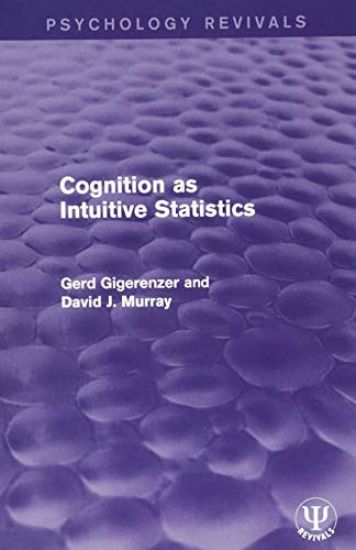
Cognition as Intuitive Statistics

Cognition as Intuitive Statistics

Gerd Gigerenzer; David J. Murray

Psychology Press Ltd
2017
nidottu
Originally published in 1987, this title is about theory construction in psychology. Where theories come from, as opposed to how they become established, was almost a no-man’s land in the history and philosophy of science at the time. The authors argue that in the science of mind, theories are particularly likely to come from tools, and they are especially concerned with the emergence of the metaphor of the mind as an intuitive statistician. In the first chapter, the authors discuss the rise of the inference revolution, which institutionalized those statistical tools that later became theories of cognitive processes. In each of the four following chapters they treat one major topic of cognitive psychology and show to what degree statistical concepts transformed their understanding of those topics.
Cognition as Intuitive Statistics

Cognition as Intuitive Statistics

Gerd Gigerenzer; David J. Murray

Psychology Press Ltd
2015
sidottu
Originally published in 1987, this title is about theory construction in psychology. Where theories come from, as opposed to how they become established, was almost a no-man’s land in the history and philosophy of science at the time. The authors argue that in the science of mind, theories are particularly likely to come from tools, and they are especially concerned with the emergence of the metaphor of the mind as an intuitive statistician. In the first chapter, the authors discuss the rise of the inference revolution, which institutionalized those statistical tools that later became theories of cognitive processes. In each of the four following chapters they treat one major topic of cognitive psychology and show to what degree statistical concepts transformed their understanding of those topics.