Kirjojen hintavertailu – 12 878 284 kirjaa ja 26 kauppaa

Kirjailija

David J. Schmidly

Kirjat ja teokset yhdessä paikassa: 8 kirjaa, julkaisuja vuosilta 1991–2023, suosituimpiin kuuluu The Mammals of Texas. Vertaile teosten hintoja ja tarkista saatavuus suomalaisista kirjakaupoista.

8 kirjaa

Kirjojen julkaisuvuodet: 1991–2023.

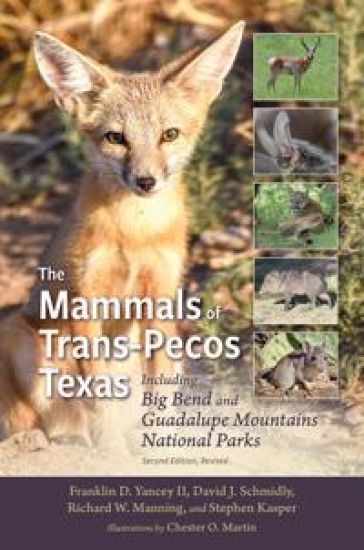
The Mammals of Trans-Pecos Texas

The Mammals of Trans-Pecos Texas

Franklin D. Yancey; David J. Schmidly; Stephen Kasper; Richard W. Manning

TEXAS A M UNIVERSITY PRESS
2023
pokkari
One hundred and five species of mammals are native to the Trans-Pecos region of Texas. The greatly varied terrain, climate, and vegetation make its mammalian life exceptionally varied, ranging from tiny shrews to great elks, from bats to aquatic beavers and muskrats, from desert-dwelling kangaroo rats to forest-loving chipmunks, and from an assortment of mice and rats to predatory cougars and coyotes. This fully revised and updated edition of The Mammals of Trans-Pecos Texas provides a guide to the identification of these animals and summarizes important facts about their lives. With nearly every species illustrated with accurate, detailed pen-and-ink drawings by artist Chester O. Martin and color plates of some of the most iconic mammals that live in the Trans-Pecos region, it exemplifies how biologists integrate art with science to develop a wider appreciation for nature. The account of each species is arranged to contain a brief description of the animal, the geographic distribution of the species, and a discussion of the natural history of the mammal. This authoritative work brings together an appreciation for and understanding of the diversity of fauna, life histories, and ecologies within a unique and fascinating landscape.

Texas Natural History in the 21st Century

Texas Natural History in the 21st Century

David J. Schmidly; Robert D. Bradley; Lisa C. Bradley

Texas Tech Press,U.S.
2022
sidottu
One hundred fifty years ago, Texas was very different. A rural population was spread thinly across the eastern and central parts of the state, and vast lands in the western regions were still undisturbed. Texas's habitats and biota changed dramatically as its population increased and people spread across the landscape. In Texas Natural History: A Century of Change (2002), David Schmidly chronicled the changes that occurred during the twentieth century. In this second edition, Schmidly is joined by colleagues Robert and Lisa Bradley of Texas Tech University to extend that story over the first two decades of the twenty-first century. The focus of Texas Natural History in the 21st Century continues to be on the mammalian fauna of the state, and it includes a reprinting of Vernon Bailey's 1905 "The Biological Survey of Texas" with new annotations and updates. In the rest of the book, the authors discuss changes in landscapes, land use, and the status of Texas mammals in the last hundred years. The authors present current challenges to conserving the natural history of Texas and suggest long-term solutions to those challenges, including actions focused on both private and public lands. As Texas approaches the daunting challenge of conserving its wildlife, Texas Natural History in the 21st Century serves as a rallying cry for addressing the scenarios imperiling Texas's natural history in our present day and in the future.
Vernon Bailey

Vernon Bailey

David J. Schmidly

Texas A M University Press
2019
sidottu
For the first time, this volume presents Vernon Bailey's correspondences and field notes spanning the majority of his life and career, collected and annotated by David J. Schmidly. Born in 1864 and raised on a Minnesota farm, Vernon Bailey became the first person to conduct extensive biological surveys of Texas, New Mexico, North Dakota, and Oregon. He was one of the founding members of the American Society of Mammalogists and pioneered the humane treatment of animals during fieldwork, developing and patenting traps designed to limit injuries or unnecessary stress. From an early age, Bailey developed an affinity for animals, observing their behaviors and eventually collecting specimens for closer study. He developed his own traps for catching mammals, birds, and reptiles and taught himself taxidermy from a book. When he was twenty-one, Bailey began sending samples of the animals he preserved to C. H. Merriam, the chief of the newly created Division of Economic Ornithology and Mammalogy of the USDA, later renamed the Bureau of Biological Survey and now the US Fish and Wildlife Service. Merriam was so impressed with Baily's work that he hired him, appointed him special field agent, and promptly sent him to the “inner frontiers” of the western and southwestern United States, despite the fact that Bailey had no formal training in biology. During his long career, Bailey kept detailed field notes, chronicling his travels and wildlife observations. These writings provide fascinating insight into not only people's relationships with and efforts to understand wildlife but also the ways the country was rapidly growing and changing at the beginning of the twentieth century.
The Mammals of Texas

The Mammals of Texas

David J. Schmidly; Robert D. Bradley

University of Texas Press
2016
nidottu
From reviews of previous editions:“This is the standard reference about Texas mammals.” -Wildlife Activist“A must for anyone seriously interested in the wildlife of Texas.” -Texas Outdoor Writers Association News“[This book] easily fills the role of both a field guide and a desk reference, and is written in a style that appeals to the professional biologist and amateur naturalist alike. . . . [It] should prove useful to anyone with an interest in the mammal fauna of Texas or the southern Great Plains.” -Prairie NaturalistThe Mammals of Texas has been the standard reference since the first edition was coauthored by William B. Davis and Walter P. Taylor in 1947. Revised several times over the succeeding decades, it remains the most authoritative source of information on the mammalian wildlife of Texas, with physical descriptions and life histories for 202 species, abundant photographs and drawings, and distribution maps. In this new edition, David J. Schmidly is joined by one of the most active researchers on Texas mammals, Robert D. Bradley, to provide a thorough update of the taxonomy, distribution, and natural history of all species of wild mammals that inhabit Texas today. Using the most recent advances in molecular biology and in wildlife ecology and management, the authors include the most current information about the scientific nomenclature, taxonomy, and identification of species, while also covering significant advances in natural history and conservation.
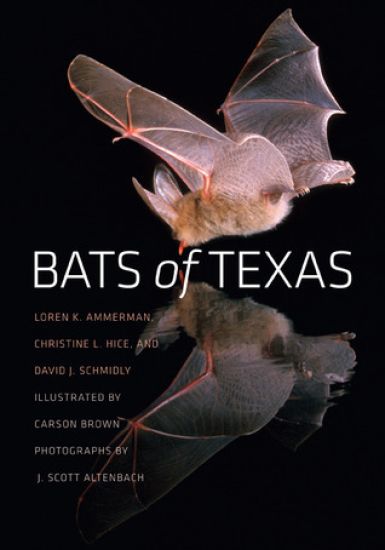
Bats of Texas

Bats of Texas

Loren K. Ammerman; Christine L. Hice; David J. Schmidly

Texas A M University Press
2012
nidottu
With all new illustrations, color photographs, revised species accounts, updated maps, and a sturdy flexible binding, this new edition of the authoritative guide to bats in Texas will serve as the field guide and all-around reference of choice for amateur naturalists as well as mammalogists, wildlife biologists, and professional conservationists. Texas is home to all four families of bats that occur in the United States, including thirty-three species of these important yet increasingly threatened mammals. Although five species, each represented by a single specimen, may be regarded as vagrants, no other state has a bat fauna more diverse, from the state’s most common species, the Brazilian free-tailed bat, to the rare hairy-legged vampire. The introductory chapter of this new edition of Bats of Texas surveys bats in general—their appearance, distribution, classification, evolution, biology, and life history—and discusses public health and bat conservation. An updated account for each species follows, with pictures by an outstanding nature photographer, distribution maps, and a thorough bibliography. Bats of Texas also features revised and illustrated dichotomous keys accompanied by gracefully detailed line drawings to aid in identification. A list of specimens examined is located at batsoftexas.com.
The Marine Mammals of the Gulf of Mexico

The Marine Mammals of the Gulf of Mexico

Bernd Würsig; Thomas A. Jefferson; David J. Schmidly

Texas A M University Press
2000
sidottu
The Gulf of Mexico teems with a much greater number and range of whales, dolphins, and other mammalian species than was suspected only a few years ago. In The Marine Mammals of the Gulf of Mexico, Bernd Wursig, Thomas A. Jefferson, and David J. Schmidly provide information on all known species, valuable identification tools, and up-to-date research on behavior, group sizes, reproduction, and underwater calls. The introduction presents an overview of the whales, dolphins, pinnipeds, and other marine mammals of the world, discussing their basic biology and outlining their differences. The authors then describe the characteristics of the Gulf that affect the marine mammal species inhabiting it or entering its waters occasionally. The main body of this important new guide provides a checklist of the species, keys to identification, and species descriptions of the marine mammals known or believed to occur in the Gulf. More than thirty color plates by marine artist Larry Foster and thirty-two color photographs illustrate these creatures. Another important feature of this volume is a set of drawings of the skulls of all the Gulf species; these skull keys will enable individuals involved in Gulf Stranding Networks, volunteer operations that rescue and recover beached or stranded marine mammals, to easily identify species along the Gulf coast. Finally, the book discusses environmental problems of the Gulf as they affect marine mammals and considers the conservation and management tools needed to preserve them in their habitats. The Marine Mammals of the Gulf of Mexico will prove a useful reference for marine biologists, volunteers with scientific and rescue organizations, and anyone else interested in further study of these magnificent animals.
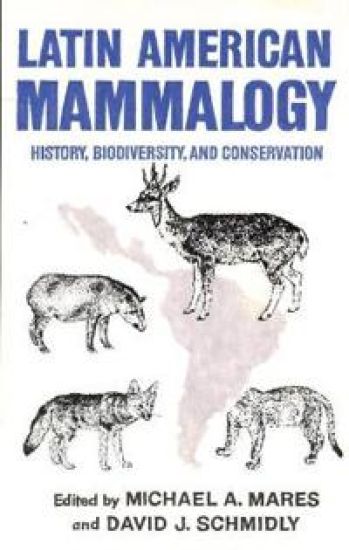
Latin American Mammalogy

Latin American Mammalogy

Michael A. Mares; David J. Schmidly

University of Oklahoma Press
1991
sidottu
In this volume thirty-six scientists from Latin American and the United States contribute substantially to our knowledge of Latin American mammals. Part 1 provides a history of the pioneers in collection-based mammalogy, which began only about two centuries ago. Chapters in Part 2 demonstrate the search for theories and methodologies that will help us understand how the fauna of this region came to be. Part 3 addresses conservation policy and management in light of recent enormous changes in the natural habitats of Latin America. Part 4 explores the need for conservation-education programs in Latin America as a critical step in the development of a sound land-use ethic. The preface of Latin American Mammalogy, overviews of the four sections, and summaries of the twenty-three chapters are given in Spanish as well as English.