Kirjojen hintavertailu – 12 859 818 kirjaa ja 27 kauppaa

Kirjailija

David Jacobson

Kirjat ja teokset yhdessä paikassa: 19 kirjaa, julkaisuja vuosilta 1991–2023, suosituimpiin kuuluu Antioch and Jerusalem. Vertaile teosten hintoja ja tarkista saatavuus suomalaisista kirjakaupoista.

19 kirjaa

Kirjojen julkaisuvuodet: 1991–2023.

Citizenship

Citizenship

David Jacobson; Manlio Cinalli

OXFORD UNIVERSITY PRESS INC
2023
sidottu
The emergence of citizenship, some 4,000 years ago, was a hinge moment in human history. Instead of the reign of blood descent, questions regarding who rules and who belongs were opened up. Yet purportedly primordial categories, such as sex and race, have constrained the emergence of a truly civic polity ever since. Untying this paradox is essential to overcoming the crisis afflicting contemporary democracies. Why does citizenship emerge, historically, and why does it maintain traction, even if in compromised forms? How can citizenship and democracy be revived? Learning from history and building on emerging social and political developments, David Jacobson and Manlio Cinalli provide the foundations for citizenship's third revolution. Citizenship: The Third Revolution considers three revolutionary periods for citizenship, from the ancient and classical worlds; to the flourishing of guilds and city republics from 1,000 CE; and to the unfinished revolution of human rights from the post-World War II period. Through historical enquiry, this book reveals the underlying principles of citizenship-and its radical promise. Jacobson and Cinalli demonstrate how the effective functioning of citizenship depends on human connections that are relational and non-contractual, not transactional. They illustrate how rights, paradoxically, can undermine as well as reinforce civic society. Looking forward, the book documents the emerging foundations of a "21st century guild" as a basis for repairing our democracies. The outcome of this scholarship is an innovative re-conceptualization of core ideas to engender more authentic civic collectivities.
Agrippa II

Agrippa II

David Jacobson

Taylor Francis Ltd
2021
nidottu
Agrippa II is the first comprehensive biography of the last descendant of Herod the Great to rule as a client king of Rome. Agrippa was the last king to assume responsibility for the management of the Temple in Jerusalem, and he ultimately saw its destruction in the Judaean-Roman War. This study documents his life from a childhood spent at the Imperial court in Rome and rise to the position of client king of Rome under Claudius and Nero. It examines his role in the War during which he sided with Rome, and offers fresh insights into his failure to intervene to prevent the destruction of Jerusalem and its Sanctuary, as well as reviewing Agrippa’s encounter with nascent Christianity through his famous interview with the Apostle Paul. Also addressed is the vexed question of the obscurity into which Agrippa II has fallen, in sharp contrast with his sister Berenice, whose intimate relationship with Titus, the heir to the Roman throne, has fired the imagination of writers through the ages. This study also includes appendices surveying the coins issued in the name of Agrippa II and the inscriptions from his reign. This volume will appeal to anyone studying Judaean-Roman relations and the Judaean-Roman War, as well as those working more broadly on Roman client kingship, and Rome’s eastern provinces. It covers topics that continue to attract general interest as well as stirring current scholarly debate. Maps 1 and 2 available in colour at www.routledge.com/9781138331815
Old Nations, New World

Old Nations, New World

David Jacobson

Routledge
2020
nidottu
This volume explores key states and their changing conceptions of the international order in the post-Cold War era. Taken collectively, the contributors' analyses of the United States, the Soviet Union and its successor states, Japan, the People's Republic of China, the East Asian Little Dragons and Germany and the European Community paint a detailed portrait of the emerging world order. This multidisciplinary group of contributors utilizes a diversity of theoretical and methodological approaches to confront common themes and questions: How do states reorganize the world by creating idioms and conceptions of international order? What is the state's definition of its own role and the role of others? How has the state's idiom and conception of the international order shifted from the recent past? What role does the past play in approaches to the world order–in terms of historical traditions, fears, and memories? These questions are illuminated by considering such crucial issues as the state's approach to international or supranational institutions and legal codes, particularly in the area of economy and international human rights, and the role of the state vis-Ã -vis other states: Does the state have hegemonic tendencies and an active role in maintaining international stability? Does it stress independence or interdependence? Isolationism or internationalism? These original essays suggest the nascent form the international order is taking in an otherwise turbulent world. Understanding how states view the post-Cold War arena is of paramount importance for comprehending the development of the new world order. In addressing these issues, this volume not only provides concrete, timely answers but offers a variety of theoretical and methodological tools for scholars, policymakers, and the informed public.
Agrippa II

Agrippa II

David Jacobson

Routledge
2019
sidottu
Agrippa II is the first comprehensive biography of the last descendant of Herod the Great to rule as a client king of Rome. Agrippa was the last king to assume responsibility for the management of the Temple in Jerusalem, and he ultimately saw its destruction in the Judaean-Roman War. This study documents his life from a childhood spent at the Imperial court in Rome and rise to the position of client king of Rome under Claudius and Nero. It examines his role in the War during which he sided with Rome, and offers fresh insights into his failure to intervene to prevent the destruction of Jerusalem and its Sanctuary, as well as reviewing Agrippa’s encounter with nascent Christianity through his famous interview with the Apostle Paul. Also addressed is the vexed question of the obscurity into which Agrippa II has fallen, in sharp contrast with his sister Berenice, whose intimate relationship with Titus, the heir to the Roman throne, has fired the imagination of writers through the ages. This study also includes appendices surveying the coins issued in the name of Agrippa II and the inscriptions from his reign. This volume will appeal to anyone studying Judaean-Roman relations and the Judaean-Roman War, as well as those working more broadly on Roman client kingship, and Rome’s eastern provinces. It covers topics that continue to attract general interest as well as stirring current scholarly debate. Maps 1 and 2 available in colour at www.routledge.com/9781138331815
Old Nations, New World

Old Nations, New World

David Jacobson

Routledge
2019
sidottu
This volume explores key states and their changing conceptions of the international order in the post-Cold War era. Taken collectively, the contributors' analyses of the United States, the Soviet Union and its successor states, Japan, the People's Republic of China, the East Asian Little Dragons and Germany and the European Community paint a detailed portrait of the emerging world order. This multidisciplinary group of contributors utilizes a diversity of theoretical and methodological approaches to confront common themes and questions: How do states reorganize the world by creating idioms and conceptions of international order? What is the state's definition of its own role and the role of others? How has the state's idiom and conception of the international order shifted from the recent past? What role does the past play in approaches to the world order–in terms of historical traditions, fears, and memories? These questions are illuminated by considering such crucial issues as the state's approach to international or supranational institutions and legal codes, particularly in the area of economy and international human rights, and the role of the state vis-Ã -vis other states: Does the state have hegemonic tendencies and an active role in maintaining international stability? Does it stress independence or interdependence? Isolationism or internationalism? These original essays suggest the nascent form the international order is taking in an otherwise turbulent world. Understanding how states view the post-Cold War arena is of paramount importance for comprehending the development of the new world order. In addressing these issues, this volume not only provides concrete, timely answers but offers a variety of theoretical and methodological tools for scholars, policymakers, and the informed public.
Transformations of Warfare in the Contemporary World

Transformations of Warfare in the Contemporary World

David Jacobson

Temple University Press,U.S.
2016
pokkari
Today’s warfare has moved away from being an event between massed national populations and toward small numbers of combatants using high-tech weaponry. The editors of and contributors to the timely collection Transformations of Warfare in the Contemporary World show that this shift reflects changes in the technological, strategic, ideological, and ethical realms. The essays in this volume discuss:·the waning connection between citizenship and soldiering; ·the shift toward more reconstructive than destructive activities by militaries; ·the ethics of irregular or asymmetrical warfare; ·the role of novel techniques of identification in military settings; ·the stress on precision associated with targeted killings and kidnappings; ·the uses of the social sciences in contemporary warfare. In his concluding remarks, David Jacobson explores the extent to which the contemporary transformation of warfare is a product of a shift in the character of the combatants themselves. Contributors include: Ariel Colonomos, Roberto J. González, Travis R. Hall, Saskia Hooiveld, Rob Johnson, Colonel C. Anthony Pfaff, Ian Roxborough, and the editors
Transformations of Warfare in the Contemporary World

Transformations of Warfare in the Contemporary World

David Jacobson

Temple University Press,U.S.
2016
sidottu
Today’s warfare has moved away from being an event between massed national populations and toward small numbers of combatants using high-tech weaponry. The editors of and contributors to the timely collection Transformations of Warfare in the Contemporary World show that this shift reflects changes in the technological, strategic, ideological, and ethical realms. The essays in this volume discuss:·the waning connection between citizenship and soldiering; ·the shift toward more reconstructive than destructive activities by militaries; ·the ethics of irregular or asymmetrical warfare; ·the role of novel techniques of identification in military settings; ·the stress on precision associated with targeted killings and kidnappings; ·the uses of the social sciences in contemporary warfare. In his concluding remarks, David Jacobson explores the extent to which the contemporary transformation of warfare is a product of a shift in the character of the combatants themselves. Contributors include: Ariel Colonomos, Roberto J. González, Travis R. Hall, Saskia Hooiveld, Rob Johnson, Colonel C. Anthony Pfaff, Ian Roxborough, and the editors
Antioch and Jerusalem

Antioch and Jerusalem

David Jacobson

Spink Son Ltd
2015
sidottu
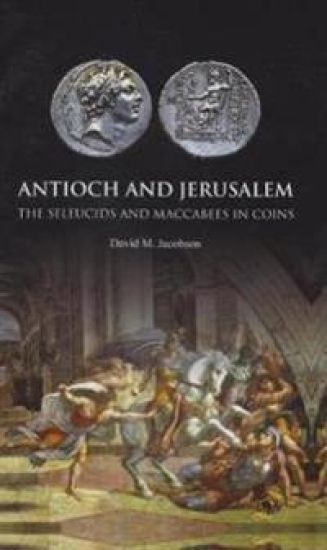
This book recounts the heroic story of the Maccabees and explains how they successfully took on the might of the Seleucid realm, illustrated by the coins issued by the main protagonists. What was an epic struggle of an oppressed people to win their national and religious freedom has provided much inspiration through the ages and continues to strike a strong resonance in our own times. However, the historical drama, as recorded in 1 and 2 Maccabees, with its unfamiliar roll-call of major players and place names, has acquired a considerable mystique. The coins put faces to many of these seemingly obscure names and help bring those stirring events back to life.
Distant Views of the Holy Land

Distant Views of the Holy Land

Felicity Cobbing; David Jacobson

Equinox Publishing Ltd
2015
sidottu
The Holy Land has been an enduring magnet for visitors seeking to retrace the footsteps of biblical prophets, kings and saints and to glimpse the setting of events recorded in the Scriptures. This book offers a selection of over 350 early photographs, paintings, and drawings of the length and breadth of the Holy Land from the rich repository of images in the archives of the Palestine Exploration Fund. As these images were produced before modern development impacted on these landscapes they are an invaluable resource. The pictures are accompanied by 7 maps and plans showing the locations depicted and a commentary describing the biblical context, informed by up-to-date scholarship. The book is divided into five chapters; an introduction which includes a brief account of pilgrimage to the Holy Land through the ages, followed by a series of geographical 'tours' through Galilee, Samaria, and Judea and Philistia, before culminating with a focus on the two main sites of interest for the traveller: Bethlehem and Jerusalem. While often very beautiful in their own right, the pictures also reflect the interest and sensibilities of the photographers and those who collected them, and capture the opposing undercurrents of scientific enquiry and piety characteristic of 19th Century European society. In the case of the photographers engaged by the PEF, a striving for objectivity is strikingly evident in their work.
Of Virgins and Martyrs

Of Virgins and Martyrs

David Jacobson

Johns Hopkins University Press
2013
sidottu
Women's bodies have become a battleground. Around the world, people argue about veiling, schooling for Afghan girls, and "SlutWalk" protests, all of which involve issues of women's sexuality and freedom. Globalization, with its emphasis on human rights and individuality, heats up these arguments. In "Of Virgins and Martyrs", David Jacobson takes the reader on a fascinating tour of how self-identity developed throughout history and what individualism means for Muslim societies struggling to maintain a sense of honor in a globalized twenty-first century. Some patriarchal societies have come to see women's control of their own sexuality as a threat to a way of life that goes back thousands of years. Many trace their lineage to tribal cultures that were organized around the idea that women's virginity represents the honor of male relatives and the good of the community at large. Anyone or anything that influences women to the contrary is considered a corrupting and potentially calamitous force. Jacobson analyzes the connection between tribal patriarchy and Muslim radicalism through an innovative tool-the tribal patriarchy index. This index helps to illuminate why women's sexuality, dress, and image so compel militant Muslim outrage and sometimes violent action, revealing a deeper human story of how women's status defines competing moral visions of society and why this present clash is erupting with such ferocity.
Of Virgins and Martyrs

Of Virgins and Martyrs

David Jacobson

Johns Hopkins University Press
2013
pokkari
Women's bodies have become a battleground. Around the world, people argue about veiling, schooling for Afghan girls, and "SlutWalk" protests, all of which involve issues of women's sexuality and freedom. Globalization, with its emphasis on human rights and individuality, heats up these arguments. In Of Virgins and Martyrs, David Jacobson takes the reader on a fascinating tour of how self-identity developed throughout history and what individualism means for Muslim societies struggling to maintain a sense of honor in a globalized twenty-first century. Some patriarchal societies have come to see women's control of their own sexuality as a threat to a way of life that goes back thousands of years. Many trace their lineage to tribal cultures that were organized around the idea that women's virginity represents the honor of male relatives and the good of the community at large. Anyone or anything that influences women to the contrary is considered a corrupting and potentially calamitous force. Jacobson analyzes the connection between tribal patriarchy and Muslim radicalism through an innovative tool-the tribal patriarchy index. This index helps to illuminate why women's sexuality, dress, and image so compel militant Muslim outrage and sometimes violent action, revealing a deeper human story of how women's status defines competing moral visions of society and why this present clash is erupting with such ferocity.
Place and Belonging in America

Place and Belonging in America

David Jacobson

Johns Hopkins University Press
2002
sidottu
How did the American people come to develop a moral association with this land, such that their very experience of nationhood was rooted in, and their republican virtues depended upon, that land? And what is happening now as the exclusivity of that moral linkage between people and land becomes ever more attenuated? In Place and Belonging in America, David Jacobson addresses the evolving relationship between geography and citizenship in the United States since the nation's origins. Americans have commonly assumed that only a people rooted in a bounded territory could safeguard republican virtues. But, as Jacobson argues, in the contemporary world of transnational identities, multiple loyalties, and permeable borders, the notion of a singular territorial identity has lost its resonance. The United States has come to represent a diverse quilt of cultures with varying ties to the land. These developments have transformed the character of American politics to one in which the courts take a much larger role in mediating civic life. An expanding web of legal rights enables individuals and groups to pursue their own cultural and social ends, in contrast to the civic republican practice of an active citizenry legislating its collective life. In the first part of his sweeping study, Jacobson considers the origins of the uniquely American sense of place, exploring such components as the Puritans and their religious vision of the New World; the early Republic and agrarian virtue as extolled in the writings of Thomas Jefferson; the nationalization of place during the Civil War; and the creation of post-Civil War monuments and, later, the national park system. The second part of Place and Belonging in America concerns the contemporary United States and its more complex interactions between space and citizenship. Here Jacobson looks at the multicultural landscape as represented by the 1991 act of Congress that changed the name of the Custer Battlefield National Monument to Little Bighorn Battlefield National Monument and the subsequent construction of a memorial honoring the Indian participants in the battle; the Vietnam Veterans Memorial; and the U. S. Holocaust Memorial Museum. He also reflects upon changing patterns of immigration and settlement. At once far-reaching and detailed, Place and Belonging in America offers a though-provoking new perspective on the myriad, often spiritual connections between territoriality, national identity, and civic culture.
Rights across Borders

Rights across Borders

David Jacobson

Johns Hopkins University Press
1997
pokkari
In Rights across Borders, political sociologist David Jacobson argues that transnational migrations have affected ideas of citizenship and the state since World War II. Jacobson shows how citizenship has been increasingly devalued as governments extend rights to foreign populations and how, in turn, international human rights law has overshadowed traditional definitions of sovereignty. Examining illegal immigration in the United States and migrant and foreign populations in Western Europe, with a special focus on Germany and France, Jacobson shows how the differing political cultures of these countries-the ethnic basis of citizenship in Germany versus its political basis in the United States, for instance-have shaped both domestic and international politics. "This short but well-written book addresses a neglected aspect of the contemporary decline of the nation-state. It studies in depth the criteria by which France, Germany, and the United States distinguish between citizen and alien, from the political-territorial definition of the French to the ethno-cultural one of the Germans."-Francis Fukuyama, Foreign Affairs "Jacobson challenges scholars to rethink their views of the state. Current theories of political sociology and international relations are rooted in conceptions that, he feels, are losing their relevance and bite ... A thought-provoking book."-Lawrence M. Friedman, Law and Politics Book Review "Few people discussing national and cultural identity or citizenship have looked at the legal ramifications of immigration. David Jacobson fills this gap in his important book."-Jeff Spinner-Halev, American Political Science Review "A compelling explanation of the intersection between transnational migration and human rights norms. It will be of interest to scholars of both international migration and human rights as well as a general reading audience interested in questions regarding immigration and citizenship"-Debra DeLaet, Perspectives on Political Science
Spying Without Spies

Spying Without Spies

David Jacobson; Charles A. Ziegler

Praeger Publishers Inc
1995
sidottu

Halvin toimitettuna 140,80 €

This is the first description of the formation of America's nulcear surveillance system. Drawing on interviews with participants and the little documentation available under the Freedom of Information Act, Ziegler and Jacobson tell a story not told before. They shed new light on questions raised in earlier interpretations of the early Cold War years and reveal the origins of a surveillance activity that is implied, but not explained, in today's headlines. This book provides the first documented description of the genesis and institutionalization of America's nuclear surveillance system. It traces the development of covert technical methods for assessing the nuclear capability of foreign powers from the introduction of these techniques in World War II to 1949, when they were successfully employed to detect the test of Russia's first atomic bomb. Ziegler and Jacobson examine the planning for the system as well as the technical and organizational obstacles that had to be overcome before it could be implemented. They describe the government decision-making processes and the ways individuals and groups with different beliefs and interests were mobilized in support of the program. They also explore the relationships between the intelligence and scientific communities that were forged in this process.
Emerson's Pragmatic Vision

Emerson's Pragmatic Vision

David Jacobson

Pennsylvania State University Press
1993
pokkari
The long ignored philosophical content of Emerson's writings has recently emerged as a central topic in Emerson studies. In Emerson's Pragmatic Vision, David Jacobson enters the discussion, placing Emerson in a line of philosophers from Kant and Hegel to Heidegger and Derrida, and adding to our understanding of his philosophical appropriations and anticipations. In the process Jacobson shows how Emerson grappled not only with basic issues of philosophy but eventually with the value of philosophical discourse itself. Conceiving Emerson's writings as reflective of a continuous inquiry into the fundamental question that motivates philosophy and guides reason—the question of Being—Jacobson traces his movement through philosophical humanism and anti-humanism to his identification of a philosophy founded on a reconceptualization of individual practice. Emerson's Pragmatic Vision depicts not two Emersons but three. Between the early humanist confidence in self-reliance and the late embrace of fate, Jacobson identifies a transitional period, enunciated in the stark lecture, "The Method of Nature" (1841), and typified by the pessimism and humanist nostalgia of "Experience." The doctrine of fate, Emerson's mature pragmatic philosophy, is presented as a response to this period in which is found Emerson's retrieval of a philosophical posture rooted in obedience to the eloquence of the practice of life.
Emerson's Pragmatic Vision

Emerson's Pragmatic Vision

David Jacobson

Pennsylvania State University Press
1993
sidottu
The long ignored philosophical content of Emerson's writings has recently emerged as a central topic in Emerson studies. In Emerson's Pragmatic Vision, David Jacobson enters the discussion, placing Emerson in a line of philosophers from Kant and Hegel to Heidegger and Derrida, and adding to our understanding of his philosophical appropriations and anticipations. In the process Jacobson shows how Emerson grappled not only with basic issues of philosophy but eventually with the value of philosophical discourse itself. Conceiving Emerson's writings as reflective of a continuous inquiry into the fundamental question that motivates philosophy and guides reason—the question of Being—Jacobson traces his movement through philosophical humanism and anti-humanism to his identification of a philosophy founded on a reconceptualization of individual practice. Emerson's Pragmatic Vision depicts not two Emersons but three. Between the early humanist confidence in self-reliance and the late embrace of fate, Jacobson identifies a transitional period, enunciated in the stark lecture, "The Method of Nature" (1841), and typified by the pessimism and humanist nostalgia of "Experience." The doctrine of fate, Emerson's mature pragmatic philosophy, is presented as a response to this period in which is found Emerson's retrieval of a philosophical posture rooted in obedience to the eloquence of the practice of life.
Reading Ethnography

Reading Ethnography

David Jacobson

State University of New York Press
1991
pokkari
This book presents a model for analyzing and evaluating ethnographic arguments. It examines the relationship between the claims anthropologists make about human behavior and the data they use to warrant them. Jacobson analyzes the textual organization of ethnographies, focusing on the ways in which problems, interpretations, and data are put together. He examines in detail a limited number of well-known ethnographic cases, which are selected to illustrate basic theoretical frameworks and modes of analysis. By advancing a method for assessing ethnographic accounts, the book contributes to the current debate on the role of rhetoric and reflexivity in anthropology.