Kirjailija
David Lodge
Kirjat ja teokset yhdessä paikassa: 48 kirjaa, julkaisuja vuosilta 1979–2026, suosituimpiin kuuluu The Modes of Modern Writing. Vertaile teosten hintoja ja tarkista saatavuus suomalaisista kirjakaupoista.
48 kirjaa
Kirjojen julkaisuvuodet: 1979–2026.
"A trio of dazzling novels in a comic mode that the author has now made completely his own...a cause for celebration." -The New York Times Book Review David Lodge's three delightfully sophisticated campus novels, now gathered together in one volume, expose the world of academia at its best-and its worst. In Changing Places, we meet Philip Swallow, British lecturer in English at the University of Rummidge, and the flamboyant American Morris Zapp of Euphoric State University, who participate in a professorial exchange program at the close of the tumultuous sixties. Ten years later in Small World, older but not noticeably wiser, they are let loose on the international conference circuit-along with a memorable and somewhat oversexed cast of dozens. And in Nice Work, the leftist feminist Dr. Robyn Penrose at Rummidge University is assigned to shadow the director of a local engineering firm, sparking a collision of ideologies and lifestyles that seems unlikely to foster anything other than mutual antipathy.
'One of the very best English comic novelists of the post-war era' Time OutThe plot lines of The Campus Trilogy, radiating from its hub at the redbrick University of Rummidge, trace the comic adventures of academics who move outside familiar territory.
Surrounded by quarrelling honeymooners, a freeloading anthropologist and assorted tourists in search of their own personal paradise, and with his father whisked off to hospital after an unfortunate accident, Bernard is beginning to regret ever coming to Haiwaii.
When Philip Swallow and Professor Morris Zapp participate in their universities' Anglo-American exchange scheme, the Fates play a hand, and each academic finds himself enmeshed in the life of his counterpart on the opposite side of the Atlantic.
Polly, Dennis, Angela, Adrian and the rest are bound to lose their spiritual innocence as well as their virginities on the journey between university in the 1950s and the marriages, families, careers and deaths that follow.
The restrictions of a wartime childhood in in London and subsequent post-war shortages have done little to enrich Timothy's early youth. But everything changes when his glamorous older sister, Kath, invites him to spend the summer at Heidelberg.
First published in 1965, it tells the story of hapless, scooter-riding young research student Adam Appleby, who is trying to write his thesis but is constantly distracted - not least by the fact that, as Catholics in the 1960s, he and his wife must rely on 'Vatican roulette' to avoid a fourth child.
When it isn't prison, it's hell. Or at least that's the heartfelt belief of conscripts Jonathan Browne and Mike 'Ginger' Brady. The reckless, impulsive Mike and the more pragmatic Jonathan adopt radically different attitudes to survive this two-year confiscation of their freedom, with dramatic consequences
In this entertaining and enlightening collection David Lodge considers the art of fiction under a wide range of headings, drawing on writers as diverse as Henry James, Martin Amis, Jane Austen and James Joyce.
In this absorbing volume, David Lodge turns his incisive critical skills onto his own profession, salutes the great writers who have influenced his work, wonders about the motives of biographers, ponders the merits of creative writing courses, pulls the rug from under certain theoretical critics and throws open the curtains on his own workshop.
As Tubby's life fragments under the weight of his self-obsession, he embarks - via Kierkegaard, strange beds from Rummidge to Tenerife to Beverly Hills, a fit of literary integrity and memories of his 1950s South London boyhood - on a picaresque quest for his lost contentment.
Philip Swallow, Morris Zapp, Persse McGarrigle and the lovely Angelica are the jet-propelled academics who are on the move, in the air and on the make in David Lodge's satirical Small World.
When Vic Wilcox (MD of Pringle's engineering works) meets English lecturer Dr Robyn Penrose, sparks fly as their lifestyles and ideologies collide head on. What, after all, are they supposed to learn from each other? But in time both parties make some surprising discoveries about each other's worlds - and about themselves.
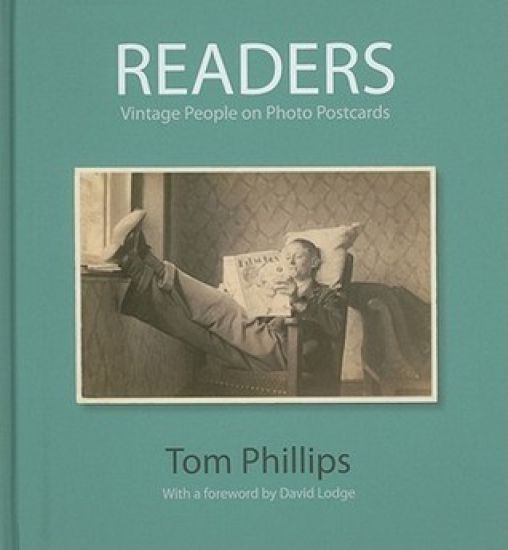
To celebrate the acquisition of the Tom Phillips archive, the Bodleian Library has asked the artist to assemble and design a series of books drawing on his themed collection of over 50,000 photographic postcards. These encompass the first half of the twentieth century, a period in which, thanks to the ever cheaper medium of photography, ‘ordinary’ people could afford to own their portraits. Readers shows people reading (or pretending to read) a wide variety of material from the Bible to Film Fun, either in the photographer’s studio, in their own home or holidaying on the beach. This book contains 200 images chosen with the eye of a leading artist from a visually rich vein of social history. Their covers will also feature a thematically linked painting, especially created for each title, from Tom Phillips’ signature work, A Humument.
The subject of enthusiastic and widespread reviews, David Lodge's fourteenth work of fiction displays the humor and shrewd observations that have made him a much-loved icon. Deaf Sentence tells the story of Desmond Bates, a recently retired linguistics professor in his mid-sixties. Vexed by his encroaching deafness and at loose ends in his personal life, Desmond inadvertently gets involved with a seemingly personable young American female student who seeks his support in matters academic and not so academic, who finally threatens to destabilize his life completely with her unpredictable?and wayward?behavior. What emerges is a funny, moving account of one man's effort to come to terms with aging and mortality?a classic meditation on modern middle age that fans of David Lodge will love.
Traces the conception, writing and publication of the author's book. This work offers psychological and literary insights which suggests nothing less than a short story by the Great Master, Henry James, himself.
"A cunning, audacious portait of Henry James."--The Boston Globe Henry James takes center stage in this brilliant story about literary ambition, creativity, and rivalry as revealed in the public career and private life of this most singular writer. Framed by a moving and dramatic account of his last illness, Author opens in the early 1880s, describing James's close friendship with an illustrator named George du Maurier and his intimate but problematic relationship with fellow American novelist Constance Fenimore Woolson. At the end of the decade, Henry, worried by the failure of his books to sell, resolves to achieve fame and fortune as a playwright, while du Maurier diversifies into writing novels. The consequences that ensue mingle comedy, irony, pathos, and suspense. As Du Maurier's novel Trilby becomes the bestseller of the century, Henry anxiously awaits the opening night of his make-or-break play, Guy Domville. This event, on January 5, 1895, and its complex sequel form the climax to Lodge's absorbing novel.
"The Language of Fiction" was the first book of criticism by the novelist David Lodge. In it he established a fresh approach to the appreciation of literature that focuses the reader's attention on the significance of language. This edition has a new foreword from David Lodge and includes in its entirety the comprehensive afterword from the 1984 edition.
Language of Fiction was the first book of criticism by the renowned novelist and critic David Lodge. His uniquely informed perspective - he was already the author of three successful novels at the time of its first publication in 1966 - and lucid exposition meant that the work proved a landmark of literary criticism, not least because it succeeded in communicating a radically new vision of English literature to a readership that reached well beyond the bounds of the academy. Now reissued with a new foreword, this major work from the pen of one of England's finest living writers is essential reading for all those who care about the creation and appreciation of literature.
David Lodge's novels have earned comparisons to those of John Updike and Philip Roth and established him as "a cult figure on both sides of the Atlantic" (The New York Times). Thinks . . . , his witty new novel about secret infidelities and the nature of consciousness, unfolds in the alternating voices of Ralph Messenger, director of the Centre for Cognitive Science at the University of Gloucester, and Helen Reed, a novelist and writer in residence at the university. Mutually attracted, the two end up in a moral standoff that is shattered by events that dramatically confirm the truth of Ralph's dictum: "we can never know for certain what another person is thinking."