Kirjojen hintavertailu – 12 859 819 kirjaa ja 27 kauppaa

Kirjailija

David Mamet

Kirjat ja teokset yhdessä paikassa: 90 kirjaa, julkaisuja vuosilta 1984–2026, suosituimpiin kuuluu The Cherry Orchard. Vertaile teosten hintoja ja tarkista saatavuus suomalaisista kirjakaupoista.

90 kirjaa

Kirjojen julkaisuvuodet: 1984–2026.

Oleanna

Oleanna

David Mamet

Josef Weinberger Plays
2002
pokkari
In David Mamet's latest play, a male college instructor and his female student sit down to discuss her grades and in a terrifyingly short time become the participants in a modern reprise of the Inquisition.
Mamet Plays: 4

Mamet Plays: 4

David Mamet

Methuen Drama
2002
nidottu
A collection of outstanding plays from one of America's greatest playwrights Cryptogram: "Mamet's play suggests that deception is an endless spiralling process that eventually corrodes the soul. But it also harps on a theme that runs right throughout Mamet's work: the notion that we use words as a destructive social camouflage to lie to others and ourselves... And here through all the repetitions, half sentences and echoing encounter of one question with another, you feel the characters devalue experience through their use of language. As Del cries in desperation at the end, 'If we could speak the truth for one instant, then we would be free.' Mamet's point is that we are held spiritually captive by our bluster and evasions." (Michael Billington, Guardian) Oleanna: "An exploration of male-femal conflicts which cogently demonstrates that whe free thought and dialogue are imperilled, nobody wins" (Independent) The Old Neighborhood: "Mamet, ranked with Miller, Albee and Shepard as America's finest living playwrights, distills the raw, rank flavour of people wading down streams of consciousness... A play of riveting disquiet" (Evening Standard)
Boston Marriage

Boston Marriage

David Mamet

Methuen Drama
2001
nidottu
One of America's most revered and provocative dramatists, David Mamet conquers new territory with this droll comedy of errors set in a Victorian drawing room. Anna and Claire are two bantering, scheming ladies of fashion who have long lived together on the fringes of upper-class society. Anna has just become the mistress of a wealthy man, from whom she has received an enormous emerald and an income to match. Claire, meanwhile, is infatuated with a respectable young lady and wants to enlist the jealous Anna's help for an assignation. As the two women exchange barbs and take turns taunting Anna's hapless parlour maid, Claire's young inamorata suddenly appears, setting off a crisis that puts the valuable emerald at risk and threatens the women's future." Devastatingly funny ...exceptionally clever" - New York Times "Brilliant ... One of Mamet's most satisfying and accomplished plays, and one of the funniest American comedies in years" - New York Post "Wickedly, wittily entertaining ...what makes the play such brilliant fun is its marriage of glinting period artifice and contemporary frankness" - Boston Phoenix "[Mamet's characters] are at each other's throats with a wit akin to characters out of Wilde and a vengeance not unlike those from Pinter or Edward Albee" - Boston Globe Boston Marriage was first performed at the American Repertory Theatre, Cambridge, Massachusetts, in June 1999. It received its British premiere at the Donmar Warehouse, London, in March 2001.
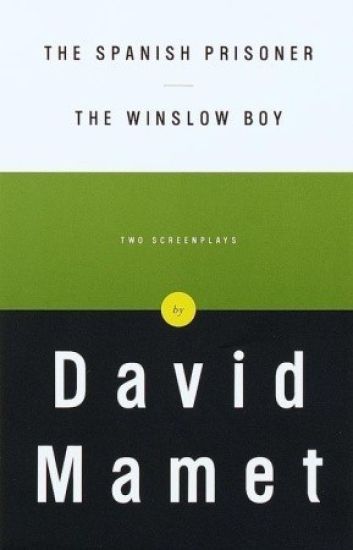
The Spanish Prisoner And The Winslow Boy

The Spanish Prisoner And The Winslow Boy

David Mamet

Random House USA Inc
1999
nidottu
THE SPANISH PRISONER"Elegant, entertaining. . . . Mamet's craftiest and most satisfying cinematic puzzle." --The New York TimesTHE WINSLOW BOY"One of the most subtly compelling love stories of the year." --The New York ObserverPulitzer Prize winner David Mamet ranks among the century's most influential writers for stage and screen. His dialogue--abrasive, rhythmic--illuminates a modern aesthetic evocative of Samuel Beckett. His plots--surprising, comic, topical--have evoked comparisons to masters from Alfred Hitchcock to Arthur Miller. Here are two screenplays demonstrating the astounding range of Mamet's talents. The Spanish Prisoner, a neo-noir thriller about a research-and-development cog hoodwinked out of his own brilliant discovery, demonstrates Mamet's incomparable use of character in a dizzying tale of twists and mistaken identity. The Winslow Boy, Mamet's revisitation of Terence Rattigan's classic 1946 play, tells of a thirteen-year-old boy accused of stealing a five-shilling postal order and the tug of war for truth that ensues between his middle-class family and the Royal Navy. Crackling with wit, intelligent and surprising, The Spanish Prisoner and The Winslow Boy celebrate Mamet's unique genius and our eternal fascination with the extraordinary predicaments of the common man.
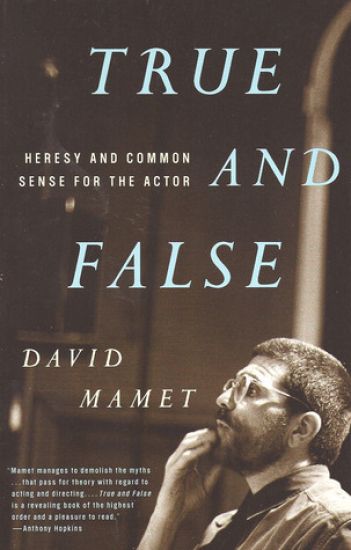
True and False

True and False

David Mamet

Random House USA Inc
1999
nidottu
The Pulitzer Prize-winning playwright, director, and teacher gives us a blunt, irreverent, unsparingly honest guide to acting that overturns conventional truths and tells aspiring actors what they really need to know. David Mamet leaves no acting tenet untouched: How to judge the role, approach the part, work with the playwright. How to concentrate and think about the scene. How to avoid becoming the Paint-by-Numbers Mechanical Actor, the "How'm I Doing?" Ham Actor, the over-the-top "Hollywood Huff " Actor. The right way to undertake auditions and rehearsals. The proper approach to agents, to individual jobs, and to the business in general. The question of talent. Mamet is unmistakably clear about why he thinks actors should not be taken in by such highly touted notions as "the arc" of the character or the play, "substitution," "sense-memory," the Method itself--in fact, by most of what is being taught in acting schools and workshops across the country today. True and False slaughters some of the profession's most sacred cows. It is bold, witty, and likely to be as controversial as the author himself.
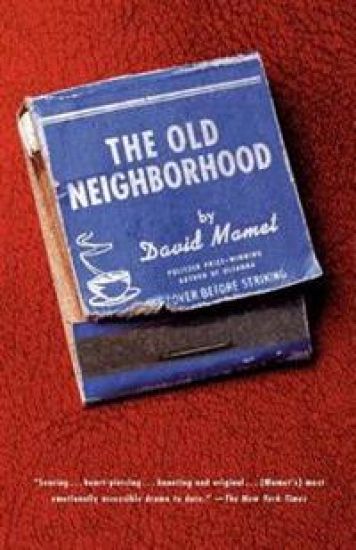
The Old Neighborhood

The Old Neighborhood

David Mamet

Methuen Drama
1998
nidottu
"The finest American playwright of his generation" (Sunday Times) When Bobby returns to the old neighborhood, the people and places of his past cast shadows over the present. In a trio of interleaved scenes, The Old Neighborhood provides a rare personal insight into the world of one of America's greatest contemporary dramatists.
True and False

True and False

David Mamet

Faber Faber
1998
nidottu

Halvin toimitettuna 21,80 €

A guide to the acting profession by a leading American playwright. He advises aspiring actors on topics such as judging a role, approaching the part, working with the playwright, undertaking auditions, and the relationship with agents and the business in general.
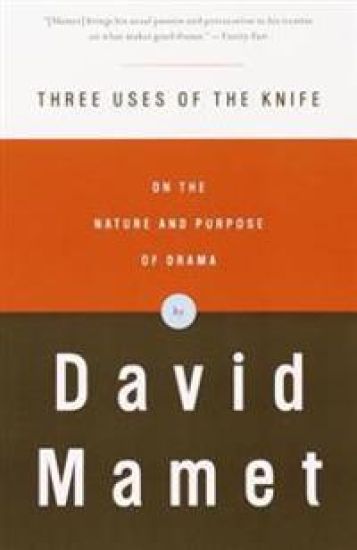
Three Uses of the Knife

Three Uses of the Knife

David Mamet

Columbia University Press
1998
sidottu
What makes good drama? How does drama matter in our lives? In Three Uses of the Knife, one of America's most respected writers reminds us of the secret powers of the play. Pulitzer Prize-winning playwright, screenwriter, poet, essayist, and director, David Mamet celebrates the absolute necessity of drama-and the experience of great plays-in our lurching attempts to make sense of ourselves and our world. In three tightly woven essays of characteristic force and resonance, Mamet speaks about the connection of art to life, language to power, imagination to survival, the public spectacle to the private script. It is our fundamental nature to dramatize everything. As Mamet says, "Our understanding of our life, of our drama...resolves itself into thirds: Once Upon a Time... Years Passed... And Then One Day." We inhabit a drama of daily life-waiting for a bus, describing a day's work, facing decisions, making choices, finding meaning. The essays in the book are an eloquent reminder of how life is filled with the small scenes of tragedy and comedy that can be described only as drama. First-rate theater, Mamet writes, satisfies the human hunger for ordering the world into cause-effect-conclusion. A good play calls for the protagonist "To create, in front of us, on the stage, his or her own character, the strength to continue. It is her striving to understand, to correctly assess, to face her own character (in her choice of battles) that inspires us-and gives the drama power to cleanse and enrich our own character." Drama works, in the end, when it supplies the meaning and wholeness once offered by magic and religion-an embodied journey from lie to truth, arrogance to wisdom. Mamet also writes of bad theater; of what it takes to write a play, and the often impossibly difficult progression from act to act; the nature of soliloquy; the contentless drama and empty theatrics of politics and popular entertainment; the ubiquity of stage and literary conventions in the most ordinary of lives; and the uselessness, finally, of drama-or any art-as ideology or propaganda.

Mamet Plays: 3

Mamet Plays: 3

David Mamet

Methuen Drama
1996
nidottu
"The finest American playwright of his generation" (Sunday Times) Glen Garry Glen Ross (also made in to a film starring Jack Lemmon and Al Pacino) "his superb play about real estate salesmen in a cut-throat sales competition" (New Society); in Prairie du Chien a railway carriage speeding through the Wisconsin night is the setting for a violent story of obsessive jealousy, murder and suicide, told within shooting distance of a card-hustler and his victim. "A short poignant study in violence and the twin drives of love and money, told with hypnotic power thorugh a travelling raconteur" (City Limits); The Shawl shows a clairvoyant wondering whether to cheat a bereaved woman of her inheritance and "confirms Mamet's place as about the best living writer of vivid American dialogue" (Daily Telegraph). Set in the cut-throat world of Hollywood, Speed-the-Plow sees two old-time movie collaborators manipulate the aspirations of a young woman who will do anything to attain her dream of success "a brilliant black comedy, a dazzling dissection of Hollywood cupidity." (Newsweek)
Mamet Plays: 2

Mamet Plays: 2

David Mamet

Methuen Drama
1996
nidottu
"The finest American playwright of his generation" (Sunday Times) Reunion shows the meeting between a father and daughter after nearly twenty years of separation: "It would be hard to over-praise the way Mr Mamet suggests behind the probing, joshing family chat, an extraordinary sense of pain and loss...although the play has a strong social comment about the destructively cyclical effect of divorce, it is neither sour nor defeatist" (Guardian); In Dark Play, a father tells his five-year-old daughter a story about an Indian boy and his pony "a subtle, lyrical, dreamlike vignette" (Star Tribune); in The Woods, a young man and woman spend the night in a cabin together "a beautifully conceived love story" (Chicago Daily News); Lakeboat portrays eight crew members of a merchant ship exchanging wild fantasies about sex, gambling and violence "Richly overheard talk...loopy, funny construction." (Village Voice); Edmond is an odyssey through the disturbing, suspended dark void of a contemporary New York "it is also a technically adventurous piece pared brilliantly to the bone, highly theatrical in its scenic elisions." (Financial Times)
The Cryptogram

The Cryptogram

David Mamet

VINTAGE
1995
nidottu
In this gripping short play, David Mamet combines mercurial intelligence with genuinely Hitchcockian menace. The Cryptogram is a journey back into childhood and the moment of its vanishing--the moment when the sheltering world is suddenly revealed as a place full of dangers. On a night in 1959 a boy is waiting to go on a camping trip with his father. His mother wants him to go to sleep. A family friend is trying to entertain them--or perhaps distract them. Because in the dark corners of this domestic scene, there are rustlings that none of the players want to hear. And out of things as innocuous as a shattered teapot and a ripped blanket, Mamet re-creates a child terrifying discovery that the grownups are speaking in code, and that that code may never be breakable.
The Cryptogram

The Cryptogram

David Mamet

Methuen Drama
1995
nidottu
"I suspect that in time, The Cryptogram will take its place among Mamet's major works" John Lahr "Mamet's play suggests that deception is an endless spiralling process that eventually corrodes the soul. But it also harps on a theme that runs right throughout Mamet's work: the notion that we use words as a destructive social camouflage to lie to others and ourselves... And here through all the repetitions, half sentences and echoing encounter of one question with another, you feel the characters devalue experience through their use of language. As Del cries in desperation at the end, 'If we could speak the truth for one instant, then we would be free.' Mamet's point is that we are held spiritually captive by our bluster and evasions." (Michael Billington, The Guardian)"Dense with thought, feeling and hard psychological insight... There is no spare flesh on this text: words, objects, images interlock in mutual dependence which is both natural and superbly contrived." (John Peter Sunday Times)
Mamet Plays: 1

Mamet Plays: 1

David Mamet

Methuen Drama
1994
nidottu
Duck Variations: "A brilliant little play...about two old men sitting on a park bench discussing ducks" (Guardian); Sexual Perversity in Chicago, bar-room banter and sexual exploits in Mamet's home town "sweet sad understanding and utterly believable" (Chicago Daily News); Squirrels is a sequence of philosophising between a younger writer, an older writer and a cleaning lady which "memorably captures the agony of the creative process" (Daily Telegraph); American Buffalo, one of Mamet's most famous plays, is set in a junk shop where Three small-time crooks plot to carry out the midnight robbery of a coin collection - in the hours leading up to the heist, friendship becomes the victim in a conflict between loyalty and business. The Water Engine is "a propulsive, kaleidoscopic nightmare" and Mr Happiness is a short ironic monologue by a Radio DJ commenting on the letters from his listeners.
A Life in the Theatre

A Life in the Theatre

David Mamet

Grove Press / Atlantic Monthly Press
1994
nidottu
David Mamet is the Pulitzer Prize-winning author of such seminal plays of our time as Glengarry Glen Ross, American Buffalo, Oleanna, and Speed-the-Plow. His A Life in the Theatre takes us into the lives of two actors: one young and rising into the first full flush of his success; the other older, anxious and beginning to wane. In a series of short, spare, and increasingly raw exchanges, we see the estrangement of youth from age and the wider, inevitable, endlessly cyclical rhythm of the world.
House of Games

House of Games

David Mamet

Grove Press / Atlantic Monthly Press
1994
nidottu
Playwright David Mamet's brilliant debut as a film director, House of Games is a psychological thriller in which a young woman psychiatrist falls prey to an elaborate and ingenious con game by one of her patients, who entraps her--with her own subconscious connivance--in a series of criminal escapades. It is a breathless roller-coaster ride of a movie that keeps springing one bizarre surprise after another, sustaining suspense with dazzling audacity. The unsuspecting audience is lured into a psychological and moral thicket of troubling implications, which bear the unmistakable imprint of Mamet's intensely personal vision.
Reunion ; Dark Pony

Reunion ; Dark Pony

David Mamet; David Mamet

Avalon Travel Publishing
1994
nidottu
In two plays, a man and his daughter seem to meet each other for the first time when they are united after twenty years, and while traveling by car a father relates a mythical tale to his child