

Kirjailija
David Myers
Kirjat ja teokset yhdessä paikassa: 37 kirjaa, julkaisuja vuosilta 1990–2026, suosituimpiin kuuluu Cage the Lie. Vertaile teosten hintoja ja tarkista saatavuus suomalaisista kirjakaupoista.
37 kirjaa
Kirjojen julkaisuvuodet: 1990–2026.

Psychology in Everyday Life
David Myers; DeWall C. Nathan; Gruber June
Macmillan Learning
2025
nidottu
Exploring Psychology
David Myers; DeWall C. Nathan; Gruber June
Macmillan Learning
2025
nidottu
Halvin toimitettuna 91,70 €

Inventories and Surveys for Heritage Management
David Myers; Janet Hansen
GETTY TRUST PUBLICATIONS
2024
nidottu
Halvin toimitettuna 67,50 €
A critical first step in the conservation of cultural heritage is to identify and understand the places we want to protect. Inventories and related data-collection activities such as surveys are essential tools in this effort, and heritage-related legislation across the globe now universally mandates their use. However, despite wide understanding of the importance and critical role of inventories and surveys in documenting heritage places, practical, up-to-date guidance on how these instruments should be created, implemented, and maintained has been sorely lacking-until now. This publication provides a step-by-step guide to identifying, recording, and managing information on heritage resources as a basis for their conservation and management. It is drawn from the Getty Conservation Institute's two decades of experience and research in this topical area, including ongoing work related to its open-source Arches Cultural Heritage Data Management Platform and, previously, the creation of the Middle Eastern Geodatabase for Antiquities (MEGA)-Jordan. It is also drawn from SurveyLA, a multiyear undertaking of historic resources that was a joint project of the City of Los Angeles and Getty and is considered the largest American urban historic resource survey assessment to date. This open-access publication provides essential guidance on digital inventories and surveys for the identification, conservation, and management of heritage places“The book seamlessly integrates praxis with relevant theoretical frameworks, principles, and guidelines. It equips readers with a diverse toolkit for the increasing use and implementation of digital methodologies in crafting comprehensive inventories and surveys of heritage sites. These foundational works serve as the basis for formulating effective management and conservation strategies crucial for conserving our cultural heritage assets. Moreover, it offers a systematic approach, precise terminology, and engagement tools tailored for community participation throughout the inventory process. Its methodologies are adaptable and accessible, catering to a broad spectrum of stakeholders, including not-for-profit organizations, governmental bodies, policymakers, educators, and industry professionals engaged in heritage site identification. This universality facilitates producing adequate inventories for the safeguarding of heritage sites on a global scale. I am sure our community will adopt this work, recognizing its inherent potential and opportunities.” — Mario Santana Quintero, honorary president ICOMOS/ISPRS CIPA Heritage Documentation and professor at Carleton University“A perfect travel companion for those about to embark on the long and winding, but oh, so beautiful, road of Inventories and Surveys.” —Leen Meganck, Head of Architectural Research, Flanders Heritage Agency, Belgium “If we are to protect cultural heritage, we need to know what we are trying to protect and where it is. The authors have been grappling with these issues for many years, and they have set out an insightful, comprehensive, and thoughtful contribution to the debate. An essential read for all involved in protecting our heritage.” — Peter G. Stone, UNESCO Chair in Cultural Property Protection and Peace, and President, The Blue Shield

Etsitkö jännitystä, uusia näkökulmia tai rentouttavaa lukuelämystä? Tutustu kirjakategorioihimme ja löydä seuraava suosikkikirjasi.
Psychology
David Myers; DeWall C. Nathan; Gruber June
Macmillan Learning
2024
nidottu
Halvin toimitettuna 98,00 €

V sedmom izdanii "Sotsialnoj psikhologii" obobschajutsja rezultaty samykh poslednikh issledovanij razlichnykh sotsialnykh javlenij. Predstavleny teorii i dannye, kotorye, s odnoj storony, vpolne dostupny rjadovomu studentu, a s drugoj - ne osveschajutsja v inykh kursakh po sotsiologii ili psikhologii. V etom izdanii, tak zhe kak i v predyduschem, bolshoe vnimanie udeleno razlichnym kulturam, fundamentalnym printsipam sotsialnogo myshlenija, sotsialnogo vlijanija i sotsialnogo povedenija. Avtor illjustriruet eti printsipy transnatsionalnymi primerami. Zhivoj jazyk avtora, obzor sotsialno-psikhologicheskikh i obschepsikhologicheskikh teorij, opisanie raznoobraznykh eksperimentov, nesomnenno, privlekut vnimanie ne tolko studentov-psikhologov i ikh prepodavatelej, no i sotsiologov, filosofov, politologov.7-e izdaniePerevodchik: Zamchuk Z. S. Redaktor: Maslova E.

Exploring Psychology (International Edition)
David Myers; DeWall C. Nathan
Macmillan Learning
2022
pokkari
Connecting Social Psychology to the world around us. Social Psychology introduces students to the science of us: our thoughts, feelings, and behaviors in a changing world. Students learn to think critically about everyday behaviors and gain an appreciation for the world around us, regardless of background or major. Social Psychology’s conversational voice allows students to access and enjoy this exciting science. Students find scientific explorations of love, hate, conformity and independence, prejudice and helping, persuasion and self-determination.
In Psychology in Modules, David Myers and Nathan DeWall break down the content of their chapter-based Psychology into 55 independent modules, assignable in any sequence and brief enough to be read in one sitting. In this remarkably fresh and current new edition, Myers and DeWall have found extraordinarily effective ways to involve students with the remarkable research underlying our understanding of human behaviour. The text itself continues to be shaped by goals David Myers established at the outset. These were to connect students to high-impact research, to focus on developing critical thinking skills, and to present a multicultural perspective on psychology, so students can see themselves in the context of a wider world. This new edition offers 2100 research citations dated 2015–2020. With so many exciting new findings, students will see the importance and value of psychological research, and how psychology can help them make sense of the world around them.
Social Psychology 3e
David Myers; Jackie Abell; Fabio Sani
McGraw-Hill Education (UK) Ltd
2020
nidottu
Social psychology has a profound influence on our everyday lives; from our shopping habits to our interactions at a party. It seeks to answer questions that we often think and talk about; questions such as: - What circumstances prompt people to help, or not to help?- What factors influence the ups and downs of our close relationships?- Why do some people behave differently when on their own compared to in a group?- What leads individuals sometimes to hurt, and other times to help one another?- Why are we attracted to certain types of people?- How do some persuade others to do what they want? This new edition of Social Psychology has been revised to introduce a more flexible structure for teaching and studying. It includes up-to-date, international research with an emphasis throughout on its critical evaluation. Applied examples across the chapters help to highlight the relevance, and hence the impact, that the theories and methods of this fascinating subject have upon the social world. Key Features Include: • Research Close-Up: In a brand-new style, this feature matches the layout used in research papers,providing an accessible introduction to journal articles and the methods used by social psychologists.• Focus On: Fully revised, these boxes look at opposing viewpoints, controversial research or alternativeapproaches. This offers a more critical outlook and prompts the questioning of the validity ofpublished research.• Recommended Readings: New to this edition, suggestions for both classic and contemporary literatureare included in each chapter, providing a springboard for further study of the topics.• With chapter contributions from Dr Juliet Wakefield. Connect Psychology is McGraw-Hill’s digital learning and teaching environment. Students – You get easy online access to homework, tests and quizzes designed by your instructor. You receive immediate feedback on how you’re doing, making it the perfect platform to test your knowledge. Lecturers – Connect gives you the power to create auto-graded assignments, tests and quizzes online. The detailed visual reporting allows you to easily monitor your students’ progress. In addition, you can access key support materials for your teaching, including a testbank, seminar materials and lecture support. Professor David N. Myers is the John Dirk Werkman Professor of Psychology at Hope College where he has taught for the past 30 years. David Myers’ love of teaching psychology has been rewarded by students on many occasions with numerous “Outstanding Professor” awards. An award-winning researcher, Professor Myers received the Gordon Allport Prize from Division 9 of the American Psychological Association for his work on group polarization. His scientific articles have appeared in more than two dozen journals, including Science, American Scientist, Psychological Bulletin, and Psychological Science. He has served his discipline as consulting editor to the Journal of Experimental Social Psychology and the Journal of Personality and Social Psychology. Dr Jackie Abell is a Reader in Social Psychology with the Research Centre for Agroecology, Water and Resilience, based at Coventry University, UK. Her current areas of research interest include the application of social psychology to wildlife conservation and environmental issues to facilitate resilience and sustainable development, place attachment and identity, social cohesion and inclusion. Professor Fabio Sani holds a Chair in Social and Health Psychology at the University of Dundee. His general research interest concerns the mental and physical health implications of gro

In Psychology, Thirteenth Edition in Modules, David Myers and Nathan DeWall break down the content of the new edition of their chapter-based Psychology into 55 independent modules, assignable in any sequence and brief enough to be read in one sitting. This flexible format is favored by a wide range of students and instructors, and supported by research showing that students working with shorter reading assignments are better able to retain the concepts. From its beginnings to this remarkably fresh and current new edition, Myers and DeWall have found extraordinarily effective ways to involve students with the remarkable research underlying our understanding of human behavior. But while the content and learning support evolves edition after edition, the text itself continues to be shaped by basic goals David Myers established at the outset, including to connect students to high-impact research, to focus on developing critical thinking skills, and to present a multicultural perspective on psychology, so students can see themselves in the context of a wider world. This new edition offers 2100 research citations dated 2015-2020, making these the most up-to-date introductory psychology course resources available. With so many exciting new findings, and every chapter updated with current new examples and ideas, students will see the importance and value of psychological research, and how psychology can help them make sense of the world around them. The abundant, high quality teaching and learning resources in LaunchPad and in Achieve Read & Practice, carefully matched to the text content, help students succeed, while making life easier and more enjoyable for instructors.
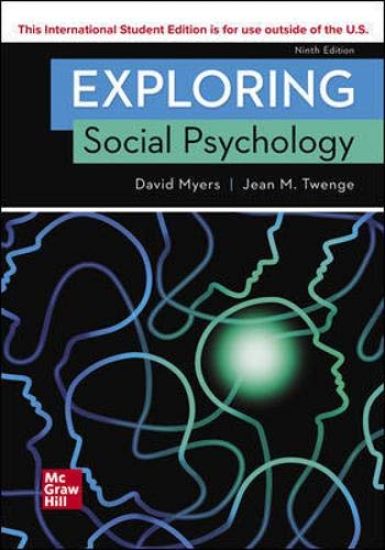
ISE Exploring Social Psychology
David Myers
McGraw-Hill Education
2020
nidottu
Halvin toimitettuna 69,80 €
Exploring Social Psychology succinctly explores social psychological science and applies it to contemporary issues and everyday life. Based on the bestselling text, Social Psychology by David Myers and Jean Twenge, the book presents 31 short modules—each readable in a single sitting—that introduce students to such scientific explorations as love and hate, conformity and independence, prejudice and helping, and persuasion and self-determination. The Connect course for this offering includes SmartBook, an adaptive reading and study experience which guides students to master, recall, and apply key concepts while providing automatically-graded assessments. McGraw-Hill Connect® is a subscription-based learning service accessible online through your personal computer or tablet. Choose this option if your instructor will require Connect to be used in the course. Your subscription to Connect includes the following:• SmartBook® - an adaptive digital version of the course textbook that personalizes your reading experience based on how well you are learning the content.• Access to your instructor’s homework assignments, quizzes, syllabus, notes, reminders, and other important files for the course.• Progress dashboards that quickly show how you are performing on your assignments and tips for improvement.• The option to purchase (for a small fee) a print version of the book. This binder-ready, loose-leaf version includes free shipping. Complete system requirements to use Connect can be found here: http://www.mheducation.com/highered/platforms/connect/training-support-students.html
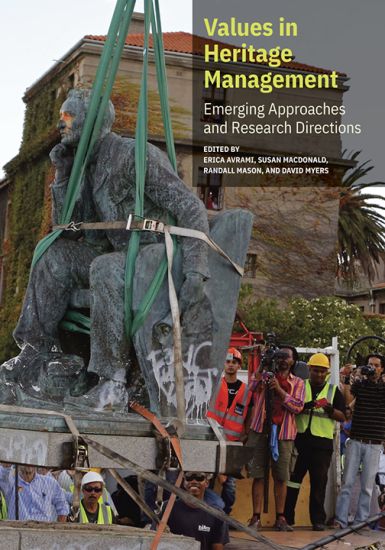
Values in Heritage Management - Emerging Approaches and Research
Erica Avrami; Susan Macdonald; Randall Mason; David Myers
Getty Publications
2019
nidottu
Over the last fifty years, conservation professionals have confronted increasingly complex political, economic, and cultural dynamics. This volume, with contributions by leading international practitioners and scholars, reviews how values-based methods have come to influence conservation, takes stock of emerging approaches to values in heritage practice and policy, identifies common challenges and related spheres of knowledge, and proposes specific areas in which the development of new approaches and future research may help advance the field.

Naskolko nadezhna nasha intuitsija? Mozhem li my polagatsja na nee, kogda delaem pokupki v magazine, vybiraem sputnika, nanimaem sotrudnikov ili otsenivaem sobstvennye sposobnosti? Izvestnyj vo vsem mire psikholog Devid Majers pokazyvaet, chto intuitsija, probuzhdaja v nas porazitelnuju pronitsatelnost, v to zhe vremja mozhet inogda vvesti v opasnoe zabluzhdenie. Avtor osveschaet silnye i slabye storony ispolzovanija intuitsii v sluchajakh, kogda sudi i prisjazhnye otsenivajut pravdivost pokazanij, kogda psikhologi i psikhiatry vyjavljajut sklonnost k prestupleniju, kogda rukovoditeli prinimajut reshenie o najme novykh sotrudnikov. Izdanie prednaznacheno dlja psikhologov i predstavitelej smezhnykh spetsialnostej, a takzhe dlja prepodavatelej i studentov profilnykh fakultetov vysshikh uchebnykh zavedenij.

V sedmom izdanii "Sotsialnoj psikhologii" obobschajutsja rezultaty samykh poslednikh issledovanij razlichnykh sotsialnykh javlenij. Predstavleny teorii i dannye, kotorye, s odnoj storony, vpolne dostupny rjadovomu studentu, a s drugoj - ne osveschajutsja v inykh kursakh po sotsiologii ili psikhologii. V etom izdanii, tak zhe kak i v predyduschem, bolshoe vnimanie udeleno razlichnym kulturam, fundamentalnym printsipam sotsialnogo myshlenija, sotsialnogo vlijanija i sotsialnogo povedenija. Avtor illjustriruet eti printsipy transnatsionalnymi primerami. Zhivoj jazyk avtora, obzor sotsialno-psikhologicheskikh i obschepsikhologicheskikh teorij, opisanie raznoobraznykh eksperimentov, nesomnenno, privlekut vnimanie ne tolko studentov-psikhologov i ikh prepodavatelej, no i sotsiologov, filosofov, politologov.7-e izdaniePerevodchik: Zamchuk Z. S. Redaktor: Maslova E.
Inspiring Stories From Amazing People: From Presidents, Youth Activists, Nobel Prize Winners, YouTubers, Leading Academics, & Innovators of Diverse Ag
David Myers; Mihaly Csikszentmihalyi; Amie Thomasson
Independently Published
2019
nidottu
Why do some people achieve outstanding success while many who work hard do not accomplish much and settle for ordinary life after some fruitless attempts at success? This book contains the testimonies of a good number of people who are globally recognized as accomplished individuals. Their stories provide a clue to the answer to that question. They say even though success does not seem to have a formula, determined individuals can overcome difficult challenges and become outstanding achievers. Their stories and the principles of success the curator of the book gathered from over 400 distinguished achievers from around the world indicate that the route to success is full of seeming contradictions. Understanding those seeming contradictions generally provides the key to what you want. The lessons in this book will aid your understanding of the barriers standing between you and your goals and point you in the direction of life of significance. The individuals serving as your guides through their stories and advice have used the ideas they have presented in this book to achieve outstanding success. It has taken some of them over five decades of diligent work to arrive at their current prestigious positions. Your own journey does not have to take that long. You can pick up the principles that have taken them that long to learn while on a bus ride to work. That may be how much time it will take you to finish this book. Smart people learn from the mistakes and right steps of others. This book may be all you need to accomplish much more than you currently desire. The lessons in it have come from Nobel Prize Winners, Presidents of countries, religious leaders, youth activists, outstanding business men and women and innovators benefitting our world with their products and services. They come from America, Europe, Africa and other continents. Enrich your network. Buy copies for some of its members.