Kirjojen hintavertailu – 12 903 735 kirjaa ja 27 kauppaa

Kirjailija

David Novak

Kirjat ja teokset yhdessä paikassa: 29 kirjaa, julkaisuja vuosilta 1986–2025, suosituimpiin kuuluu Zionism and Judaism. Vertaile teosten hintoja ja tarkista saatavuus suomalaisista kirjakaupoista.

29 kirjaa

Kirjojen julkaisuvuodet: 1986–2025.

The Sanctity of Human Life

The Sanctity of Human Life

David Novak

Georgetown University Press
2007
sidottu
Heated debates are not unusual when confronting tough medical issues where it seems that moral and religious perspectives often erupt in conflict with philosophical or political positions. In The Sanctity of Human Life, Jewish theologian David Novak acknowledges that it is impossible not to take into account the theological view of human life, but the challenge is how to present the religious perspective to nonreligious people. In doing so, he shows that the two positions—the theological and the philosophical—aren't as far apart as they may seem. Novak digs deep into Jewish scripture and tradition to find guidance for assessing three contemporary controversies in medicine and public policy: the use of embryos to derive stem cells for research, socialized medicine, and physician-assisted suicide. Beginning with thinkers like Plato, Aristotle, Kant, and Nietsche, and drawing on great Jewish figures in history—Maimonides, Rashi, and various commentators on the Torah (written law) and the Mishnah (oral law)—Novak speaks brilliantly to these modern moral dilemmas. The Sanctity of Human Life weaves a rich and sophisticated tapestry of evidence to conclude that the Jewish understanding of the human being as sacred, as the image of God, is in fact compatible with philosophical claims about the rights of the human person—especially the right to life—and can be made intelligible to secular culture. Thus, according to Novak, the use of stem cells from embryos is morally unacceptable; the sanctity of the human person, and not capitalist or socialist approaches, should drive our understanding of national health care; and physician-assisted suicide violates humankind's fundamental responsibility for caring for one another. Novak's erudite argument and rigorous scholarship will appeal to all scholars and students engaged in the work of theology and bioethics.
The Jewish Social Contract

The Jewish Social Contract

David Novak

Princeton University Press
2005
sidottu
The Jewish Social Contract begins by asking how a traditional Jew can participate politically and socially and in good faith in a modern democratic society, and ends by proposing a broad, inclusive notion of secularity. David Novak takes issue with the view--held by the late philosopher John Rawls and his followers--that citizens of a liberal state must, in effect, check their religion at the door when discussing politics in a public forum. Novak argues that in a "liberal democratic state, members of faith-based communities--such as tradition-minded Jews and Christians--ought to be able to adhere to the broad political framework wholly in terms of their own religious tradition and convictions, and without setting their religion aside in the public sphere. Novak shows how social contracts emerged, rooted in biblical notions of covenant, and how they developed in the rabbinic, medieval, and "modern periods. He offers suggestions as to how Jews today can best negotiate the modern social contract while calling upon non-Jewish allies to aid them in the process. The Jewish Social Contract will prove an enlightening and innovative contribution to the ongoing debate about the role of religion in liberal democracies.
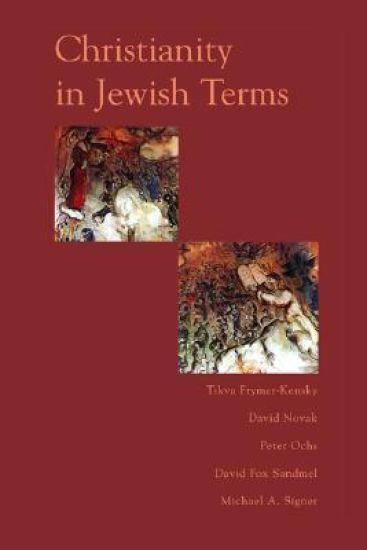
Christianity In Jewish Terms

Christianity In Jewish Terms

David Novak; David Sandmel; Michael Singer; Peter Ochs; Tikva Frymer-kensky

Basic Books
2002
pokkari
Over the past few decades, there has been a dramatic and unprecedented shift in Jewish-Christian relations, including signs of a new, improved Christian attitude towards Jews. Christianity in Jewish Terms is a Jewish theological response to the profound changes that have taken place in Christian thought. The book is divided into ten chapters, each of which features a main essay, written by a Jewish scholar, that explores the meaning of a set of Christian beliefs. Following the essay are responses from a second Jewish scholar and a Christian scholar. Designed to generate new conversations within the American Jewish community and between the Jewish and Christian communities, Christianity in Jewish Terms lays the foundation for better understanding. It was named a Choice Outstanding Academic Book of 2001.
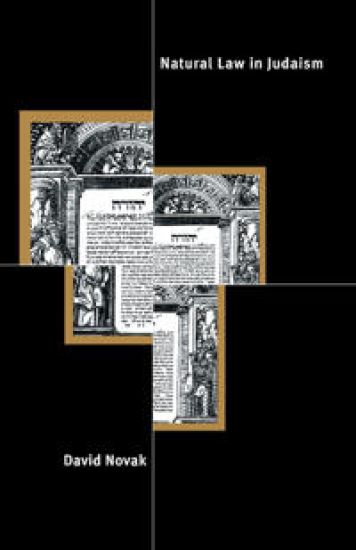
Natural Law in Judaism

Natural Law in Judaism

David Novak

Cambridge University Press
1998
sidottu
This book breaks new ground in the study of Judaism, in philosophy, and in comparative ethics. It demonstrates that the assumption that Judaism has no natural law theory to speak of, held by the vast majority of scholars, is simply wrong. The book shows how natural law theory, using a variety of different terms for itself throughout the ages, has been a constant element in Jewish thought. The book sorts out the varieties of Jewish natural law theory, illuminating their strengths and weaknesses. It also presents a case for utilising natural law theory in order to deal with current theological and philosophical questions in Judaism’s ongoing reflection on its own meaning and its meaning for the wider world. David Novak combines great erudition in the Jewish tradition, the history of philosophy and law, and the imagination to argue for Judaism in the context of current debates, both theoretical and practical.
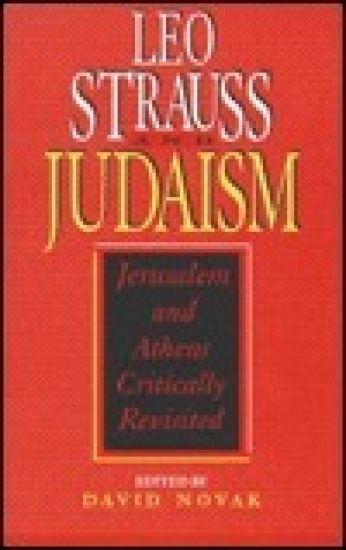
Leo Strauss and Judaism

Leo Strauss and Judaism

David Novak

Rowman Littlefield
1996
nidottu
This collection of original essays by prominent scholars of political philosophy analyzes Leo Strauss's thoughts concerning the relationship between revelation and reason within the context of Jewish religion and thought. Unlike other edited collections about Strauss, the contributors to Leo Strauss and Judaism: Jerusalem and Athens Critically Revisited examine their subject using a wide range of ideological and methodological approaches, arriving at a variety of conclusions, many of which are controversial. This book will be of interest to students and scholars of Leo Strauss, Jewish philosophy, and political theory.
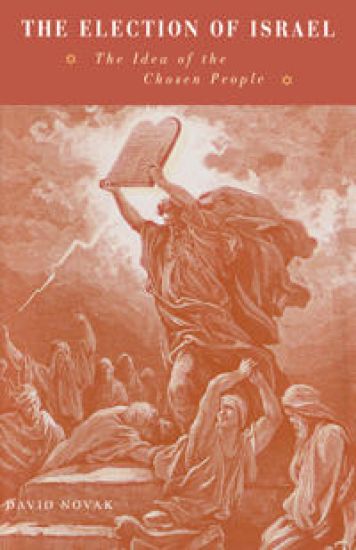
The Election of Israel

The Election of Israel

David Novak

Cambridge University Press
1995
sidottu
In this book, David Novak conducts an historical, philosophical, and theological reflection on the central Jewish doctrine of Israel’s election by God, also known as the idea of the chosen people. Historically, he analyses the great change in modern Jewish thought brought about by Spinoza’s inversion of the doctrine: that it was not God who elected Israel, but Israel who elected God. The development of that inversion is illustrated by the thought of the German philosopher-theologian, Hermann Cohen. Philosophically, Novak explores the ontological implications of the two differing theologies of election. Theologically, he argues for the correlation of election and revelation, and maintains that a theology of election is required in order to deal with two central questions, namely: who are the Jews, and how are Jews to be related to the world? The constructive picture which results leads to a new understanding of Jewish modernity.
Jewish-Christian Dialogue

Jewish-Christian Dialogue

David Novak

Oxford University Press Inc
1992
nidottu
Most of the available books that deal with the Jewish-Christian relationship are primarily historical studies concentrating on the Jewish background of Christianity, the separation of Christianity from Judaism, or the medieval disputations between Judaism and Christianity. This volume is a philosophically constructed theological argument carefully drawing upon classical Jewish sources. It advocates that there is actual justification from within the Jewish religious tradition for the new relationship between Judaism and Christianity. As such, the book lays the groundwork for a more theologically serious development of Jewish-Christian dialogue.
Creation and the End of Days

Creation and the End of Days

David Novak; Norbert Samuelson

University Press of America
1986
sidottu
In this colleciton, leading astrophysicists and Jewish philosophers present views about cosmology from both contemporary science and religious tradition. This volume of proceedings from the 1984 meeting of the Academy of Jewish Philosophers may be the most significant statement in modern times about fundamental Jewish beliefs of the creation of the universe and the end of days. Co-published with Studies in Judaism.