Kirjojen hintavertailu – 12 859 819 kirjaa ja 27 kauppaa

Kirjailija

David P. Auerswald

Kirjat ja teokset yhdessä paikassa: 4 kirjaa, julkaisuja vuosilta 2000–2025, suosituimpiin kuuluu Overseen or Overlooked?. Vertaile teosten hintoja ja tarkista saatavuus suomalaisista kirjakaupoista.

4 kirjaa

Kirjojen julkaisuvuodet: 2000–2025.

Overseen or Overlooked?

Overseen or Overlooked?

David P. Auerswald; Philippe Lagassé; Stephen M. Saideman

STANFORD UNIVERSITY PRESS
2025
sidottu

Halvin toimitettuna 78,10 €

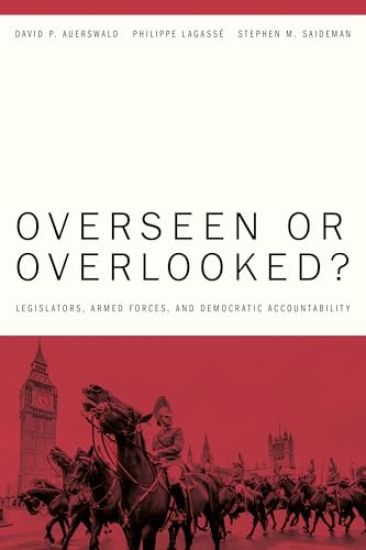
"War is too important to be left to the generals," declared French Prime Minister Georges Clemenceau over a century ago. But which civilians, exactly, play the most important roles in controlling the armed forces? When civilian control is studied, the focus is typically on those in the upper echelons of the executive branch: presidents, prime ministers, or defense secretaries. Yet, because civilians in the executive may be tempted to hide problems or use the military in controversial ways, researchers must extend Clemenceau's dictum: if war is too important to be left to the generals, civilian control is too important to leave with the executive. This book aims to understand the similarities and differences among the world's democracies regarding the role of legislatures in democratic civil-military relations. Drawing on over a dozen cases from across the globe, the authors examine how most legislatures face capability and motivational impediments to conducting truly robust oversight and propose realistic reforms to strengthen military accountability to elected officials and the public—the heart of the civil-military relationship.
NATO in Afghanistan

NATO in Afghanistan

David P. Auerswald; Stephen M. Saideman

Princeton University Press
2016
pokkari
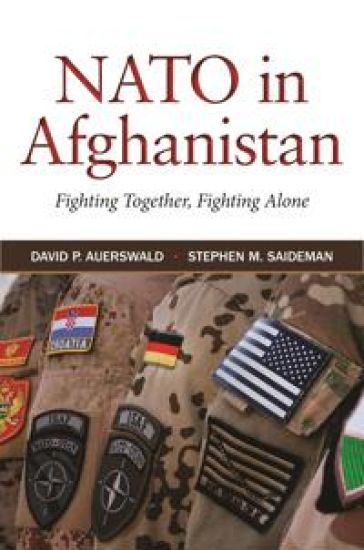
Modern warfare is almost always multilateral to one degree or another, requiring countries to cooperate as allies or coalition partners. Yet as the war in Afghanistan has made abundantly clear, multilateral cooperation is neither straightforward nor guaranteed. Countries differ significantly in what they are willing to do and how and where they are willing to do it. Some refuse to participate in dangerous or offensive missions. Others change tactical objectives with each new commander. Some countries defer to their commanders while others hold them to strict account. NATO in Afghanistan explores how government structures and party politics in NATO countries shape how battles are waged in the field. Drawing on more than 250 interviews with senior officials from around the world, David Auerswald and Stephen Saideman find that domestic constraints in presidential and single-party parliamentary systems--in countries such as the United States and Britain respectively--differ from those in countries with coalition governments, such as Germany and the Netherlands. As a result, different countries craft different guidelines for their forces overseas, most notably in the form of military caveats, the often-controversial limits placed on deployed troops. Providing critical insights into the realities of alliance and coalition warfare, NATO in Afghanistan also looks at non-NATO partners such as Australia, and assesses NATO's performance in the 2011 Libyan campaign to show how these domestic political dynamics are by no means unique to Afghanistan.
NATO in Afghanistan

NATO in Afghanistan

David P. Auerswald; Stephen M. Saideman

Princeton University Press
2014
sidottu
Modern warfare is almost always multilateral to one degree or another, requiring countries to cooperate as allies or coalition partners. Yet as the war in Afghanistan has made abundantly clear, multilateral cooperation is neither straightforward nor guaranteed. Countries differ significantly in what they are willing to do and how and where they are willing to do it. Some refuse to participate in dangerous or offensive missions. Others change tactical objectives with each new commander. Some countries defer to their commanders while others hold them to strict account. NATO in Afghanistan explores how government structures and party politics in NATO countries shape how battles are waged in the field. Drawing on more than 250 interviews with senior officials from around the world, David Auerswald and Stephen Saideman find that domestic constraints in presidential and single-party parliamentary systems--in countries such as the United States and Britain respectively--differ from those in countries with coalition governments, such as Germany and the Netherlands. As a result, different countries craft different guidelines for their forces overseas, most notably in the form of military caveats, the often-controversial limits placed on deployed troops. Providing critical insights into the realities of alliance and coalition warfare, NATO in Afghanistan also looks at non-NATO partners such as Australia, and assesses NATO's performance in the 2011 Libyan campaign to show how these domestic political dynamics are by no means unique to Afghanistan.
Disarmed Democracies

Disarmed Democracies

David P. Auerswald

The University of Michigan Press
2000
sidottu
In Disarmed Democracies: Domestic Institutions and the Use of Force, David P. Auerswald examines how the structure of domestic political institutions affects whether democracies use force or make threats during international disputes. Auerswald argues that the behavior of democracies in interstate conflict is shaped as much by domestic political calculations as by geopolitical circumstance. Variations in the structure of a democracy's institutions of governance make some types of democracies more likely to use force than others. To test his theory, Auerswald compares British, French, and U. S. behavior during military conflicts and diplomatic crises from the Cold War era to the present. He discusses how accountability and agenda control vary between parliamentary, presidential, and premier-presidential democracies and shows how this affects the ability of the democracy to signal its intentions, as well as the likelihood that it will engage in military conflict. His findings have implications for the study of domestic politics and the use of force, as well as of U. S. leadership during the next century. This study will interest social scientists interested in the domestic politics of international security, comparative foreign policy, or the study of domestic institutions. It will interest those concerned with the exercise of U. S. leadership in the next century, the use of force by democracies, and the future behavior of democratizing nations. David P. Auerswald is Assistant Professor of Political Science and International Affairs, George Washington University.