Kirjojen hintavertailu – 12 870 670 kirjaa ja 27 kauppaa

Kirjailija

David P. Levine

Kirjat ja teokset yhdessä paikassa: 26 kirjaa, julkaisuja vuosilta 1987–2021, suosituimpiin kuuluu A Dangerous Place to Be. Vertaile teosten hintoja ja tarkista saatavuus suomalaisista kirjakaupoista.

Nimi esiintyy myös muodoissa: David P Levine

26 kirjaa

Kirjojen julkaisuvuodet: 1987–2021.

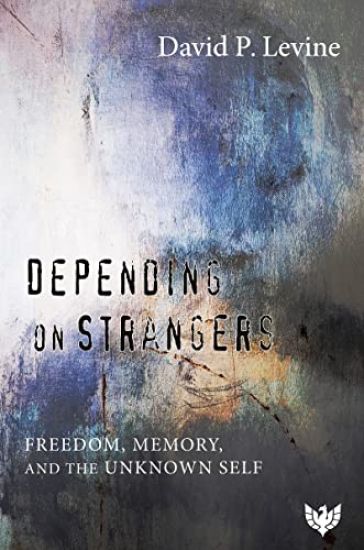
Depending on Strangers

Depending on Strangers

David P. Levine

Phoenix Publishing House
2021
pokkari
We live in a world where our livelihood depends on our ability to relate to strangers. The central quality that defines strangers is that they are unknown. Because strangers are unknown, they represent, in the world outside, the unknown self within. The unknown self is the core of the personality considered as a potential to become something yet to be determined. To be already known is to be determined prior to and independently of our presence in our lives. At the outset of the process of taking form, the individual is, in a sense, a stranger to self and to others. The more this is the case, the greater the openness of the process of self-formation and the more marked the role of freedom from predetermination in that process. Freedom from predetermination exists along three dimensions: the free movement of thoughts and ideas or “inner freedom”; the freedom to relate, which is also the freedom not to relate; and freedom in relating, which is the possibility of maintaining secure self-boundaries in relations with others. In exploring freedom understood in this way, Professor Levine considers such topics as: the nature of inner freedom and its relationship to deliberation and choice; stranger anxiety and its connection to group dynamics and social connection; the internal factors that enable us to make the decisions that shape our lives and through our actions realize the ends embedded in our decisions; how our memories shape our thought processes and therefore the choices we make and the lives we lead that result from them; what makes it possible for us to live comfortably with and depend on people we do not know; concern for the welfare of strangers and how our welfare can be secure in a world where we do not care about others and they do not care about us.

Self-Seeking and the Pursuit of Justice
First published in 1997, this volume delves into the most influential theories of economic justice, which ground themselves in utilitarian or related contractarian ideas about the self. These ideas take self-interest to be transparent and unproblematic. Favoured assumptions about the self also make scarcity the primary reality with which economic justice must deal. Much is lost in consideration of the justness of economic arrangements when we take the wants and interests of the self for granted in this way, and treat scarcity as a premise. In this book the author places the discussion of economic justice on a sounder foundation as regards the nature and ends of the self. The book begins with a discussion of the self as a structure, and proceeds to consider aspects of self-interest, public ends, economic welfare, needs and wants, the limits of the market, economic democracy, global inequality, and justice as the end of development.
Dark Fantasy

Dark Fantasy

David P. Levine

Routledge
2019
sidottu
Recent trends in politics culminating in the US with the election of Donald Trump both provoked and expressed a troubling intensification of emotion in the body politic. Heightened levels of anger, frustration, and distrust, the dismissal of the norms of politics and policy making, and the prevalence of intractable conflict indicated an increase in the power of regressive forces. The power of these forces takes the form of dark fantasies involving the loss, indeed the destruction, of safe space, the prevalence of existential threat, and the corrosion of the kinds of relationships that make living in the world tolerable. This book explores the emotional meaning of regressive movements in contemporary politics with special reference to Trump and his supporters. Its main hypothesis is that the primary goal of these movements is not to restore a lost world of safety and wellbeing as they claim it is, but to make their members' experience of the destruction and loss of that world universal.
Self-Seeking and the Pursuit of Justice
First published in 1997, this volume delves into the most influential theories of economic justice, which ground themselves in utilitarian or related contractarian ideas about the self. These ideas take self-interest to be transparent and unproblematic. Favoured assumptions about the self also make scarcity the primary reality with which economic justice must deal. Much is lost in consideration of the justness of economic arrangements when we take the wants and interests of the self for granted in this way, and treat scarcity as a premise. In this book the author places the discussion of economic justice on a sounder foundation as regards the nature and ends of the self. The book begins with a discussion of the self as a structure, and proceeds to consider aspects of self-interest, public ends, economic welfare, needs and wants, the limits of the market, economic democracy, global inequality, and justice as the end of development.
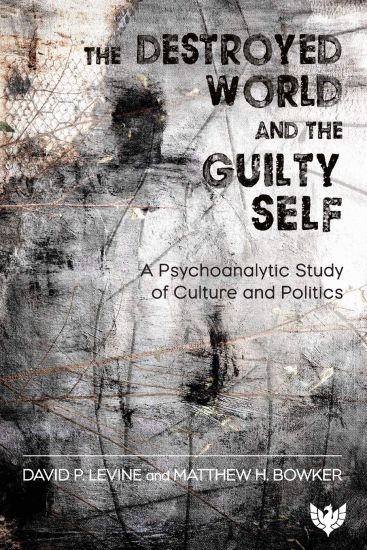
The Destroyed World and the Guilty Self

The Destroyed World and the Guilty Self

David P. Levine; Matthew H. Bowker

Phoenix Publishing House
2019
pokkari
David Levine and Matthew Bowker explore cultural and political trends organized around the conviction that the world we live in is a dangerous place to be, that it is dominated by hate and destruction, and that in it our primary task is to survive by carrying on a life-long struggle against hostile forces. Their method involves the analysis of public fantasies to reveal their hidden meanings. The central fantasy explored is the fantasy of a destroyed world, which appears most commonly in the form of post-apocalyptic and dystopian narratives. Their special concern in the book is with defenses against the painful consequences of the dominance of this fantasy in the inner world, especially defenses involving the use of guilt to assure that something can be done to repair the destroyed world. Topics explored include: the formation of internal fortresses and their projection into the world outside, forms of guilt including bystander guilt and survivor guilt, the loss of and search for home, and manic forms of reparation.
A Dangerous Place to Be

A Dangerous Place to Be

Matthew H. Bowker; David P. Levine

Karnac Books
2018
nidottu
Over the past several decades, colleges and universities in the United States and United Kingdom have made significant commitments to increasing diversity, most notably regarding race and gender. The result has not, however, been an amelioration of conflict over matters of difference. Instead, there has been continuing, if not increasing, conflict and strife in universities, often reflecting conflict in the larger society. A Dangerous Place to Be examines identity-based conflict in colleges and universities, analyzing the actions of students, teachers, administrators, and educational organizations as efforts to manage dilemmas and disturbances arising in the process of identity formation.
Dark Fantasy

Dark Fantasy

David P. Levine

Karnac Books
2017
nidottu
Recent trends in politics culminating in the US with the election of Donald Trump both provoked and expressed a troubling intensification of emotion in the body politic. Heightened levels of anger, frustration, and distrust, the dismissal of the norms of politics and policy making, and the prevalence of intractable conflict indicated an increase in the power of regressive forces. The power of these forces takes the form of dark fantasies involving the loss, indeed the destruction, of safe space, the prevalence of existential threat, and the corrosion of the kinds of relationships that make living in the world tolerable. This book explores the emotional meaning of regressive movements in contemporary politics with special reference to Trump and his supporters. Its main hypothesis is that the primary goal of these movements is not to restore a lost world of safety and wellbeing as they claim it is, but to make their members' experience of the destruction and loss of that world universal.
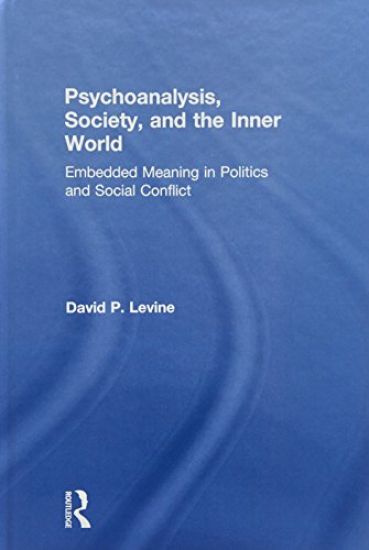
Psychoanalysis, Society, and the Inner World
Psychoanalysis, Society, and the Inner World explores ideas from psychoanalysis that can be valuable in understanding social processes and institutions and in particular, how psychoanalytic ideas and methods can help us understand the nature and roots of social and political conflict in the contemporary world. Among the ideas explored in this book, of special importance are the ideas of a core self (Heinz Kohut and Donald Winnicott) and of an internal object world (Melanie Klein, Ronald Fairbairn). David Levine shows how these ideas, and others related to them, offer a framework for understanding how social processes and institutions establish themselves as part of the individual’s inner world, and how imperatives of the inner world influence the shape of those processes and institutions. In exploring the contribution psychoanalytic ideas can make to the study of society, emphasis is placed on post-Freudian trends that emphasize the role of the internalization of relationships as an essential part of the process of shaping the inner world. The book’s main theme is that the roots of social conflict will be found in ambivalence about the value of the self. The individual is driven to ambivalence by factors that exist simultaneously as part of the inner world and the world outside. Social institutions may foster ambivalence about the self or they may not. Importantly, this book distinguishes between institutions on the basis of whether they do or do not foster ambivalence about the self, shedding light on the nature and sources of social conflict. Institutions that foster ambivalence also foster conflict at a societal level that mirrors and is mirrored by conflict over the standing of the self in the inner world. Levine makes extensive use of case material to illuminate and develop his core ideas. Psychoanalysis, Society, and the Inner World will appeal to psychoanalysts and to social scientists interested in psychoanalytic ideas and methods, as well as students studying across these fields who are keen to explore social and political issues.
Psychoanalytic Studies of Creativity, Greed, and Fine Art
Throughout the history of psychoanalysis, the study of creativity and fine art has been a special concern. Psychoanalytic Studies of Creativity, Greed and Fine Art: Making Contact with the Self makes a distinct contribution to the psychoanalytic study of art by focusing attention on the relationship between creativity and greed. This book also focuses attention on factors in the personality that block creativity, and examines the matter of the self and its ability to be present and exist as the essential element in creativity. Using examples primarily from visual art David Levine explores the subjects of creativity, empathy, interpretation and thinking through a series of case studies of artists, including Robert Irwin, Ad Reinhardt, Susan Burnstine, and Mark Rothko. Psychoanalytic Studies of Creativity, Greed and Fine Art explores the highly ambivalent attitude of artists toward making their presence known, an ambivalence that is evident in their hostility toward interpretation as a way of knowing. This is discussed with special reference to Susan Sontag’s essay on the subject of interpretation. Psychoanalytic Studies of Creativity, Greed and Fine Art contributes to a long tradition of psychoanalytically influenced writing on creativity including the work of Deri, Kohut, Meltzer, Miller and Winnicott among others. It will be of interest to psychoanalysts, psychoanalytic psychotherapists, historians and theorists of art.
Subjectivity in Political Economy

Subjectivity in Political Economy

David P. Levine

Routledge
2014
nidottu
This book explores the way political economy understands human motivation. In it, the author argues that the assumptions typically made by economists regarding want and choice cannot adequately lay a foundation for answering important questions about the design of economic institutions and the appropriate use of markets. This volume offers an exciting and unusual contribution to political economy, offering a novel integration of the insights of political economy, philosophy, and psychology, applying them to vital foundational issues in political economy.
Normative Political Economy

Normative Political Economy

David P. Levine

Routledge
2014
nidottu
Normative Political Economy explores the criteria we use for judging economic institutions and economic policy. It argues that prevailing criteria lack sufficient depth in their understanding of subjective experience. David Levine's arguments cover topics which include: * basic needs, equality and justice * freedom, self-integration and creative living * the role of the state * capitalism and the good society
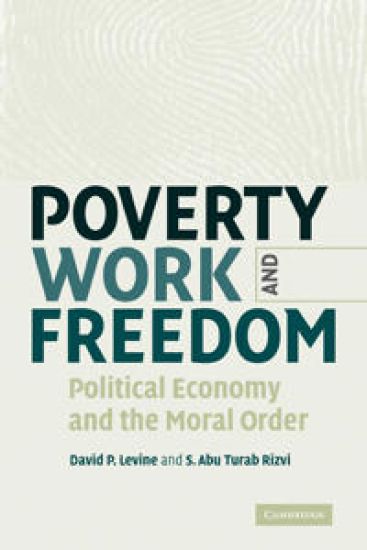
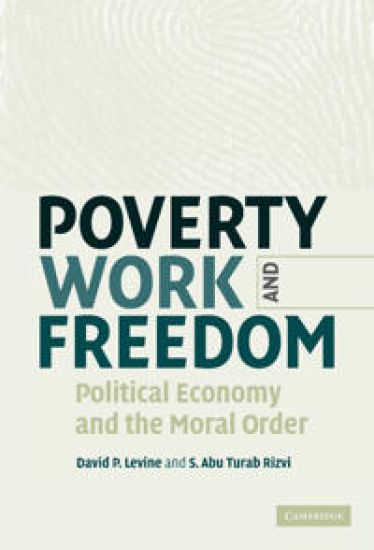
Poverty, Work, and Freedom

Poverty, Work, and Freedom

David P. Levine; S. Abu Turab Rizvi

Cambridge University Press
2011
pokkari
The poor seem easy to identify: those who do not have enough money or enough of the things money can buy. This book explores a different approach to poverty, one suggested by the notion of capabilities emphasized by Amartya Sen and Martha Nussbaum. In the spirit of the capabilities approach, the book argues that poverty refers not to a lack of things but to the lack of the ability to live life in a particular way. The authors argue that the poor are those who cannot live a life that is discovered and created rather than already known. Avoiding poverty, then, means having the capacity and opportunity for creative living. The authors argue that the capacity to do skilled work plays a particularly important role in creative living, and suggest that the development of the ability to do skilled work is a vital part of solving the problem of poverty.
Welfare, Right and the State

Welfare, Right and the State

David P. Levine

Routledge
2011
nidottu
This book develops a creative theoretical framework for understanding the welfare state: the theory of the state and the idea of welfare connected to autonomy. Written by a well-known expert of political economy and welfare, it explores the nature of welfare and connects welfare not to basic needs, but to what Levine refers to as the capacity to lead the self-made life, considering different ways of grounding the claim that providing for the welfare of citizens might be considered a duty of the state. Among the ideas explored are: shared membership in a communityrightscompassionand security. Welfare, Right and the State will be of interest to academics and advanced students working in the field of social administration, sociology, political science, economics, philosophy, international studies and social work.
Object Relations, Work and the Self

Object Relations, Work and the Self

David P. Levine

Routledge
2009
sidottu
In this book, David P. Levine applies psychoanalytic object relations theory to understanding work motivation and the meaning of work. Drawing on the writings of authors such as Donald Winnicott, Otto Kernberg and Melanie Klein, he explores three factors central to our effort to understand work: guilt, greed and the self. Special attention is paid to the factors that determine the individual’s emotional capacity to do work that engages the self and its creative potential and to the related matter of impairment in that capacity. Chapters include: the problem of workgreed, envy and the search for the selfskill, power and authoritywork and reality. Object Relations, Work and the Self will be of interest to psychoanalysts and organizational consultants as well as anyone concerned with what determines the quality of life in the workplace.
Object Relations, Work and the Self

Object Relations, Work and the Self

David P. Levine

Routledge
2009
nidottu
In this book, David P. Levine applies psychoanalytic object relations theory to understanding work motivation and the meaning of work. Drawing on the writings of authors such as Donald Winnicott, Otto Kernberg and Melanie Klein, he explores three factors central to our effort to understand work: guilt, greed and the self. Special attention is paid to the factors that determine the individual’s emotional capacity to do work that engages the self and its creative potential and to the related matter of impairment in that capacity. Chapters include: the problem of workgreed, envy and the search for the selfskill, power and authoritywork and reality. Object Relations, Work and the Self will be of interest to psychoanalysts and organizational consultants as well as anyone concerned with what determines the quality of life in the workplace.
Welfare, Right and the State

Welfare, Right and the State

David P. Levine

Routledge
2007
sidottu
This book develops a creative theoretical framework for understanding the welfare state: the theory of the state and the idea of welfare connected to autonomy. Written by a well-known expert of political economy and welfare, it explores the nature of welfare and connects welfare not to basic needs, but to what Levine refers to as the capacity to lead the self-made life, considering different ways of grounding the claim that providing for the welfare of citizens might be considered a duty of the state. Among the ideas explored are: shared membership in a communityrightscompassionand security. Welfare, Right and the State will be of interest to academics and advanced students working in the field of social administration, sociology, political science, economics, philosophy, international studies and social work.
Poverty, Work, and Freedom

Poverty, Work, and Freedom

David P. Levine; S. Abu Turab Rizvi

Cambridge University Press
2005
sidottu
The poor seem easy to identify: those who do not have enough money or enough of the things money can buy. This book explores a different approach to poverty, one suggested by the notion of capabilities emphasized by Amartya Sen and Martha Nussbaum. In the spirit of the capabilities approach, the book argues that poverty refers not to a lack of things but to the lack of the ability to live life in a particular way. The authors argue that the poor are those who cannot live a life that is discovered and created rather than already known. Avoiding poverty, then, means having the capacity and opportunity for creative living. The authors argue that the capacity to do skilled work plays a particularly important role in creative living, and suggest that the development of the ability to do skilled work is a vital part of solving the problem of poverty.