Kirjojen hintavertailu – 12 859 829 kirjaa ja 27 kauppaa

Kirjailija

David Rose

Kirjat ja teokset yhdessä paikassa: 44 kirjaa, julkaisuja vuosilta 1989–2026, suosituimpiin kuuluu The Big Eddy Club. Vertaile teosten hintoja ja tarkista saatavuus suomalaisista kirjakaupoista.

44 kirjaa

Kirjojen julkaisuvuodet: 1989–2026.

Working with Discourse

Working with Discourse

J. R. Martin; David Rose

Continuum International Publishing Group Ltd.
2007
sidottu
This second edition of the best-selling textbook "Working with Discourse" has been revised and updated throughout. The book builds an accessible set of analytic tools that can be used to explore how speakers and writers construe meaning through discourse. These techniques are introduced in clear steps, through analyses of spoken, written and visual texts that focus on truth and reconciliation in post-apartheid South Africa. The new edition includes a chapter on Negotiation, clear definitions of key terms, chapter summaries and revised suggestions for further reading. Accessibly written and presupposing no prior knowledge of discourse or functional linguistics, this is the ideal textbook for students encountering discourse analysis for the first time at advanced undergraduate or postgraduate level.
Consciousness

Consciousness

David Rose

Oxford University Press
2006
nidottu
Consciousness is a state of being aware - of our self, of our surroundings, of our place in those surroundings. Yet what makes us conscious? What neural processes drive our awareness, and how do these processes relate to what we think of as our mind? Consciousness: Philosophical, Psychological, and Neural Theories seeks to respond to some of these questions, offering a wealth of information from which the reader can develop their own views of the subject. Taking a critical, thought-provoking approach, the book integrates studies from philosophy, psychology, and neuroscience to capture the major themes on which our current understanding of consciousness is based. Opening with a series of chapters that introduce us to thinking about mind, the book goes on to explore function and brain, examining such topics as functionalism, representation, and brain dynamics. Understanding consciousness remains one of today's greatest challenges. Consciousness: Philosophical, Psychological, and Neural Theories demystifies what is known about the interface of brain and mind, and offers intriguing insights into what remains to be discovered. Online Resource Centre The Online Resource Centre features figures from the book available to download to facilitate lecture preparation.
Guantanamo: The War on Human Rights
Praised as a "tour-de-force deconstruction of Bush's supermax gulag" (San Diego Union Tribune) when first published in hardcover, Guant namo makes shocking allegations about the infamous U. S. detention camp in Cuba. Award-winning journalist David Rose argues that the camp not only constitutes a grotesque abuse of human rights but is also ineffective as a tool for combating terrorism. Through firsthand research in Cuba, government documents, and dozens of interviews with guards, intelligence officials, military lawyers, and former detainees, Rose sheds light on Gitmo's ugly inner workings. He reveals that, contrary to the Bush administration's claims, the prisoners at Guant namo are not "the hardest of the hard-core" Al Qaeda terrorists, ruthless men "involved in a plot to kill thousands of ordinary Americans." And he provides solid evidence that the brutal interrogations that supposedly justify the camp's existence have yielded very little useful intelligence.
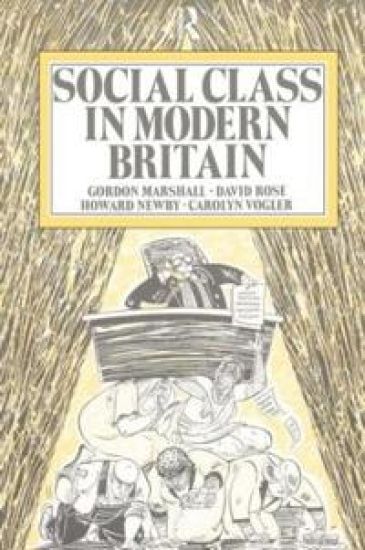
Social Class in Modern Britain

Social Class in Modern Britain

Gordon Marshall; Howard Newby; David Rose; Carol Vogler

Routledge
1989
nidottu
The book incorporates three alternative conceptions of class. Erik Olin Wright's structural Marxist account is set alongside John Goldthorpe's occupational class schema, and the Registrar-General's prestige and skill-related categories. The authors use their unique data on inequality and conflict in contemporary Britain to provide, for the first time, a rigourous comparison of Marxist, sociological and official class frameworks. The book ranges widely across such topics as sectionalism in the workforce; privatism of families and individuals; fatalism; gender and class processes; sectoral production and consumption cleavages. The authors conclude that class is still crucial in structuring economic, political and social life.