Kirjojen hintavertailu – 12 903 724 kirjaa ja 27 kauppaa

Kirjailija

David Rosenthal

Kirjat ja teokset yhdessä paikassa: 9 kirjaa, julkaisuja vuosilta 1983–2023, suosituimpiin kuuluu Consciousness and Mind. Vertaile teosten hintoja ja tarkista saatavuus suomalaisista kirjakaupoista.

9 kirjaa

Kirjojen julkaisuvuodet: 1983–2023.

Consciousness and Mind

Consciousness and Mind

David Rosenthal

Clarendon Press
2005
nidottu
Consciousness and Mind presents David Rosenthal's influential work on the nature of consciousness. Central to that work is Rosenthal's higher-order-thought theory of consciousness, according to which a sensation, thought, or other mental state is conscious if one has a higher-order thought (HOT) that one is in that state. The first four essays develop various aspects of that theory. The next three essays present Rosenthal's homomorphism theory of mental qualities and qualitative consciousness, and show how that theory fits with and helps sustain the HOT theory. A crucial feature of homomorphism theory is that it individuates and taxonomizes mental qualities independently of the way we're conscious of them, and indeed independently of our being conscious of them at all. So the theory accommodates the qualitative character not only of conscious sensations and perceptions, but also of those which fall outside our stream of consciousness. Rosenthal argues that, because this account of mental qualities makes no appeal to consciousness, it enables us to dispel such traditional quandaries as the alleged conceivability of undetectable quality inversion, and to disarm various apparent obstacles to explaining qualitative consciousness and understanding its nature. Six further essays build on the HOT theory to explain various important features of consciousness, among them the complex connections that hold in humans between consciousness and speech, the self-interpretative aspect of consciousness, and the compelling sense we have that consciousness is unified. Two of the essays, one an extended treatment of homomorphism theory, appear here for the first time. There is also a substantive introduction, which draws out the connections between the essays and highlights their implications.

Consciousness and Mind

Consciousness and Mind

David Rosenthal

Clarendon Press
2005
sidottu
Consciousness and Mind presents David Rosenthal's influential work on the nature of consciousness. Central to that work is Rosenthal's higher-order-thought theory of consciousness, according to which a sensation, thought, or other mental state is conscious if one has a higher-order thought (HOT) that one is in that state. The first four essays develop various aspects of that theory. The next three essays present Rosenthal's homomorphism theory of mental qualities and qualitative consciousness, and show how that theory fits with and helps sustain the HOT theory. A crucial feature of homomorphism theory is that it individuates and taxonomizes mental qualities independently of the way we're conscious of them, and indeed independently of our being conscious of them at all. So the theory accommodates the qualitative character not only of conscious sensations and perceptions, but also of those which fall outside our stream of consciousness. Rosenthal argues that, because this account of mental qualities makes no appeal to consciousness, it enables us to dispel such traditional quandaries as the alleged conceivability of undetectable quality inversion, and to disarm various apparent obstacles to explaining qualitative consciousness and understanding its nature. Six further essays build on the HOT theory to explain various important features of consciousness, among them the complex connections that hold in humans between consciousness and speech, the self-interpretative aspect of consciousness, and the compelling sense we have that consciousness is unified. Two of the essays, one an extended treatment of homomorphism theory, appear here for the first time. There is also a substantive introduction, which draws out the connections between the essays and highlights their implications.
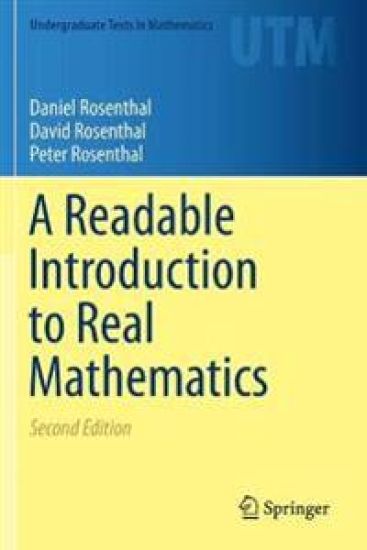
A Readable Introduction to Real Mathematics

A Readable Introduction to Real Mathematics

Daniel Rosenthal; David Rosenthal; Peter Rosenthal

Springer Nature Switzerland AG
2021
nidottu
Designed for an undergraduate course or for independent study, this text presents sophisticated mathematical ideas in an elementary and friendly fashion. The fundamental purpose of this book is to teach mathematical thinking while conveying the beauty and elegance of mathematics. The book contains a large number of exercises of varying difficulty, some of which are designed to help reinforce basic concepts and others of which will challenge virtually all readers. The sole prerequisite for reading this text is high school algebra. Topics covered include: * mathematical induction * modular arithmetic * the Fundamental Theorem of Arithmetic * Fermat's Little Theorem * RSA encryption * the Euclidean algorithm * rational and irrational numbers * complex numbers * cardinality * Euclidean plane geometry * constructibility (including a proof that an angle of 60 degrees cannot be trisected with a straightedge and compass)* infinite series * higher dimensional spaces. This textbook is suitable for a wide variety of courses and for a broad range of students of mathematics and other subjects. Mathematically inclined senior high school students will also be able to read this book. From the reviews of the first edition:“It is carefully written in a precise but readable and engaging style… I thoroughly enjoyed reading this recent addition to the Springer Undergraduate Texts in Mathematics series and commend this clear, well-organised, unfussy text to its target audiences.” (Nick Lord, The Mathematical Gazette, Vol. 100 (547), 2016) “The book is an introduction to real mathematics and is very readable. … The book is indeed a joy to read, and would be an excellent text for an ‘appreciation of mathematics’ course, among other possibilities.” (G. A. Heuer, Mathematical Reviews, February, 2015)“Many a benighted book misguidedly addresses the need [to teach mathematical thinking] by framing reasoning, or narrowly, proof, not as pervasive modality but somehow as itself an autonomous mathematical subject. Fortunately, the present book gets it right.... [presenting] well-chosen, basic, conceptual mathematics, suitably accessible after a K-12 education, in a detailed, self-conscious way that emphasizes methodology alongside content and crucially leads to an ultimate clear payoff. … Summing Up: Recommended. Lower-division undergraduates and two-year technical program students; general readers.” (D. V. Feldman, Choice, Vol. 52 (6), February, 2015)
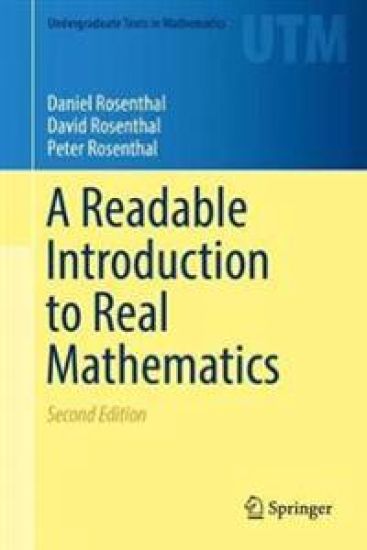
A Readable Introduction to Real Mathematics

A Readable Introduction to Real Mathematics

Daniel Rosenthal; David Rosenthal; Peter Rosenthal

Springer Nature Switzerland AG
2019
sidottu
Designed for an undergraduate course or for independent study, this text presents sophisticated mathematical ideas in an elementary and friendly fashion. The fundamental purpose of this book is to teach mathematical thinking while conveying the beauty and elegance of mathematics. The book contains a large number of exercises of varying difficulty, some of which are designed to help reinforce basic concepts and others of which will challenge virtually all readers. The sole prerequisite for reading this text is high school algebra. Topics covered include: * mathematical induction * modular arithmetic * the Fundamental Theorem of Arithmetic * Fermat's Little Theorem * RSA encryption * the Euclidean algorithm * rational and irrational numbers * complex numbers * cardinality * Euclidean plane geometry * constructibility (including a proof that an angle of 60 degrees cannot be trisected with a straightedge and compass)* infinite series * higher dimensional spaces. This textbook is suitable for a wide variety of courses and for a broad range of students of mathematics and other subjects. Mathematically inclined senior high school students will also be able to read this book. From the reviews of the first edition:“It is carefully written in a precise but readable and engaging style… I thoroughly enjoyed reading this recent addition to the Springer Undergraduate Texts in Mathematics series and commend this clear, well-organised, unfussy text to its target audiences.” (Nick Lord, The Mathematical Gazette, Vol. 100 (547), 2016) “The book is an introduction to real mathematics and is very readable. … The book is indeed a joy to read, and would be an excellent text for an ‘appreciation of mathematics’ course, among other possibilities.” (G. A. Heuer, Mathematical Reviews, February, 2015)“Many a benighted book misguidedly addresses the need [to teach mathematical thinking] by framing reasoning, or narrowly, proof, not as pervasive modality but somehow as itself an autonomous mathematical subject. Fortunately, the present book gets it right.... [presenting] well-chosen, basic, conceptual mathematics, suitably accessible after a K-12 education, in a detailed, self-conscious way that emphasizes methodology alongside content and crucially leads to an ultimate clear payoff. … Summing Up: Recommended. Lower-division undergraduates and two-year technical program students; general readers.” (D. V. Feldman, Choice, Vol. 52 (6), February, 2015)
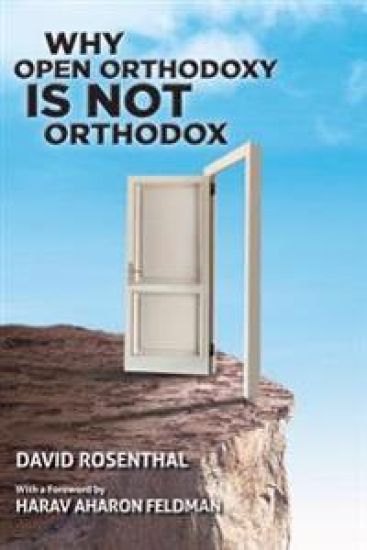
Why Open Orthodoxy Is Not Orthodox

Why Open Orthodoxy Is Not Orthodox

David Rosenthal

Yad Yosef Publications
2016
nidottu
Since 1997, Open Orthodoxy, through its institutions, Yeshivat Chovevei Torah and Yeshivat Maharat, has ordained over 100 students, most of whom serve in positions throughout America. It is often viewed as-and claims to be-a branch of Orthodoxy. However, the truth is far from this. Citing countless statements from the leaders and disciples of Open Orthodoxy, this book shows beyond a shadow of a doubt that this movement is not Orthodox and, in fact, seeks to undermine Orthodoxy. "... Open Orthodoxy is a movement which poses as Orthodoxy, with teachers who pose as halachic authorities and students who pose as Orthodox Rabbis." -From the Foreword by Harav Aharon Feldman
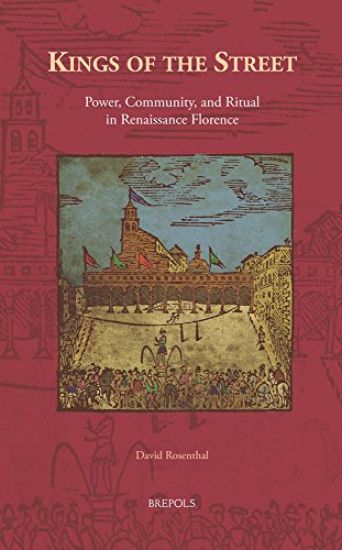
Kings of the Street

Kings of the Street

David Rosenthal

Brepols N.V.
2015
sidottu
For more than a century the artisans and labourers of Renaissance Florence turned the city into their own 'empire' during times of public festivity. From the republic of the late 1400s through to the grand duchy of the early seventeenth century, up to forty brigades of men called the potenze, or powers, elected kings, carved out territories, and entered into a dialogue with citizens and with their Medici patrons. This study traces the rise and fall of this carnivalesque subculture for the first time. It describes how workers represented themselves, their neighbourhoods, and their trades on the public stage through rituals such as stone-fighting and jousting, and reveals how the politics of this festive world were closely linked to everyday patterns of social bargaining around the person of the prince. In the early 1600s the micro-states of the potenze were partially suppressed and they gradually disappeared from the Florentine urban stage. The account of this transformation presented here shows how Tridentine reform and economic crisis combined to undermine hypermasculine carnival ritual as a language of civic contract, confining the potenze to making pilgrimages to shrines and convents in the Florentine countryside. At the same time it is shown how economic and religious change empowered groups of artisan women to take up the model of the potenze in order to make their own collective pilgrimages outside the city walls. Through the story of the potenze, this book provides fresh insights into the dynamics of class and gender relations, and the nature of agency, in early modern Italy.
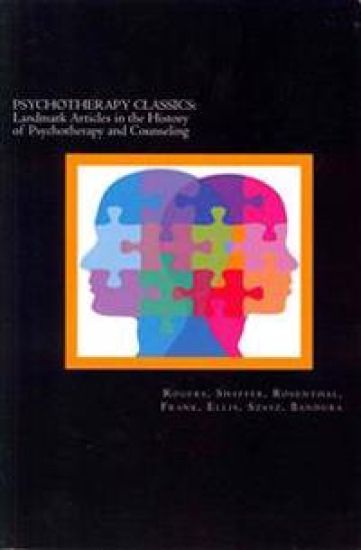
Psychotherapy Classics: Landmark Articles in the History of Psychotherapy and Counseling

Psychotherapy Classics: Landmark Articles in the History of Psychotherapy and Counseling

Laurance Shaffer; David Rosenthal; Jerome Frank

Createspace Independent Publishing Platform
2013
nidottu
Psychotherapy Classics Featuring contributions from some of the most influential and enigmatic thinkers of the 20th century, Psychotherapy Classics: Landmark Articles in the History of Psychotherapy and Counseling is essential reading for anybody with an interest in this area. Significant Aspects of Client-Centered Therapy By Carl Rogers In this landmark publication Carl Rogers outlines the origins of client-centered therapy, the process of client-centered therapy, the discovery and capacity of the client and the client-centered nature of the therapeutic relationship. The Problem of Psychotherapy by Laurance Shaffer Originally presented as the address of the President of the Division of Clinical and Abnormal Psychology, American Psychological Association; this landmark paper draws attention to issues relating to the nature of the therapeutic process within psychotherapy which are just as relevant today: How can we understand what takes place in the therapeutic interview? Why does it readjust the distressed person? Under what conditions is psychotherapy applicable? What techniques, applied in appropriately selected circumstances will produce predictable and effective results? Shaffer's central argument is that the psychologist's major problem with respect to therapy is not that of the professional conditions of practice, but is the problem of understanding what therapy is and does. Psychotherapy And The Placebo Effect by David Rosenthal & Jerome D. Frank Describes the placebo effect, discusses some of its implications for the evaluation of psychotherapy, and makes recommendations concerning research design in psychotherapy based on these considerations. Rational Psychotherapy and Individual Psychology by Albert Ellis One of the first published accounts of rational psychotherapy; a theory of personality and a system of therapeutic technique that would eventually develop into what is now known as rational emotive behavior therapy. In the course of this landmark paper Ellis introduces and expands upon his hypothesis that thinking represents the most important way in which human emotion is caused and controlled. He then goes on to outline the main points of agreement and disagreement between rational therapy and the individual Psychology of Alfred Adler. Recollections of A Psychoanalytic Psychotherapy: The Case of "Prisoner K" by Thomas-Szasz Fascinating account of "psychoanalytic psychotherapy" conducted by Thomas Szasz; who was soon to elevated into a position of international renown and controversy following the publication of his classic text "The Myth of Mental Illness." Psychotherapy As A Learning Process by Albert Bandura In this classic paper eminent psychologist Albert Bandura explores systematic attempts to apply principles of learning to the area of psychotherapy. Bandura begins this exploration by asking whether human behavior can be modified through psychological means and if so, what are the learning mechanisms that mediate behavior change? He then sets about discussing some of these learning mechanisms in turn i.e., counterconditioning, extinction, discrimination learning, methods of reward, punishment and social imitation. Psychotherapy Classics: Landmark Articles in the History of Psychotherapy and Counseling has been produced as part of an initiative by the website www.all-about-psychology.com to make historically important psychology publications widely available.
Yerushalmi Neziqin

Yerushalmi Neziqin

E. S. Rosenthal; Saul Lieberman; David Rosenthal

Israel Academy of Sciences and Humanities
1983
sidottu
In the Escorial manuscript, the text of Tractate Nezikin of the Babylonian Talmud is presented in the center of the page. Below it, in the margins, is the legal digest of Isaac al-Fasi; on the right and left of the folios are the rulings of Maimonides; and at the top of the page, in a narrow strip, is the text of the Talmud Yerushalmi. The surprising discovery of this text places at the disposal of researchers an additional version of the Talmud Yerushalmi for the tractates Bava Qama, Bava Mezi a, and Bava Batra. In its style and formulations, the Escorial manuscript represents a different and usually superior tradition to that represented in the Leiden manuscript and shows an affinity to one of the ancient, reliable fragments from the Cairo Geniza. A survey of European libraries turned up thousands of fragments of Hebrew manuscripts that had been used as covers for archival material. These included fragments of Yerushalmi Neziqin, which are preserved today in archives in Bologna and Savona in Italy. They are included in this new printing, with Introductions describing their genealogy and the nature of their formulation and style. The Savona fragments provide a further textual witness to the Sephardic-Oriental tradition of Yerushalmi Neziqin preserved in the Escorial manuscript and in the Cairo Geniza fragments, while those from Bologna provide a further witness to the western-Italian tradition preserved in the Leiden manuscript.