Kirjojen hintavertailu – 12 903 725 kirjaa ja 27 kauppaa

Kirjailija

David S. Neal

Kirjat ja teokset yhdessä paikassa: 4 kirjaa, julkaisuja vuosilta 2010–2025, suosituimpiin kuuluu Roman Mosaics of Britain Volume IV. Vertaile teosten hintoja ja tarkista saatavuus suomalaisista kirjakaupoista.

Nimi esiintyy myös muodoissa: David S Neal

4 kirjaa

Kirjojen julkaisuvuodet: 2010–2025.

A Mosaic of Recollections

A Mosaic of Recollections

David S. Neal

Archaeopress
2025
nidottu
A Mosaic of Recollections is the autobiography of David S. Neal, whose name has become synonymous with the study and illustration of Roman mosaics in Britain. It tells the story of a working-class boy, born into the travails of war-torn London, and his evacuation to South Wales to live with a mining community. The return to London in time to celebrate VE-Day remains a vivid memory. After moving to Hemel Hempstead New Town he became fascinated with the museums at St Albans and spent many hours watching excavations on Roman Verulamium before being invited to help. Studying graphic design at Watford School of Art developed his talents, which he was able to combine with his activities on the excavations as he began to record the mosaic pavements then being exposed. Work as a graphic designer with the Gas Board was not compelling, and he was fortunate to secure employment as an archaeological illustrator with the government’s Ancient Monuments Inspectorate, where he met a wide range of unusual personalities. Tea-breaks were an education, as were lectures he was invited to attend at the Society of Antiquaries of London. Soon Neal became the manager of the archaeological drawing office, responsible for a team of illustrators recording a wide range of artefacts from excavations sponsored by the department. His work became renowned in the profession and, increasingly, he was invited to help on excavations in England and abroad. At the age of 23 he directed his own excavations on the Roman villa in Gadebridge Park, Hemel Hempstead, which led to the publication of a monograph. With his growing interest and expertise, he was frequently invited to record Roman mosaics, often at a moment’s notice, and was able to share the excitement of discovery of many of them. After 15 years he became a full-time archaeologist and excavated a variety of sites of all periods culminating on the extensive excavations of a Roman settlement at Stanwick, Northamptonshire. Early retirement allowed the time to concentrate, with a colleague, on the publication of the corpus of Roman Mosaics of Britain and, later, to record the medieval mosaics at Westminster Abbey and Canterbury.
Canterbury Cathedral, Trinity Chapel

Canterbury Cathedral, Trinity Chapel

David S Neal; Warwick Rodwell

OXBOW BOOKS
2022
sidottu
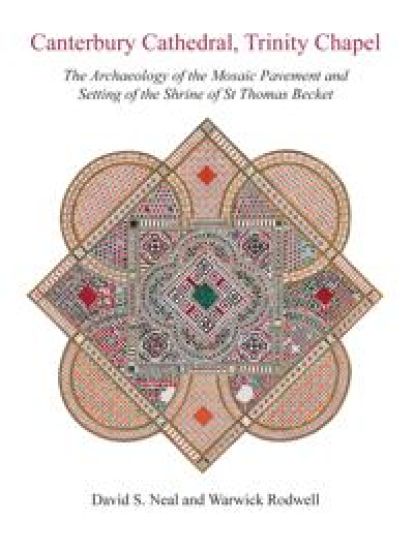
Canterbury Cathedral possesses a unique marble mosaic pavement, dating from the early 12th century, which has long intrigued scholars and been the subject of speculation and debate. It forms part of the floor of the Trinity chapel, adjacent to the site where the shrine of St Thomas Becket stood, prior to the Reformation. Since the mosaic is older than the chapel itself and partly destroyed a pavement of figurative roundels, laid c.1215, it must have been moved here from elsewhere in the cathedral. This volume explores the history and archaeology of the Trinity chapel, the pavement and the physical remains of the cult of Becket, based largely on hitherto unrecorded and unpublished evidence. In the early 12th century, Archbishop Anselm rebuilt the eastern arm of the cathedral, introducing architectural elements from his native Italy, and these included a magnificent mosaic pavement, composed of the most expensive marbles, which lay in front of the high altar. In 1170, Archbishop Becket was murdered in the cathedral, and his body rested overnight on the pavement before being buried in the crypt. Thomas was immediately revered as a martyr, and in 1173 was canonised by the pope; a simple shrine was erected over his tomb. In the following year, a fire (arson) destroyed the eastern arm of the cathedral, precipitating the construction of the present Trinity and Corona chapels, wherein St Thomas’s remains were enshrined. After decades of delay and political strife, the enshrinement took place in 1220, in the presence of Henry III. The shrine comprised a great marble table, supported on six clusters of columns. On top of the table was a marble sarcophagus containing the saint’s body in an iron-bound timber coffin, over which stood the sumptuous feretory, a gabled timber ‘roof’, plated with sheets of gold and adorned with jewels. East of the shrine lies the small Corona chapel in which a fragment of Becket’s skull was separately encased in a ‘head-shrine’, and to the west a large area was paved with forty-eight figurative stone roundels, created by French artisans. All around, stained-glass windows display the early miracles of Becket. The layout of the Trinity chapel underwent transmutations, first around 1230, when the mosaic pavement was taken up from the old presbytery, reduced in size and relaid in front of Becket’s shrine, where is it today. Second, the chapel was reordered in c. 1290, when the podium carrying the shrine was enlarged and the paving around it reconfigured. Medieval tombs were now being installed in the chapels, including those of the Black Prince and Henry IV. The end came in 1538, when Henry VIII ordered the thorough destruction of Becket’s shrines, but a great deal of archaeological evidence remained in the floors, walls and a few surviving fragments of the shrines, all now recorded and discussed in this beautifully illustrated volume for the first time.
The Cosmatesque Mosaics of Westminster Abbey

The Cosmatesque Mosaics of Westminster Abbey

Warwick Rodwell; David S. Neal

Oxbow Books
2019
sidottu
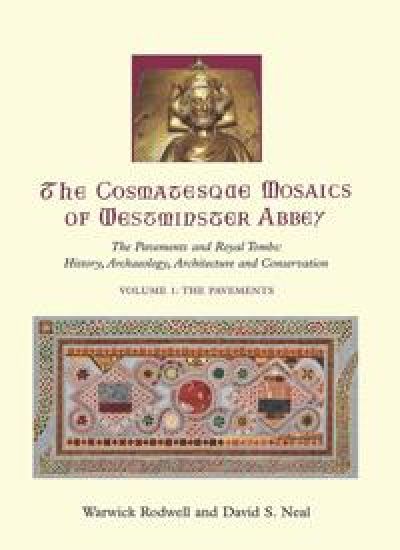
Westminster Abbey contains the only surviving medieval Cosmatesque mosaics outside Italy. They comprise: the ‘Great Pavement’ in the sanctuary; the pavement around the shrine of Edward the Confessor; the saint’s tomb and shrine; Henry III’s tomb; the tomb of a royal child, and some other pieces. Surprisingly, the mosaics have never before received detailed recording and analysis, either individually or as an assemblage. This two-volume publication presents a holistic study of this outstanding group of monuments in their historical architectural and archaeological context. The shrine of St Edward is a remarkable survival, having been dismantled at the Dissolution and re-erected (incorrectly) in 1557 under Queen Mary. Large areas of missing mosaic were replaced with plaster on to which mosaic designs were carefully painted. This 16th-century fictive mosaic is unique in Britain. Conservation of the sanctuary pavement was accompanied by full archaeological recording with every piece of mosaic decoration drawn and coloured by David Neal, phase plans have been prepared, and stone-by-stone examination undertaken, petrologically identifying and recording the locations of all the materials present. It has revealed that both the pavements and tombs include a range of exotic stone types. The Cosmati study has shed fresh light on every aspect of the unique series of monuments in Westminster Abbey; this work will fill a major lacuna in our knowledge of 13th-century English art of the first rank, and will command international interest.
Roman Mosaics of Britain Volume IV

Roman Mosaics of Britain Volume IV

Stephen R. Cosh; David S. Neal

Society of Antiquaries of London
2010
sidottu
This volume brings to a triumphant conclusion this monumental project to catalogue, describe and illustrate every Romano-British mosaic. The area covered by the fourth and final volume in the corpus is one of the richest regions of Britain in economic as well as architectural and artistic terms and this is reflected in the quantity and quality of the region's mosaics, which include the largest figured mosaic ever found in Britain - the Woodchester Orpheus pavement - which was perhaps the inspiration for the other famous Orpheus mosaics of the Roman Cotswolds. At the heart of this affluent region is Cirencester, Roman Britain's second largest town, represented here by more than sixty mosaics, the second-century examples being the most exquisite in the country. There are also many fine mosaics from the region's highly ornate villas, as well as from the towns of Gloucester, Caerwent and Wroxeter. The catalogue follows the format of earlier volumes in providing an account of each mosaic's discovery and locating the mosaic within its building plan. Following the description are notable parallels and major references. Many of the illustrations are by the authors, with additional ones by Luigi Thompson, as well as photographs and historical engravings, a high proportion of the latter by Samuel Lysons whose home was in Gloucestershire where he did much of his pioneering work in archaeological excavation and illustration. Brief biographies of Lysons and all the other artists whose work grace all four volumes appear at the end of this volume. As with previous volume the work is preceded with a substantial introduction. This deals with the history and topography of the region, buildings and rooms, an assessment of regional workshops, and schemes, ending with a consideration of mosaics in relation to the end of Roman Britain.