Kirjojen hintavertailu – 12 903 724 kirjaa ja 27 kauppaa

Kirjailija

David Shulman

Kirjat ja teokset yhdessä paikassa: 23 kirjaa, julkaisuja vuosilta 1993–2025, suosituimpiin kuuluu The Demon's Daughter. Vertaile teosten hintoja ja tarkista saatavuus suomalaisista kirjakaupoista.

23 kirjaa

Kirjojen julkaisuvuodet: 1993–2025.

God Inside-Out

God Inside-Out

Don Handelman; David Shulman

Oxford University Press Inc
1997
nidottu
This book offers a new exploration of the mythology of the Hindu god Siva, who spends his time playing dice with his wife, to whom he habitually loses. The result of the game is our world, which turns the god inside-out and changes his internal composition. Hindus maintain that Siva is perpetually absorbed in this game, which is recreated in innumerable stories, poems, paintings, and sculptural carvings. This notion of the god at play, argue Handelman and Shulman, is one of the most central and expressive veins in the metaphysics elaborated through the centuries, in many idioms and modes, around the god. The book comprises three interlocking essays; the first presents the dice-game proper, in the light of the texts and visual depictions the authors have collected. The second and third chapters take up two mythic "sequels" to the game. Based on their analysis of these sequels, the authors argue that notions of "asceticism" so frequently associated with Siva, with Yoga, and with Hindu religion are, in fact, foreign to Hinduism's inherent logic as reflected in Siva's game of dice. They suggest an alternative reading of this set of practices and ideas, providing startling new insights into Hindu mythology and the major poetic texts from the classical Sanskrit tradition.

When God is a Customer

When God is a Customer

A. K. Ramanujan; Velcheru Narayana Rao; David Shulman

University of California Press
1994
pokkari
How is it that this woman's breasts glimmer so clearly through her saree? Can't you guess, my friends? What are they but rays from the crescents left by the nails of her lover pressing her in his passion, rays now luminous as the moonlight of a summer night? These South Indian devotional poems show the dramatic use of erotic language to express a religious vision. Written by men during the fifteenth to eighteenth century, the poems adopt a female voice, the voice of a courtesan addressing her customer. That customer, it turns out, is the deity, whom the courtesan teases for his infidelities and cajoles into paying her more money. Brazen, autonomous, fully at home in her body, she merges her worldly knowledge with the deity's transcendent power in the act of making love. This volume is the first substantial collection in English of these Telugu writings, which are still part of the standard repertoire of songs used by classical South Indian dancers. A foreword provides context for the poems, investigating their religious, cultural, and historical significance. Explored, too, are the attempts to contain their explicit eroticism by various apologetic and rationalizing devices. The translators, who are poets as well as highly respected scholars, render the poems with intelligence and tenderness. Unusual for their combination of overt eroticism and devotion to God, these poems are a delight to read.
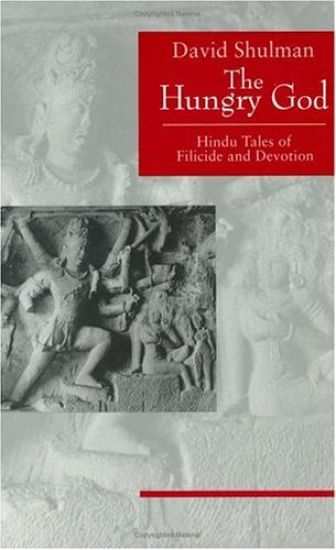
The Hungry God

The Hungry God

David Shulman

University of Chicago Press
1993
sidottu
The folklore and classical literature of India abound with stories of parents who sacrifice their children. In this book the author examines one set of such tales - Hindu texts that bear similarities to the biblical aqedah, the account of Abraham's near-sacrifice of Isaac. In all the stories that Shulman explores, the sacrifice proceeds from a divine command and has no utilitarian explanation or rationale. Both the biblical and Indian aqedah texts are central to their cultures: later texts resume the narrative, rework its premises, and develop its paradigmatic character so that it comes to function as a "root metaphor" for its civilization. Shulman traces this history by unravelling the cumulative meanings of the Hindu, aqedah, particularly the Tamil tale of the Little Devotee and the stories of Sunahsepa and Suka. Throughout, Shulman is sensitive to the poignant tones and overtones of each text. His final chapter contrasts the Hindu tales of child sacrifice and their counterparts in Hebrew and Greek.