

Kirjailija
David Stephenson
Kirjat ja teokset yhdessä paikassa: 25 kirjaa, julkaisuja vuosilta 1984–2026, suosituimpiin kuuluu Un-Caged. Vertaile teosten hintoja ja tarkista saatavuus suomalaisista kirjakaupoista.
25 kirjaa
Kirjojen julkaisuvuodet: 1984–2026.

Water services include water supply, sewerage and stormwater drainage. The facilities needed for these services are pipelines, reservoirs and treatment works; but the service goes beyond the infrastructure. It includes economics, billing, and business management. Although these services exist in every city, being advanced by the growing use of automation and information technology, costs are also increasing without many consumers seeing increased benefits. Customer service is therefore becoming important to the industry. Water Services Management is intended to educate engineers to manage and improve water services, rather than simply designing and constructing treatment works and distribution systems. The text covers water supply and drainage from the hydraulic and economic points of view, and while design and construction practices are reviewed, the focus of the book is on improving existing systems to turn the emerging industry into an attractive business. Topics covered include: Potable water supply, sewerage and stormwater drainage. Hydraulic management: storage, peak flow attenuation and pumping. Water quality: standards, pollution control and treatment. Infrastructure management: rehabilitation, reconstruction, upgrading and maintenance. Economic efficiency: asset management, privatization, and risk analysis. Improving economic viability via efficient use of energy and construction project management. Characteristics encountered in developing countries are also considered, including: Low cost sanitation, water supply standards and off-grid energy sources. Capacity building and appropriate technologies. Financing, operation and benchmarking.

This ground-breaking study explores the rise of a Welsh elite of administrators and military figures in the generations after the Edwardian Conquests of 1277–88. It shows how a ministerial aristocracy had developed in the Age of the Princes, before the Edwardian conquest threatened to impose English colonial administrations throughout the land. However, close documentary analysis reveals that Edward I (d.1307) emerged in his later life not as the vindictive conqueror of most accounts, but as a ruler dependent on Welsh support, ready to listen to and remedy Welsh grievances, and to encourage the revival of a Welsh governing class. In addition, the book includes the first detailed study of scores of members of that class throughout Wales in the first half of the fourteenth century. It concludes by exploring the mid-century crises that shook the Welsh establishment and set them on the road to the Glyn Dwr rising of 1400.

Faithful Change
Vanessa Conant; Rod Green; Ruth Hulse; Joanne Grenfell; Saju Muthalaly; Mike Wilkins; David Stephenson
CHURCH HOUSE PUBLISHING
2025
nidottu
Change is a constant in the life of the world and the church – and faithful change responds to the call to proclaim the gospel afresh in each generation, and to make new disciples. Some change is chosen, other change is demanded by circumstance or opportunity. This book explores change honestly, hopefully and helpfully, and aims to help churches facing change, whether it’s changing the way it worships or uses its assets, begins a new ministry or brings another to an end. The authors bring together biblical reflection, theological, liturgical and formational resources to help congregations travel emotionally and spiritually through the process of change, as well as support for taking the necessary practical steps. It also offers coaching questions to guide conversation and a resource section to help congregations root the experience of change in the local context. With stories of change from a range of different settings, the book will inspire communities to face change with honesty, openness, courage and faith.

Tervetuloa Pohjoismaiden suurimpaan verkkokirjakauppaan! Adlibris kannattaa sananvapautta, ja haluamme edistää kirjallisuuden ja tiedon saatavuutta.

In Wall of Sound, David Stephenson's sonnets, rhymed quatrains, and blank verse illuminate a rich variety of worlds and personalities. From a steel mill to a paint factory to a police impound lot, Stephenson's poetry of place explores unexpectedly fascinating locales. He persuasively imagines the lives within a snow globe, and he draws thoughtful parallels between a casino and a mine, a crop duster and a god. Stephenson engages the reader with a conversational tone and well-chosen rhymes; the clever eye-rhyme of "watch" and "match" makes clear the frustration of a man hoping to synchronize all his timepieces. And with convincing empathy, Stephenson writes in the voices of others-animate and inanimate-including a lab rat, a match, a spacecraft, and Sir Isaac Newton. "Toolmaker" exemplifies one of the book's most effective techniques, the juxtaposition of the mundane and the profound: this poem's persona suggests, with understated but scathing wisdom, that what marks us as human is not our use of tools, but "an inborn urge to sharpen blades." Jean L. KreilingDavid Stephenson's Wall of Sound is rich and full, many-textured and multi-layered. Stephenson's detailed poems cover a wide range of subjects, with landscapes both urban (a freeway casino, a muffler shop, a Ramada Inn) and rural (the ditches and fields of his childhood, a rock quarry on his grandfather's farm). Stephenson also writes in the voices of others, both human (Spartacus, Merlin, a tomb-builder at Thebes) and non-human (a pet dog, a cavefish, a dairy cow), as well as the "in-between" monster of Frankenstein. The book contains more personal poems too, and the most moving ones include memories of his late father and brother. There are well-made sonnets here, rhyming quatrains and other forms, which give the book an overall music. But kudos to Stephenson for crafting his poems in a more relaxed formalism - iambic pentameter that's not metronomic, rhymes that often work quietly in the background. In these poems, meaning and substance are as important as form, making Wall of Sound an antidote for the indecipherable lines that inundate poetry today. Elise Hempel

Patronage and Power in the Medieval Welsh March
David Stephenson
UNIVERSITY OF WALES PRESS
2021
nidottu
This is the first full-length study of a Welsh family of the thirteenth to fifteenth centuries who were not drawn from the princely class. Though they were of obscure and modest origins, the patronage of great lords of the March - such as the Mortimers of Wigmore or the de Bohun earls of Hereford - helped them to become prominent in Wales and the March, and increasingly in England. They helped to bring down anyone opposed by their patrons - like Llywelyn, prince of Wales in the thirteenth century, or Edward II in the 1320s. In the process, they sometimes faced great danger but they contrived to prosper, and unusually for Welshmen one branch became Marcher lords themselves. Another was prominent in Welsh and English government, becoming diplomats and courtiers of English kings, and over some five generations many achieved knighthood. Their fascinating careers perhaps hint at a more open society than is sometimes envisaged.

Business Skills for Data Scientists
David Stephenson; John Elder
Data Science Innovation
2021
pokkari
This book explains the foundational business skills you'll need to deliver business value and grow your career as an analyst or data scientist. Drawing on best practices, published research, case studies and personal anecdotes from two decades of industry experience, David Stephenson lays out a practical and concise overview of foundational skills related to Company, Colleagues, Storytelling, Expectations, Results and Careers--emphasizing how each topic relates to your unique position as an analytics professional within a larger corporation. From the introduction: "The six topics in this book-company, colleagues, communication (storytelling), expectations, results and careers-are covered in six sections. They are presented roughly in the order you'll need them during your career, with project leadership skills coming later in the book. The final topic, careers, will be relevant at all stages of your career, even as you pursue your first job as a data scientist. The first section, company, will help you work within a larger organization. Chapter one discusses how organizations generally view data scientists, why they hire them and what they expect from them. This chapter begins to explain how you as a data scientist can produce business value, a topic that is more fully developed in chapter ten. Chapter two describes how to relate to the diverse range of individuals within your organization. By understanding how various roles and functions differ in their goals and values, you will be better prepared to deliver valuable results to them. The second section, colleagues, covers interpersonal challenges that often present significant problems for data scientists-cultural misunderstandings, negotiating through disagreements, and office politics. Younger data scientists generally perceive these topics as less important, until the day when they suddenly find them extremely important. The third section, storytelling, covers principles and methods key to oral and visual presentations. This section describes how to clarify your message, which is easy in principle but difficult in practice, and how to produce clear slides, graphs and tables. It goes into detail on techniques for decluttering and drawing focus, leveraging principles such as Gestalt and preattentive processing. The two chapters in this section are perhaps the most immediately relevant for data scientists and will provide you with some very quick wins, as I've seen from the responses of my training participants. The fourth section, expectations, covers techniques for setting expectations, kicking off a project, and maintaining the trust of your stakeholders. In particular, I cover ways to build consensus at the start of a project and ways to avoid the common mistake of working hard to build a solution that no one wants to use. The fifth section, results, presents principles, techniques and case studies related to selecting the most beneficial data science projects. It then describes concepts and frameworks that will help you run those projects to successful completion, despite the shifting expectations and lack of clarity that are so prevalent in data science projects. The sixth and final section, careers, addresses questions I'm often asked by data scientists, such as how to choose between job opportunities, how to strengthen your CV, and even whether to start working independently as a freelance data scientist."

Dangerous to get close. To anyone. Trust no one, completely. Some, a little - some he cares for - but those he must avoid, for harm he might bring. Not safe, in a crowd. Or apart. Even ... alone. The story of Selvorne, a young man whose enviable, simple life is torn apart by a single, sudden event. All he loved - all that was most dear - lost. And forced to abandon everything else. His home, town, people. His very name a threat, to himself, and his friends. His life before ... perhaps never was as safe as he thought. Why has this happened? Horrifically unfair. Unprepared. Too young, but then no one could be ready for what he faced. Except, perhaps, one man. Clues unlocked, he discovers dangers not only to himself, and begins to wonder why it had not happened ... before. He has a choice - to run, to hide. To disappear. But no, that is no choice, truly. Face the fear - disappear, in a different way. Another name. And one name given, of a person he might trust - one only, who he has never met. Find them, wherever they are. Search the lands. Quietly, carefully. All the while smiling, though his heart is crushed. Warily onward - new friends met - allies embraced - attractions unexpected. And enemies, unknown.

After outlining conventional accounts of Wales in the High Middle Ages, this book moves to more radical approaches to its subject. Rather than discussing the emergence of the March of Wales from the usual perspective of the ‘intrusive’ marcher lords, for instance, it is considered from a Welsh standpoint explaining the lure of the March to Welsh princes and its contribution to the fall of the native principality of Wales. Analysis of the achievements of the princes of the twelfth and thirteenth centuries focuses on the paradoxical process by which increasingly sophisticated political structures and a changing political culture supported an autonomous native principality, but also facilitated eventual assimilation of much of Wales into an English ‘empire’. The Edwardian conquest is examined and it is argued that, alongside the resultant hardship and oppression suffered by many, the rising class of Welsh administrators and community leaders who were essential to the governance of Wales enjoyed an age of opportunity. This is a book that introduces the reader to the celebrated and the less well-known men and women who shaped medieval Wales.
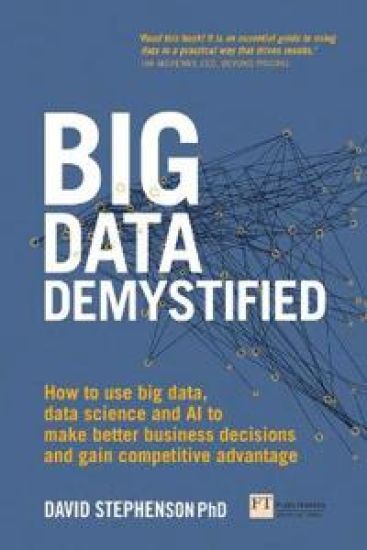
Big Data is a big topic, based on simple principles. Guided by leading expert in the field, David Stephenson, you will be amazed at how you can transform your company, and significantly improve KPIs across a broad range of business units and applications. Find out how an ecommerce company avoided two million product returns per year, how a newspaper saw triple-digit annual growth in digital subscriptions, how researchers in England learned to better detect pending cardiovascular problems, and how AI programs taught themselves to win games using techniques that even their human programmers didn’t understand, all thanks to big data. Find out also how one company realized it could swap a million dollar hardware system with a twenty thousand dollar replacement. With simple and straightforward chapters that allow you to map examples onto your own business, Big Data Demystified will help you: · Know which data is most useful to collect now and why it’s important to start collecting that data as soon as possible. · Understand big data and data science and how they can help you reach your business goals and gain competitive advantage. · Use big data to understand where you are now and how you can improve in the future. · Understand factors in choosing a big data system, including whether to go with cloud-based solutions. · Construct your big data team in a way that supports an effective strategy and helps make your business more data-driven. BIG DATA MAKES A BIG DIFFERENCE “ Read this book! It is an essential guide to using data in a practical way that drives results." Ian McHenry, CEO Beyond Pricing “ This is the book we’ve been missing: big data explained without the complexity.” Marc Salomon, Professor in Decision Sciences and Dean at University of Amsterdam Business School " Big Data for the rest of us! I have never come across a book that is so full of practical advice, actionable examples and helpful explanations. Read this one book and start executing Big Data at your workplace tomorrow!" Tobias Wann CEO at @Leisure Group

First full-scale account of the medieval realm of Powys. Powys, extending over north-east and central Wales, was one of three great medieval Welsh polities, along with Gwynedd to the north and Deheubarth (south-west), occupying nearly a quarter of the country. However, it has been somewhat neglected by historians, who have tended to dismiss it as a satellite realm of England, and viewed its leaders as obstacles to the efforts of Gwynedd leaders to construct a principality of Wales. This book provides the first full, authoritative history of Powys in the twelfth and thirteenth centuries. It argues in particular that the Powysian rulers were dogged and resourceful survivors in the face of pressure from Welsh rivals and the problems ofinternal fragmentation; and that, paradoxically, co-operation with the English and intermarriage with marcher families underlay a desire to regain lands to the east lost in earlier centuries. Dr David Stephenson is anHonorary Research Fellow in the School of History, Welsh History and Archaeology, Bangor University.


Buddha Never Heard of Buddha
David Stephenson
Createspace Independent Publishing Platform
2014
nidottu
If you found this book, it is meant for you.

First published in 1984 under the title The Governance of Gwynedd, this book has been reprinted to meet continued interest on the Princes of Gwynedd in Medieval Wales. Political Power in Medieval Gwynedd: Governance and the Welsh Princes investigates the governance exercised by the thirteenth-century Princes of Gwynedd, particularly Llywelyn the Great (fl. 1194 - 1240) and Llywelyn the Last (fl. 1243 - 82) as they strove to extend their political control over much of Wales. The analysis rests on the combination of different classes of evidence - literary texts, Welsh laws, thirteenth- and fourteenth-century record sources, and the results of archaeological work. After a descriptive survey of the work of the Princes' officials, the range of revenues available to the Princes is discussed, as are their attempts to increase their income. The recruitment of a privileged ministerial elite is examined and detailed prosopographical analysis reveals the Princes' attempts to overcome the segmentary nature of the political structure. Finally, attention is focused on the ways in which the rise of the Llywelyns and the increased pressures of governance imposed by their ambitions created tensions within Gwynedd and contributed to the final collapse of native rule in Wales. A new introductory section discusses recently published work.

The Complete Finance & Insurance Reference Book: ... includes an introduction to Neuro-Linguistic Programming
David Stephenson
Createspace Independent Publishing Platform
2013
nidottu

Rugby Stories: ... and other misadventures
David Stephenson
Createspace Independent Publishing Platform
2013
nidottu

Through the medium of old photographs, programmes and advertisements, this book provides a fascinating look at the history of cinema-going in the city of Bristol and its suburbs during the last century. From mobile cinemas to penny gaffs, this A-Z of cinemas in Bristol chronicles the places frequented by Bristolians over the years, including the ABC on Whiteladies Road, the Magic Box in Stokes Croft and the Picture House in Knowle.

The Dings and St Philips: Images of England
David Stephenson; Jill Wilmott
The History Press Ltd
2005
nidottu
This volume provides a glimpse into the history of The Dings and St Philips during the last century. With over 200 images, this selection highlights changes and events that have taken place in these once industrious Bristol suburbs. Aspects of everyday life are also recalled, from shops, pubs and to celebrations and local sporting heroes.
Water services include water supply, sewerage and stormwater drainage. The facilities needed for these services are pipelines, reservoirs and treatment works; but the service goes beyond the infrastructure. It includes economics, billing, and business management. Although these services exist in every city, being advanced by the growing use of automation and information technology, costs are also increasing without many consumers seeing increased benefits. Customer service is therefore becoming important to the industry. Water Services Management is intended to educate engineers to manage and improve water services, rather than simply designing and constructing treatment works and distribution systems. The text covers water supply and drainage from the hydraulic and economic points of view, and while design and construction practices are reviewed, the focus of the book is on improving existing systems to turn the emerging industry into an attractive business. Topics covered include: Potable water supply, sewerage and stormwater drainage. Hydraulic management: storage, peak flow attenuation and pumping. Water quality: standards, pollution control and treatment. Infrastructure management: rehabilitation, reconstruction, upgrading and maintenance. Economic efficiency: asset management, privatization, and risk analysis. Improving economic viability via efficient use of energy and construction project management. Characteristics encountered in developing countries are also considered, including: Low cost sanitation, water supply standards and off-grid energy sources. Capacity building and appropriate technologies. Financing, operation and benchmarking.