Kirjojen hintavertailu – 12 859 828 kirjaa ja 27 kauppaa

Kirjailija

David Tittensor

Kirjat ja teokset yhdessä paikassa: 5 kirjaa, julkaisuja vuosilta 2014–2022, suosituimpiin kuuluu Religion and Change in Australia. Vertaile teosten hintoja ja tarkista saatavuus suomalaisista kirjakaupoista.

5 kirjaa

Kirjojen julkaisuvuodet: 2014–2022.

Religion and Change in Australia

Religion and Change in Australia

Adam Possamai; David Tittensor

Allen Unwin
2022
sidottu
This timely book offers a panoramic overview of the enduring significance of religion in Australia. Drawing on both foundational and contemporary studies of religion and society, it contests conventional assumptions around the extent of secularisation in Australia and instead argues that religious institutions, groups, and individuals have proved remarkably adaptable to social change and continue to play a major role in Australian life. After the Second World War, Australia, in common with other Western societies, appeared to have become increasingly secularised. Religious observance declined dramatically, and it was commonplace to speak of Australia in the post-war period as a secular society. However, Religion and Change in Australia challenges this view. The 2016 census revealed that over half of the population still identify as Christian, whilst in politics, the religious right has come to exert considerable influence on the Liberal-National Coalition, and has led to a normalisation of religion in political discourse. Further, new technologies, such as the internet and social media, have provided additional avenues for religious expression and proselytization, in conjunction with so-called ‘Mega-Churches’ that have been built to cater to their increasing congregations. The adoption of multiculturalism and immigration from Asia has also led to a religiously pluralist society, though this has often been controversial. In particular, the position of Islam in Australia has been the subject of fierce debate and Islamophobic attitudes still remain. Atheism, non-belief and alternative spiritualities have also become increasingly widespread, especially amongst the young. Given these developments, and firmly grounded in history, Religion and Change in Australia argues that if Australia is today a post-secular society, the processes of desecularisation are not uniform, and have manifested differently at the micro, meso and macro level. In doing so, it draws on sociological perspectives and explores how religion intersects with a wide range of other contemporary issues, including politics, race, migration, gender, and new media. This book is therefore a vital resource for students, academics and general readers seeking to understand contemporary debates surrounding religion and secularisation in Australia.
Religion and Change in Australia

Religion and Change in Australia

Adam Possamai; David Tittensor

TAYLOR FRANCIS LTD
2022
nidottu
This timely book offers a panoramic overview of the enduring significance of religion in modern Australian society. Applying sociological perspectives and contemporary theories of religion in society, it challenges conventional assumptions around the extent of secularisation in Australia and instead argues that religious institutions, groups, and individuals have proved remarkably adaptable to social change and continue to play a major role in Australian life. In doing so, it explores how religion intersects with a wide range of other contemporary issues, including politics, race, migration, gender, and new media. Religion and Change in Australia explores Australia’s unique history regarding religion. Christianity was originally imported as a tool of social control to keep convicts, settlers, and Australian Aboriginal peoples in check. This had a profound impact on the social memory of the nation, and lingering resentment towards the "excessive" presence of religion continues to be felt today. Freedom of religion was enshrined in Section 116 of the Australian Constitution in 1901. Nevertheless, the White Australia Policy effectively prevented adherents of non-Christian faiths from migrating to Australia and the nation remained overwhelmingly Christian. However, after WWII, Australia, in common with other western societies, appears to have become increasingly secularised, as religious observance declined dramatically. However, Religion and Change in Australia employs a range of social theories to challenge this securalist view and argues that Australia is a post-secular society. The 2016 census revealed that over half of the population still identify as Christian. In politics, the socially conservative religious right has come to exert considerable influence on the ruling Liberal-National Coalition, particularly under John Howard and Scott Morrison. New technologies, such as the Internet and social media, have provided new avenues for religious expression and proselytisation whilst so-called "megachurches" have been built to cater to their increasing congregations. The adoption of multiculturalism and increased immigration from Asia has led to a religiously pluralist society, though this has often been controversial. In particular, the position of Islam in Australia has been the subject of fierce debate, and Islamophobic attitudes remain common. Atheism, non-belief, and alternative spiritualities have also become increasingly widespread, especially amongst the young. Religion and Change in Australia analyses these developments to offer new perspectives on religion and its continued relevance within Australian society. This book is therefore a vital resource for students, academics, and general readers seeking to understand contemporary debates surrounding religion and secularisation in Australia.
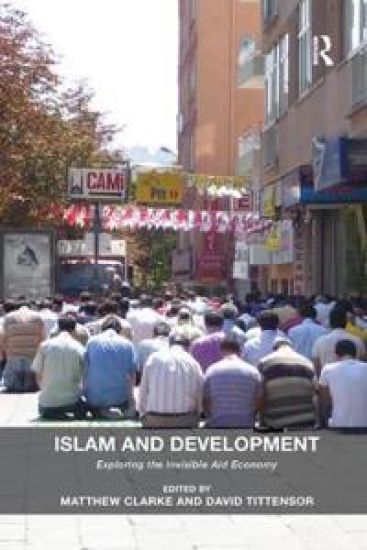
Islam and Development

Islam and Development

Matthew Clarke; David Tittensor

Routledge
2018
nidottu
The study of Islam since the advent of 9/11 has made a significant resurgence. However, much of the work produced since then has tended to focus on the movements that not only provide aid to their fellow Muslims, but also have political and at times violent agendas. This tendency has led to a dearth of research on the wider Muslim aid and development scene. Focusing on the role and impact of Islam and Islamic Faith Based Organisations (FBOs), an arena that has come to be regarded by some as the 'invisible aid economy', Islam and Development considers Islamic theology and its application to development and how Islamic teaching is actualized in case studies of Muslim FBOs. It brings together contributions from the disciplines of theology, sociology, politics and economics, aiming both to raise awareness and to function as a corrective step within the development studies literature.
Islam and Development

Islam and Development

Matthew Clarke; David Tittensor

Ashgate Publishing Limited
2014
sidottu
The study of Islam since the advent of 9/11 has made a significant resurgence. However, much of the work produced since then has tended to focus on the movements that not only provide aid to their fellow Muslims, but also have political and at times violent agendas. This tendency has led to a dearth of research on the wider Muslim aid and development scene. Focusing on the role and impact of Islam and Islamic Faith Based Organisations (FBOs), an arena that has come to be regarded by some as the 'invisible aid economy', Islam and Development considers Islamic theology and its application to development and how Islamic teaching is actualized in case studies of Muslim FBOs. It brings together contributions from the disciplines of theology, sociology, politics and economics, aiming both to raise awareness and to function as a corrective step within the development studies literature.
The House of Service

The House of Service

David Tittensor

Oxford University Press Inc
2014
sidottu
David Tittensor offers a groundbreaking new perspective on the Gülen movement, a Turkish Muslim educational activist network that emerged in the 1960s and has grown into a global empire with an estimated worth of $25 billion. Named after its leader Fethullah Gülen, the movement has established more than 1,000 secular educational institutions in over 140 countries, aiming to provide holistic education that incorporates both spirituality and the secular sciences. Despite the movement's success, little is known about how its schools are run, or how Islam is operationalized. Drawing on thirteen months of ethnographic fieldwork in Turkey, Tittensor explores the movement's ideo-theology and how it is practiced in the schools. His interviews with both teachers and graduates from Africa, Indonesia, Central Asia, and Turkey show that the movement is a missionary organization, but of a singular kind: its goal is not simply widespread religious conversion, but a quest to recoup those Muslims who have apparently lost their way through proselytism and to show non-Muslims that Muslims can embrace modernity and integrate into the wider community. Tittensor also examines the movement's operational side and shows how the schools represent an example of Mohammad Yunus's social business model: a business with a social cause at its heart. The House of Service is an insightful exploration of one of the largest transnational Muslim associations in the world today, and will be invaluable for those seeking to understand how Islam will be perceived and practiced in the future.