Kirjojen hintavertailu – 12 903 725 kirjaa ja 27 kauppaa

Kirjailija

David Truesdale

Kirjat ja teokset yhdessä paikassa: 6 kirjaa, julkaisuja vuosilta 2013–2023, suosituimpiin kuuluu A New Battlefield. Vertaile teosten hintoja ja tarkista saatavuus suomalaisista kirjakaupoista.

6 kirjaa

Kirjojen julkaisuvuodet: 2013–2023.

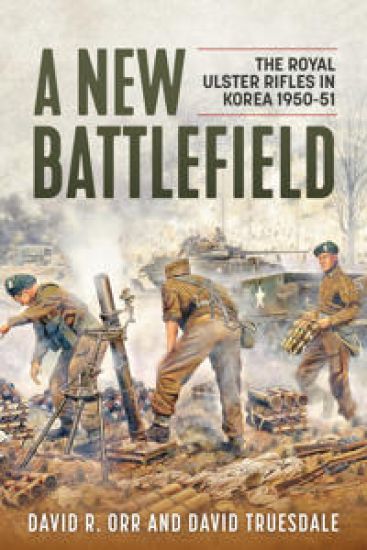
A New Battlefield

A New Battlefield

David R. Orr; David Truesdale

Helion Company
2013
nidottu
Since the publication of The Rifles Are There in 2005, which dealt with the 1st and 2nd Battalions Royal Ulster Rifles in the Second World War, it was felt by many that a follow up volume dealing with the Korean conflict was overdue. A limited yet competent history had been produced in 1953 by the then Adjutant Captain Hugh Hamill, although this has been long out of print. A New Battlefield follows the Battalion as it prepares for the first major conflict fought by Britain since the defeat of the Japanese in 1945. During the summer of 1950 the Battalion was stationed at Sobraon Barracks in Colchester and was in the process of being issued with desert kit for a tour of duty at Khartoum in the Sudan and its numbers were just under four hundred men. For service in Korea these numbers had to be drastically increased and drafts of volunteers and reservists were brought in from various sources. Consequently this 'Irish' Battalion contained men from the Lancastrian Brigade, Welsh Brigade, Mercian Brigade, the Light Infantry and other Battalions of the Irish Brigade. The Irish Brigade also reinforced other regiments, the Royal Inniskilling Fusiliers sending two officers and fifty 'other ranks' to the King's (Liverpool) Regiment. Despite their varied backgrounds all ranks soon coalesced into a professional unit that took the campaign in its stride. From winter temperatures that dropped well below 40f to a summer heat that rose to 105f with a humidity to match these men survived all and dealt with a brave and tenacious enemy. The Battalion sailed for Korea in October 1950 and fought its first major action in January 1951 at Chaegunghyon, or as it was known to the Rifles, 'Happy Valley'. Here, for the first time they faced an enemy that often literally fought to the death, despite overwhelming firepower, bombing and widespread use of napalm. Three months later, on the banks of the Imjin River, the Rifles, in conjunction with the remainder of 29 Brigade, faced an army that came in such numbers that running out of ammunition before the enemy ran out of men became a reality. Besides numerous photographs there are also appendices including Honours and Awards, Operation 'Spitfire', an Order of Battle for 29 Brigade, and a Nominal Roll, which includes casualties.
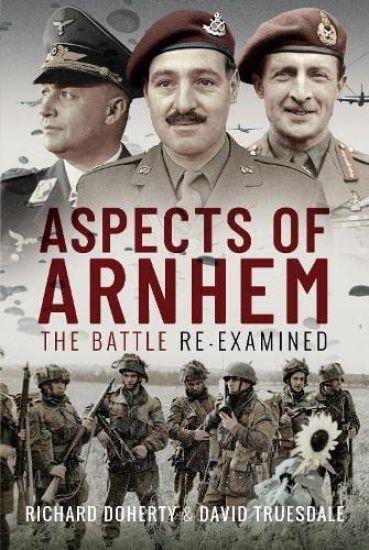
Aspects of Arnhem

Aspects of Arnhem

Richard Doherty; David Truesdale

PEN SWORD BOOKS LTD
2023
sidottu

Halvin toimitettuna 38,00 €

Almost 80 years on the battle for the Arnhem Rhine crossing remains controversial. Opinion on its justification and success differs widely. This superbly researched book, written by two acknowledged experts, takes a wide-ranging examination of Operation MARKET GARDEN from the strategic, operational and tactical level. The role of the Allied commanders involved is scrutinised with surprising results. For example, US General Brereton's pivotal role has seldom been mentioned, yet he is revealed as responsible for choosing landing and drop zones. The record of airborne forces, both German and Allied, prior to September 1944 raises questions and the doubt that many senior commanders, including Eisenhower, had as to their effectiveness is highlighted. The parts played by VIII and XII Corps of Second Army and General Dempsey, its Commander are scrutinised, as are the actions of local commanders and troops on the ground. Both those with a deep interest in military history and the layman will find much to inform and satisfy them in this valuable and at times provocative account.
Ulster Will Fight

Ulster Will Fight

David Truesdale

HELION COMPANY
2022
pokkari
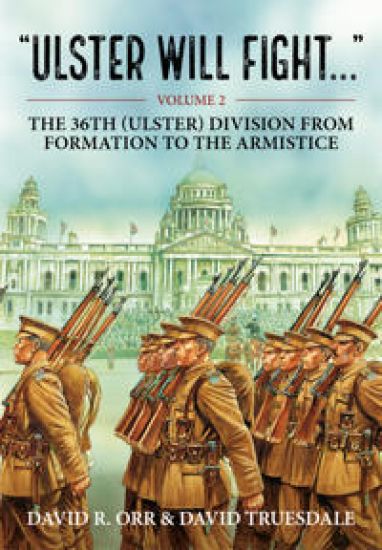
Despite what has been written in many books and magazine articles, the Ulster Division was not formed overnight by an en bloc enlistment from the Ulster Volunteer Force and Young Citizen Volunteers, nor were the YCV the youth wing of the UVF, as some believe. Despite the surge of patriotic enlistments on the outbreak of war, by December 1914 there was still a shortfall of 1,697 men, the majority of these shortages being in the divisional troops, not the infantry brigades. It was proving difficult to fill the ranks of the Royal Army Medical Corps, Army Service Corps, Cyclist Company and Royal Engineers, in fact any unit that required a degree of mechanical skill, however small. Despite these initial difficulties the Division sailed for France in October 1915 and by the following June had gained ample experience in trench life. However it was 1 July 1916, that would change the Division from naive volunteers into battle hardened warriors and ensure their undying fame. This study follows the division from its creation through to disbandment, drawing extensively on unpublished materials, official documents and newspapers. In doing so it provides an up-to-date picture of this famous and important formation.
Steel Wall at Arnhem

Steel Wall at Arnhem

David Truesdale

Helion Company
2019
nidottu
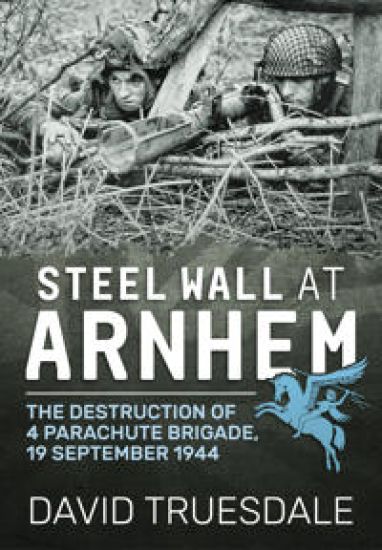
The deployment of the British 1st Airborne Division somewhere in Europe prior to the end of the war was indeed a case of ‘coins burning holes in the pockets of SHAEF’. The Allied High Command was anxious to commit to battle a division that, while it contained some elite units, was not fully trained, had carried out only one divisional exercise and contained several officers who were either unfit or unsuitable for airborne command. On Monday 18 September 1944, the aircraft and gliders carrying the men and equipment of 4 Parachute Brigade took off from airfields in the south of England. For the first time from its creation in North Africa, the brigade was going into battle as a unified formation, albeit not fully trained and far from experienced. Within 24 hours, the Brigade would cease to exist, having achieved nothing more than the deaths of good men for no good reason. Despite the fine words of Winston Churchill that the operation had not been ‘in vain’ and Montgomery’s ‘90% successful’, there is more logic to be found in the words of the Great War poet Wilfred Owen when he wrote in his poem Dulce et decorum est pro patria mori. There were those commanders who were indeed ‘ardent for some desperate glory’. This is a full account of the brigade and its actions at Arnhem.
For Queen and Company

For Queen and Company

David Truesdale; John Young

Helion Company
2019
nidottu
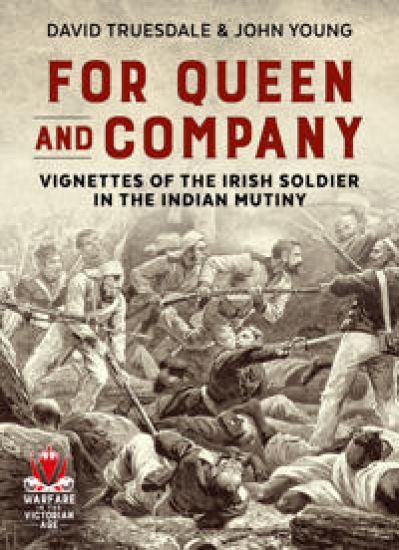
This book records the actions of those Irish soldiers (and others) who were awarded the Victoria Cross in the event known to the British public in 1857 as 'The Indian Mutiny'. Since then, revisionist historians have applied other names to what occurred: a 'war of independence', 'a revolt', or 'a great rebellion'... none of these are accurate for the events that began in Meerut on Sunday, 10 May 1857: it was a mutiny; when soldiers refused a lawful command, it was a mutiny. Those former members of the Indian regiments were mutineers and those civilians who joined or supported them were rebels... these were the words of the time and, in recounting the activities of the time, these are the words that should be used. It took two and a half years to quell the Mutiny, and more than half the regiments of the British Army would, at some stage, see action - and this involved only the Indian troops in one of three Presidencies. While many regimental records show the names of those men who were wounded, or who died of disease or were killed in action - allowing a total number to be calculated - the overall cost to the native populations of Indian towns and villages can only be guessed at.