Kirjailija
David Welsh
Kirjat ja teokset yhdessä paikassa: 9 kirjaa, julkaisuja vuosilta 2007–2026, suosituimpiin kuuluu Logan and the Pony. Vertaile teosten hintoja ja tarkista saatavuus suomalaisista kirjakaupoista.
9 kirjaa
Kirjojen julkaisuvuodet: 2007–2026.
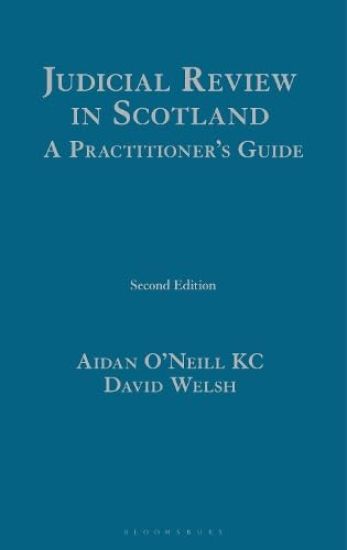
Judicial Review in Scotland: A Practitioner's Guide
Aidan O’Neill; David Welsh
BLOOMSBURY PUBLISHING PLC
2026
sidottu
This book is a practical guide to judicial review in Scotland. It provides an exposition not only of the legal bases on which review can be sought, but also an examination of the practical decisions to be considered: when to seek it, how to fund it, what orders to seek. It focuses on the law, but also on its application and on its use as a form of litigation, a form of campaigning, and a form of holding the government to account as a constitutional function. The Second Edition is thoroughly revised throughout and provides coverage of:- The significant impact that the Courts Reform (Scotland) Act 2014 has had on Scottish courts, particularly the judicial review procedure through the introduction of the permission stage and appeals.- Significant amendments to the Scotland Act 1998 increasing the powers of the devolved parliament and the challenges brought in relation to that.- All of the Brexit withdrawal legislation that was passed since the previous edition, significantly altering the sources of Scots law for public law purposes. In addition, the substantive changes to public law following constitutional challenges taken in the Scottish courts in the wake of Brexit.- The Equality Act 2010 which heavily altered the manner in which certain discrimination law claims are to be brought.- Significant development in Scotland in relation to successful challenges to some of the lockdown restrictions during the Covid-19 pandemic. - Developments to the methods of funding judicial review and access to the courts and other methods of litigating public law in the Scottish courts. This title is included in Bloomsbury Professional's Scottish Law Service.
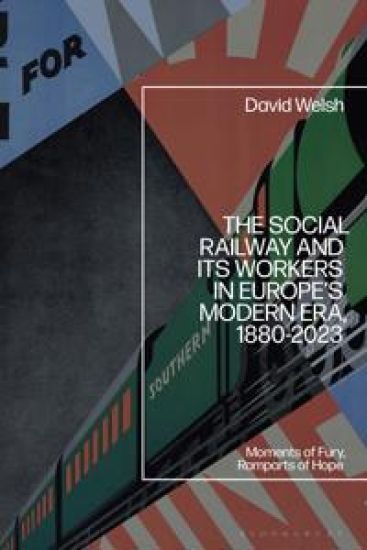
The Social Railway and Its Workers in Europe’s Modern Era, 1880-2023
David Welsh
BLOOMSBURY PUBLISHING PLC
2025
sidottu
This thematically arranged book examines the evolution of rail transport and a number of railway workforces across Europe in the modern era, from around 1880 to 2023. Each chapter explores how, within the context of a social railway, rail workers developed distinct national and international perspectives on the nature of their work and their roles in societies and states. David Welsh convincingly argues that workers formed a raft of entirely new and enduring organisations such as trade unions that, in turn, became ramparts of hope. Welsh goes on to consider how the insurgent character of these organisations produced moments of fury during tumultuous periods in the 20th century. The Social Railway and its Workers in Europe’s Modern Era, 1880-2023 explores the national and European contexts in which both characteristics came to the fore, including the ecology of fossil fuel technology (coal and oil). Above all, it argues that social, economic and political forces are not simply external ‘scene-shifting’ but integral to the history of railway systems. The book examines the cultural construction of European railways through literature, art and other forms of writing as well as recent oral history. It also includes a detailed investigation of the role played by nationalisation and public ownership in Europe. In the context of neoliberalism and globalization, it proposes a 21st century programme for the social railway.

The release of Nelson Mandela from twenty-seven years imprisonment in 1990 and the free elections which followed four years later were among the most dramatic events of the twentieth century. David Welsh and J. E. Spence here examine the complex forces which lay behind that drama. They chart the rise and decline of apartheid ideology in South Africa, the internal insurrection and increased international isolation which characterised the 1980s and the political roller-coaster ride of the period after 1990 as constitutional negotiations got underway. Based on extensive interviews with those involved, Ending Apartheid traces the negotiating process in penetrating detail, noting the political skills of de Klerk and Mandela in keeping their potentially unruly constituencies in line and avoiding the major violence that many had predicted. Reaching agreement on a democratic constitution was a major achievement that surprised many sceptical observers, but the book ends on a more sombre note. Reviewing the period subsequent to the transition, it argues that while progress has been made, the future of South Africa's democracy is still far from assured. Written by two eminent scholars with decades of experience teaching in the field, Ending Apartheid is an invaluable resource for all students of South African politics seeking a deeper understanding of a defining episode in recent history.

Lectures on the Philosophy of the Human Mind. THIRTEENTH EDITION
Thomas Brown; David Welsh
British Library, Historical Print Editions
2011
pokkari
Title: Lectures on the Philosophy of the Human Mind. Publisher: British Library, Historical Print EditionsThe British Library is the national library of the United Kingdom. It is one of the world's largest research libraries holding over 150 million items in all known languages and formats: books, journals, newspapers, sound recordings, patents, maps, stamps, prints and much more. Its collections include around 14 million books, along with substantial additional collections of manuscripts and historical items dating back as far as 300 BC. The HISTORY OF PHILOSOPHY & ETHICS collection includes books from the British Library digitised by Microsoft. The works in this collection include expositions and scholarly analyses of philosophy and ethics for the earliest recorded Western religious and secular works. Documents concern prehistoric, medieval, and modern times, with background and historical narratives on Western thought. The collection provides insights into how philosophies have changed through history, what has driven these changes, and to what degree philosophical texts from prior eras are understood in the contemporary times of the authors. ++++The below data was compiled from various identification fields in the bibliographic record of this title. This data is provided as an additional tool in helping to insure edition identification: ++++ British Library Brown, Thomas; Welsh, David; 1841. xxxi, 692 p.; 8 . 722.h.19.
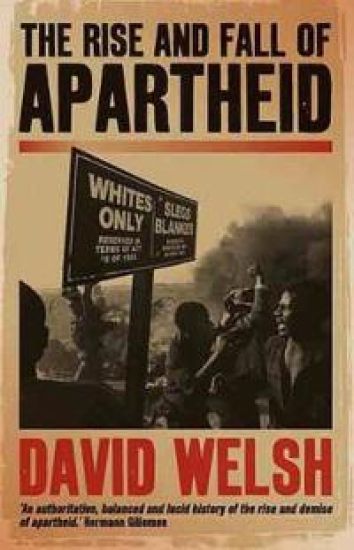
On his way into Parliament on February 2, 1990, F. W. de Klerk turned to his wife Marike and said, referring to his forthcoming speech: ""South Africa will never be the same again after this."" Did white South Africa crack, or did its leadership yield sufficiently and just in time to avert a revolution? The transformation has been called a miracle, belying gloomy predictions of race war in which the white minority circled the wagons and fought to the last drop of blood. Why did it happen? In The Rise and Fall of Apartheid, David Welsh views the topic against the backdrop of a long history of conflict spanning apartheid’s rise and demise, and the liberation movement’s suppression and subsequent resurrection. His view is that the movement away from apartheid to majority rule would have taken far longer and been much bloodier were it not for the changes undergone by Afrikaner nationalism itself. There were turning points, such as the Soweto Uprising of 1976, but few believed that the transition from white domination to inclusive democracy would occur as soon—and as relatively peacefully—as it did. In effect, however, a multitude of different factors led the African National Congress and the National Party to see that neither side could win the conflict on its own terms. Utterly dissimilar in background, culture, beliefs, and political style, Nelson Mandela and F. W. de Klerk were an unlikely pair of liberators. But both soon recognized that they were dependent on each other to steer the transformation process through to its conclusion.
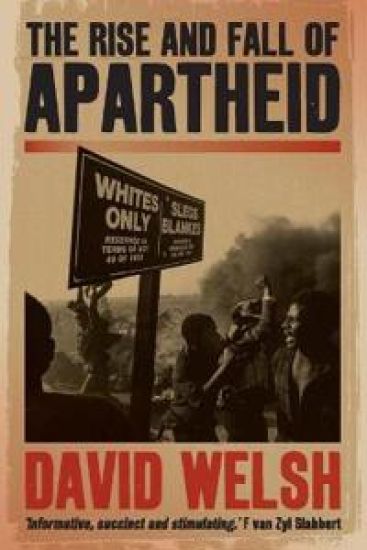
The rise and fall of apartheid
David Welsh
Jonathan Ball Publishers SA
2010
nidottu
Halvin toimitettuna 38,50 €
Did white South Africa crack, or did its leadership yield sufficiently and just in time to avert a revolution? The transformation has been called a miracle, belying gloomy predictions of race war in which the white minority went into a laager and fought to the last drop of blood. Why did it happen? Professor Welsh views the topic against the backdrop of a long history of conflict spanning apartheid's rise and demise, and the liberation movement's suppression and subsequent resurrection. His view is that the movement away from apartheid to majority rule would have taken far longer and been much bloodier were it not for the changes undergone by Afrikaner nationalism itself. There were turning points, such as the Soweto uprising of 1976, but few believed that the transition from white domination to inclusive democracy would occur as soon -- and as relatively peacefully -- as it did. In effect, however, a multitude of different factors led the ANC and the National Party to see that neither side could win the conflict on its own terms. Utterly dissimilar in background, culture, beliefs and political style, Nelson Mandela and FW de Klerk were an unlikely pair of liberators. But both soon recognised that they were dependent on each other to steer the transformation process through to its conclusion.