Kirjojen hintavertailu – 12 903 725 kirjaa ja 27 kauppaa

Kirjailija

David Wheatley

Kirjat ja teokset yhdessä paikassa: 12 kirjaa, julkaisuja vuosilta 2002–2024, suosituimpiin kuuluu The President of Planet Earth. Vertaile teosten hintoja ja tarkista saatavuus suomalaisista kirjakaupoista.

12 kirjaa

Kirjojen julkaisuvuodet: 2002–2024.

Child Ballad

Child Ballad

David Wheatley

Wake Forest University Press
2024
nidottu
In Child Ballad, his sixth collection, David Wheatley explores a world transformed by the poet's experience of parenthood. Leading his children through the landscapes of Northern Scotland, he follows pathways laid down by departed Irish missionaries and wolves, mapping a rich landscape of rivers, trees, and mountains. Writing across geographical and historical distances as he often does, Wheatley hones an aesthetic of complex intimacy, alert to questions of memory and loss while communicating the ache of the here and now, as seen through the eyes of young children. Wheatley is an Irish poet living and teaching in Scotland. As a cultural corridor, his Scotland is a space of migrations and palimpsests, holding different traditions in dynamic balance and fusion. Stylistically, Child Ballad draws on a spectrum of these traditions, from the Scottish ballad to the Gaelic bards, French symbolism, and the American Objectivists. A closing sequence on wildflowers and fungi of the poet's home in Aberdeenshire becomes an exercise in Orphic taxonomy, rippling outwards from the world of small flowers and mushrooms to a vision of deep history, geology, and ultimately the mysterious origins from

Child Ballad

Child Ballad

David Wheatley

CARCANET PRESS LTD
2023
nidottu

Halvin toimitettuna 21,80 €

A Poetry Book Society Winter Recommendation 2023. A Sunday Times Book of the Year. In Child Ballad, David Wheatley's sixth collection, he explores a world transformed by the experience of parenthood. Conducting his children through landscapes of Northern Scotland, he follows pathways laid down by departed Irish missionaries and by wolves. He maps a rich territory of rivers, trees and mountains. Also present are histories, some evidenced, some no longer visible and yet to be inferred. Stylistically, Child Ballad is multifaceted, drawing on influences from the Scottish ballad tradition and the Gaelic bards, on French symbolism and on the American Objectivists. Wheatley is an Irish poet living and teaching in Scotland: as a cultural corridor, his Scotland is a space of migrations and palimpsests, different traditions held in dynamic balance and fusion. Writing across geographical and historical distances as he does, Wheatley develops an aesthetic of complex intimacy, alert to questions of memory and loss, communicating the ache of the here and now. He sees through the eyes of young children and the world looks very different in its gifts and threats. Wheatley provides intimate descriptions of parenthood as well as of a Northern Scottish natural world. He deploys an ambitious range of poetic styles and forms. His poems put deep roots down into history and geology, and with translation into other languages. Themes of migration and politics are never far away. Child Ballad sings of midlife, of resettlement and marriage as well as of parenthood.
Stretto

Stretto

David Wheatley

CB EDITIONS
2022
pokkari
Stretto is both a novel of travel and migration, moving between Ireland, England and Scotland over a twenty-year period, and an exploration of the nature of self and reality. Reconnecting with the modernist energies of Joyce and Beckett, Stretto is a radical and audacious debut novel.
Stravaig

Stravaig

David Wheatley

Broken Sleep Books
2021
pokkari
Stravaig: A fiction for voices is a rewrite of Samuel Beckett's great radio play All That Fall, set in rural Aberdeenshire. Where Beckett's text is about two old people and the spectre of death, David Wheatley's text inverts the source material, centering it on two parents with young children. Stravaig, in remarkable style, presents certain obscurities to the reader, such as words or sentences in Scots, and discussion of matters Gaelic. This is a gem of a playscript and a truly sublime book.
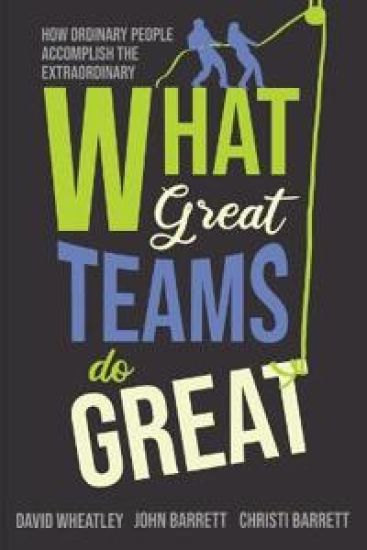
What Great Teams Do Great

What Great Teams Do Great

David Wheatley; John Barrett; Christi Barrett

Koehler Books
2020
pokkari
Teamwork makes the dream work. Or not. Human beings are wired to form connections, but that doesn't mean that they are naturally equipped for teamwork. Too many people find that working with others makes them miserable, wastes their time and makes them feel like kicking the dog at the end of the day. What Great Teams Do Great is a practical guide to activating the power of choice and the right team processes that create excitement, shared mission, trust and collaboration to achieve bold objectives (and have fun along the way).
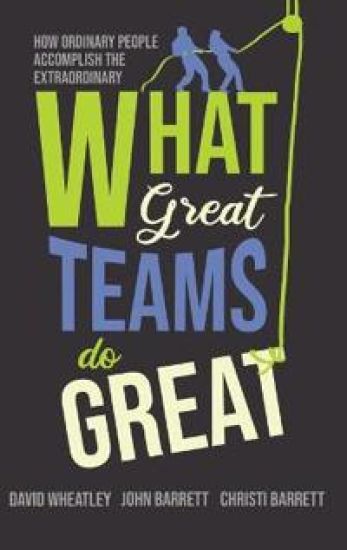
What Great Teams Do Great

What Great Teams Do Great

David Wheatley; John Barrett; Christi Barrett

Koehler Books
2020
sidottu
Teamwork makes the dream work. Or not. Human beings are wired to form connections, but that doesn't mean that they are naturally equipped for teamwork. Too many people find that working with others makes them miserable, wastes their time and makes them feel like kicking the dog at the end of the day. What Great Teams Do Great is a practical guide to activating the power of choice and the right team processes that create excitement, shared mission, trust and collaboration to achieve bold objectives (and have fun along the way).
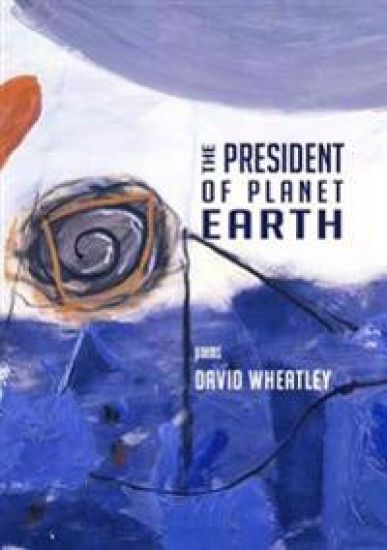
The President of Planet Earth

The President of Planet Earth

David Wheatley

Wake Forest University Press
2017
nidottu
In a state of apocalyptic rapture, Russian futurist poet Velimir Khlebnikov pronounced himself the "president of planet earth." In this, David Wheatley's fifth collection but the first to be published in North America, he brings an experimental sensibility to bear on questions of land and territory, channelling the messianic ambitions of modernism into rich and subversive comedy. Long sequences explore the other country that is childhood, Khlebnikov's Russia, and the Scottish landscapes where the poet now makes his home. History, translation, and animal life are constant presences. The President of Planet Earth aspires to a transformative poetics, refashioning language and the world it helps us shape.
The President of Planet Earth

The President of Planet Earth

David Wheatley

Carcanet Press Ltd
2017
nidottu
Shortlisted for the 2018 Irish Times Poetry Now Award. In his fifth collection of poems, David Wheatley twins his birthplace and his current home, Ireland and Scotland, to engage issues of globalism, identity, and language. He takes inspiration from the Russian Futurist poet Velimir Khlebnikov, self-nominated President of Planet Earth, who in a state of apocalyptic rapture envisioned a new world culture, its rise and its dramatic undoing. In The President of Planet Earth Wheatley brings an experimental sensibility to bear on questions of land and territory, channelling the messianic aspirations of modernism into subversive comedy. We move between Pictish pre-history, the imaginary South American nation ofaA A aA A `Oblivia', aA A and post-independence referendum Scotland. Wheatley marries classical, Gaelic, Scots and continental traditions. He deploys several styles - prose poetry; concrete poetry; translations from Middle Irish, Latin and French; sestinas and sonnets in Scots - to heady effect. The President of Planet Earth refashions language and the world it shapes, devising a transformative poetics.
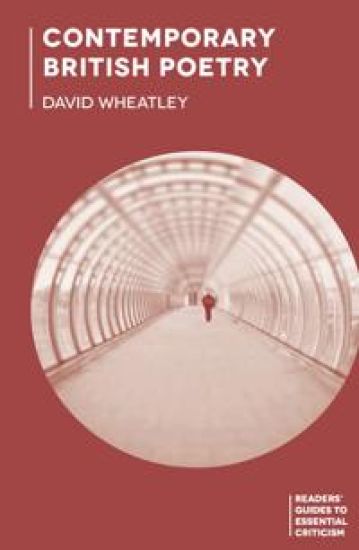
Contemporary British Poetry

Contemporary British Poetry

David Wheatley

Red Globe Press
2014
nidottu
This Reader's Guide provides a timely critical overview that allows readers to orient themselves authoritatively in the rapidly-evolving field of contemporary British poetry. Focusing on key themes and issues, and a wide range of poets, the Guide captures the intersection between the historical and cultural contexts of critical debate today.
Contemporary British Poetry

Contemporary British Poetry

David Wheatley

Red Globe Press
2014
sidottu
This Reader's Guide provides a timely critical overview that allows readers to orient themselves authoritatively in the rapidly-evolving field of contemporary British poetry. Focusing on key themes and issues, and a wide range of poets, the Guide captures the intersection between the historical and cultural contexts of critical debate today.
Spatial Technology and Archaeology

Spatial Technology and Archaeology

David Wheatley; Mark Gillings

CRC Press
2002
sidottu
Geographical Information Systems (GIS) and related spatial technologies have a new and powerful role to play in archaeological interpretation. Beginning with a conceptual approach to the representation of space adopted by GIS, this book examines spatial databases; the acquisition and compilation of data; the analytical compilation of data; the analytical functionality of GIS; and the creation and utilization of critical foundation data layers such as the Digital Elevation Model (DEM). The ways in which GIS can most usefully facilitate archaeological analysis and interpretation are then explored particularly as a tool for the management of archaeological resources. Formal analysis of archaeological material, and the use of trend surface, contouring and interpolation procedures are considered along with predictive modeling analysis of visibility and intervisibility. Finally there is a discussion of leading-edge issues, including three-dimensional GIS, object-oriented GIS, the relationship between GIS and 'Virtual Reality' technologies, and the integration of GIS with distributed systems and the Internet. The approach is light, and technical detail is kept to a minimum, recognizing that most readers are simply interested in using GIS effectively. The text is carefully illustrated with worked case-studies using archaeological data. Spatial Technology and Archaeology provides a single reference source for archaeologists, students, professionals, and academics in archaeology as well as those in anthropology and related disciplines.
Spatial Technology and Archaeology

Spatial Technology and Archaeology

David Wheatley; Mark Gillings

CRC Press
2002
nidottu
Geographical Information Systems (GIS) and related spatial technologies have a new and powerful role to play in archaeological interpretation. Beginning with a conceptual approach to the representation of space adopted by GIS, this book examines spatial databases; the acquisition and compilation of data; the analytical compilation of data; the analytical functionality of GIS; and the creation and utilization of critical foundation data layers such as the Digital Elevation Model (DEM). The ways in which GIS can most usefully facilitate archaeological analysis and interpretation are then explored particularly as a tool for the management of archaeological resources. Formal analysis of archaeological material, and the use of trend surface, contouring and interpolation procedures are considered along with predictive modeling analysis of visibility and intervisibility. Finally there is a discussion of leading-edge issues, including three-dimensional GIS, object-oriented GIS, the relationship between GIS and 'Virtual Reality' technologies, and the integration of GIS with distributed systems and the Internet. The approach is light, and technical detail is kept to a minimum, recognizing that most readers are simply interested in using GIS effectively. The text is carefully illustrated with worked case-studies using archaeological data. Spatial Technology and Archaeology provides a single reference source for archaeologists, students, professionals, and academics in archaeology as well as those in anthropology and related disciplines.