Kirjailija
David Zhang
Kirjat ja teokset yhdessä paikassa: 36 kirjaa, julkaisuja vuosilta 2006–2026, suosituimpiin kuuluu Advanced Fingerprint Recognition: From 3D Shape to Ridge Detail. Vertaile teosten hintoja ja tarkista saatavuus suomalaisista kirjakaupoista.
36 kirjaa
Kirjojen julkaisuvuodet: 2006–2026.
This genuinely pocket-sized guide to essential medical equipment is ideal for medical students, newly qualified junior doctors and other healthcare professionals seeking a convenient and concise handbook to refer to in busy clinical settings including emergency departments. Clear, concise and systematic, it provides a visual guide to enable readers to identify correctly common medical equipment and use it appropriately without overwhelming or extraneous information. Key Features: Convenient – everything at your fingertips, for speedy access in the emergency department, on the ward and in the clinic Portable – actually fits in a pocket Illustrated – plentiful photographs and explanatory line diagrams support and enhance the text Tailored – written specifically with the less experienced practitioner in mindProviding guidance and answering questions when senior help is not readily available, with this book as your indispensable companion you will be equipped to identify and use equipment with confidence in order to provide safe and effective care for patients.


While voice is widely used in speech recognition and speaker identification, its application in biomedical fields is much less common. This book systematically introduces the authors’ research on voice analysis for biomedical applications, particularly pathological voice analysis. Firstly, it reviews the field to highlight the biomedical value of voice. It then offers a comprehensive overview of the workflow and aspects of pathological voice analysis, including voice acquisition systems, voice pitch estimation methods, glottal closure instant detection, feature extraction and learning, and the multi-audio fusion approaches. Lastly, it discusses the experimental results that have shown the superiority of these techniques. This book is useful to researchers, professionals and postgraduate students working in fields such as speech signal processing, pattern recognition, and biomedical engineering. It is also a valuable resource for those involved in interdisciplinary research.
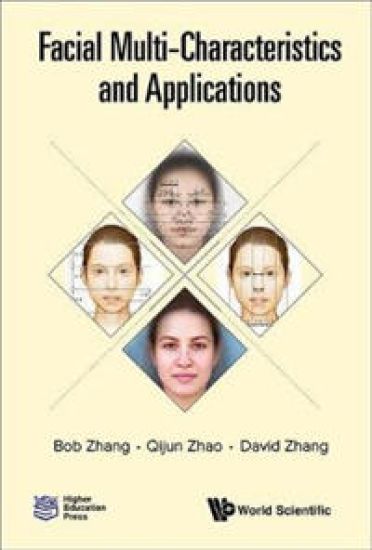
Facial Multi-characteristics And Applications
Bob Zhang; Qijun Zhao; David Zhang
World Scientific Publishing Co Pte Ltd
2019
sidottu
What features or information can we observe from a face, and how can these information help us to understand the person concerned, in terms of their well-being and what can we learn about and from each given feature? This book answers these questions by first dividing a face's multiple characteristics into two main categories: original (or physiological) features and features that change over a lifetime. The first category, original features, may be further divided into two sub-classes: features special (or unique) to an individual, and features common to a particular group. The second, changed features, can also be subdivided into two groups: features altered due to disease or features altered by other external factors. From these four sub-categories, four different applications — facial identification using original and special features; beauty analysis using original common features; facial diagnosis by disease changed features; and expression recognition through affect-changed features — are identified. The book will benefit researchers, professionals, and graduate students working in the field of computer vision, pattern recognition, security/clinical practice, and beauty analysis, and will also be useful for interdisciplinary research.
Computational Pulse Signal Analysis
David Zhang; Wangmeng Zuo; Peng Wang
Springer Verlag, Singapore
2019
nidottu
This book describes the latest advances in pulse signal analysis and their applications in classification and diagnosis. First, it provides a comprehensive introduction to useful techniques for pulse signal acquisition based on different kinds of pulse sensors together with the optimized acquisition scheme. It then presents a number of preprocessing and feature extraction methods, as well as case studies of the classification methods used. Lastly it discusses some promising directions for the future study and clinical applications of pulse signal analysis. The book is a valuable resource for researchers, professionals and postgraduate students working in the field of pulse diagnosis, signal processing, pattern recognition and biometrics. It is also useful for those involved in interdisciplinary research.
Breath Analysis for Medical Applications
David Zhang; Dongmin Guo; Ke Yan
Springer Verlag, Singapore
2018
nidottu
This book describes breath signal processing technologies and their applications in medical sample classification and diagnosis. First, it provides a comprehensive introduction to breath signal acquisition methods, based on different kinds of chemical sensors, together with the optimized selection and fusion acquisition scheme. It then presents preprocessing techniques, such as drift removing and feature extraction methods, and uses case studies to explore the classification methods. Lastly it discusses promising research directions and potential medical applications of computerized breath diagnosis. It is a valuable interdisciplinary resource for researchers, professionals and postgraduate students working in various fields, including breath diagnosis, signal processing, pattern recognition, and biometrics.
Computational Pulse Signal Analysis
David Zhang; Wangmeng Zuo; Peng Wang
Springer Verlag, Singapore
2018
sidottu
This book describes the latest advances in pulse signal analysis and their applications in classification and diagnosis. First, it provides a comprehensive introduction to useful techniques for pulse signal acquisition based on different kinds of pulse sensors together with the optimized acquisition scheme. It then presents a number of preprocessing and feature extraction methods, as well as case studies of the classification methods used. Lastly it discusses some promising directions for the future study and clinical applications of pulse signal analysis. The book is a valuable resource for researchers, professionals and postgraduate students working in the field of pulse diagnosis, signal processing, pattern recognition and biometrics. It is also useful for those involved in interdisciplinary research.
Advanced Biometrics
David Zhang; Guangming Lu; Lei Zhang
Springer International Publishing AG
2018
nidottu
This book describes a range of new biometric technologies, such as high-resolution fingerprint, finger-knuckle-print, multi-spectral backhand, 3D fingerprint, tongueprint, 3D ear, and multi-spectral iris technologies. Further, it introduces readers to efficient feature extraction, matching and fusion algorithms, in addition to developing potential systems of its own. These advanced biometric technologies and methods are divided as follows: 1. High-Resolution Fingerprint Recognition; 2. Finger-Knuckle-Print Verification; 3. Other Hand-Based Biometrics; and 4. New Head-Based Biometrics. Traditional biometric technologies, such as fingerprint, face, iris, and palmprint, have been extensively studied and addressed in many research books. However, all of these technologies have their own advantages and disadvantages, and there is no single type of biometric technology that can be used for all applications. Many new biometric technologies have been developed in recent years, especially in response to new applications. The contributions gathered here focus on how to develop a new biometric technology based on the requirements of essential applications, and how to design efficient algorithms that yield better performance.
Advanced Biometrics
David Zhang; Guangming Lu; Lei Zhang
Springer International Publishing AG
2017
sidottu
This book describes a range of new biometric technologies, such as high-resolution fingerprint, finger-knuckle-print, multi-spectral backhand, 3D fingerprint, tongueprint, 3D ear, and multi-spectral iris technologies. Further, it introduces readers to efficient feature extraction, matching and fusion algorithms, in addition to developing potential systems of its own. These advanced biometric technologies and methods are divided as follows: 1. High-Resolution Fingerprint Recognition; 2. Finger-Knuckle-Print Verification; 3. Other Hand-Based Biometrics; and 4. New Head-Based Biometrics. Traditional biometric technologies, such as fingerprint, face, iris, and palmprint, have been extensively studied and addressed in many research books. However, all of these technologies have their own advantages and disadvantages, and there is no single type of biometric technology that can be used for all applications. Many new biometric technologies have been developed in recent years, especially in response to new applications. The contributions gathered here focus on how to develop a new biometric technology based on the requirements of essential applications, and how to design efficient algorithms that yield better performance.
Breath Analysis for Medical Applications
David Zhang; Dongmin Guo; Ke Yan
Springer Verlag, Singapore
2017
sidottu
This book describes breath signal processing technologies and their applications in medical sample classification and diagnosis. First, it provides a comprehensive introduction to breath signal acquisition methods, based on different kinds of chemical sensors, together with the optimized selection and fusion acquisition scheme. It then presents preprocessing techniques, such as drift removing and feature extraction methods, and uses case studies to explore the classification methods. Lastly it discusses promising research directions and potential medical applications of computerized breath diagnosis. It is a valuable interdisciplinary resource for researchers, professionals and postgraduate students working in various fields, including breath diagnosis, signal processing, pattern recognition, and biometrics.
Multispectral Biometrics
David Zhang; Zhenhua Guo; Yazhuo Gong
Springer International Publishing AG
2016
nidottu
Describing several new biometric technologies, such as high-resolution fingerprint, finger-knuckle-print, multi-spectral backhand, 3D fingerprint, tongueprint, 3D ear, and multi-spectral iris recognition technologies, this book analyzes a number of efficient feature extraction, matching and fusion algorithms and how potential systems have been developed. Focusing on how to develop new biometric technologies based on the requirements of applications, and how to design efficient algorithms to deliver better performance, the work is based on the author’s research with experimental results under different challenging conditions described in the text. The book offers a valuable resource for researchers, professionals and postgraduate students working in the fields of computer vision, pattern recognition, biometrics, and security applications, amongst others.
Medical Biometrics: Computerized Tcm Data Analysis
David Zhang; Wangmeng Zuo
World Scientific Publishing Co Pte Ltd
2016
sidottu
The introduction of traditional Chinese medicine (TCM) through modern information technology will not only achieve the objective progress of the heritage of thousands of years of TCM, but also deliver novel discoveries for modern medicines. This book is an advanced monograph based on a decade's worth of research work by the authors. After a brief introduction on the four diagnosis approaches in TCM, this book delves into the three main TCM data analysis techniques: computerized tongue, pulse and odor analysis. Both graduate students and researchers in computerized TCM data analysis will benefit from the book as it will provide a comprehensive understanding of the state-of-the-art analysis methods, image / signal acquisition devices, and the related feature extraction and classification methods.
Multispectral Biometrics
David Zhang; Zhenhua Guo; Yazhuo Gong
Springer International Publishing AG
2015
sidottu
Describing several new biometric technologies, such as high-resolution fingerprint, finger-knuckle-print, multi-spectral backhand, 3D fingerprint, tongueprint, 3D ear, and multi-spectral iris recognition technologies, this book analyzes a number of efficient feature extraction, matching and fusion algorithms and how potential systems have been developed. Focusing on how to develop new biometric technologies based on the requirements of applications, and how to design efficient algorithms to deliver better performance, the work is based on the author’s research with experimental results under different challenging conditions described in the text. The book offers a valuable resource for researchers, professionals and postgraduate students working in the fields of computer vision, pattern recognition, biometrics, and security applications, amongst others.
Automatic personal authentication using biometric information is becoming more essential in applications of public security, access control, forensics, banking, etc. Many kinds of biometric authentication techniques have been developed based on different biometric characteristics. However, most of the physical biometric recognition techniques are based on two dimensional (2D) images, despite the fact that human characteristics are three dimensional (3D) surfaces. Recently, 3D techniques have been applied to biometric applications such as 3D face, 3D palmprint, 3D fingerprint, and 3D ear recognition. This book introduces four typical 3D imaging methods, and presents some case studies in the field of 3D biometrics. This book also includes many efficient 3D feature extraction, matching, and fusion algorithms. These 3D imaging methods and their applications are given as follows: - Single view imaging with line structured-light: 3D ear identification - Single view imaging with multi-line structured-light: 3D palmprint authentication - Single view imaging using only 3D camera: 3D hand verification - Multi-view imaging: 3D fingerprint recognition 3D Biometrics: Systems and Applications is a comprehensive introduction to both theoretical issues and practical implementation in 3D biometric authentication. It will serve as a textbook or as a useful reference for graduate students and researchers in the fields of computer science, electrical engineering, systems science, and information technology. Researchers and practitioners in industry and R&D laboratories working on security system design, biometrics, immigration, law enforcement, control, and pattern recognition will also find much of interest in this book.