Kirjojen hintavertailu – 12 903 725 kirjaa ja 27 kauppaa

Kirjailija

Dayton Duncan

Kirjat ja teokset yhdessä paikassa: 9 kirjaa, julkaisuja vuosilta 1995–2023, suosituimpiin kuuluu Country Music: An Illustrated History. Vertaile teosten hintoja ja tarkista saatavuus suomalaisista kirjakaupoista.

9 kirjaa

Kirjojen julkaisuvuodet: 1995–2023.

Blood Memory: The Tragic Decline and Improbable Resurrection of the American Buffalo
The epic story of the buffalo in America, from prehistoric times to today--a moving and beautifully illustrated work of natural history inspired by the PBS series "American Buffalo" The American buffalo--our nation's official mammal--is an improbable, shaggy beast that has found itself at the center of many of our most mythic and sometimes heartbreaking tales. The largest land animals in the Western Hemisphere, they are survivors of a mass extinction that erased ancient species that were even larger. For nearly 10,000 years, they evolved alongside Native people who weaved them into every aspect of daily life; relied on them for food, clothing, and shelter; and revered them as equals. Newcomers to the continent found the buffalo fascinating at first, but in time they came to consider them a hindrance to a young nation's expansion. And in the space of only a decade, they were slaughtered by the millions for their hides, with their carcasses left to rot on the prairies. Then, teetering on the brink of disappearing from the face of the earth, they would be rescued by a motley collection of Americans, each of them driven by different--and sometimes competing--impulses. This is the rich and complicated story of a young republic's heedless rush to conquer a continent, but also of the dawn of the conservation era--a story of America at its very best and worst.
Mapping America's National Parks

Mapping America's National Parks

Ken Burns; Dayton Duncan

Environmental Systems Research Institute Inc.,U.S.
2021
pokkari
Get an insider look at the US National Park Service to see how they use maps and geospatial technology to protect and manage America’s national parks. Maps easily cap your first greeting upon arrival at a national park, allowing you to visualize its vastness, plan your trip, and keep a compact souvenir of your visit. But for the US National Park Service (NPS), maps do more than provide guidance and navigation. Maps help the NPS protect visitors and natural resources. They help manage fires, both unplanned and prescribed. They provide a basis for preserving cultural resources, such as archaeological sites and historic buildings, and for establishing needed facilities, infrastructure, and transportation. The maps in Mapping America’s National Parks: Preserving Our Natural and Cultural Treasures are not only beautiful representations of special places. Within the maps are layers of geographic information—a bevy of research and science—that the NPS uses to perform these myriad essential services and to ultimately fulfill their mission. With over 240 full-color maps and photographs of national parks, monuments, battlefields, historic sites, lakeshores, seashores, scenic rivers and trails, and more, Mapping America’s National Parks takes you on a journey through our most treasured locations and shows how geographic information system (GIS) software helps the NPS keep the balance between park enjoyment and preservation. Through stories told by their own staff, discover how GIS helps the NPS: provide security for individual wildlife species, members of a crowd at a peaceful demonstration, and entire ecosystems;analyze where people most likely are stranded, where they are least likely stranded, and distribute assets in search and rescue operations;develop strategic plans, budgets, and protection for fire management; andshare intelligence on wildlife trafficking, zoonotic diseases, field medicine protocols, and more. Go behind the scenes to see how mapping and geospatial analysis support the full range of NPS natural resource stewardship and science activities. With NPS planning aided by geospatial technology, future generations of park visitors—your children and their children—will be able to enjoy our national parks for years to come.
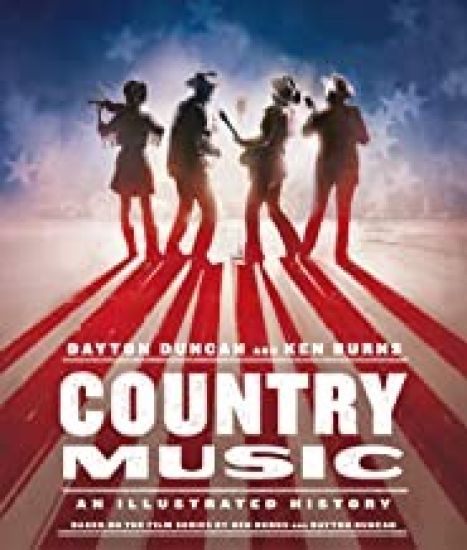
Country Music: An Illustrated History

Country Music: An Illustrated History

Dayton Duncan; Kenneth Burns

Knopf Publishing Group
2019
sidottu
A gorgeously illustrated and hugely entertaining story of America's most popular music and the singers and songwriters who captivated, entertained, and consoled listeners throughout the twentieth century--based on the eight-part film series. This fascinating history begins where country music itself emerged: the American South, where people sang to themselves and to their families at home and in church, and where they danced to fiddle tunes on Saturday nights. With the birth of radio in the 1920s, the songs moved from small towns, mountain hollers, and the wide-open West to become the music of an entire nation--a diverse range of sounds and styles from honky tonk to gospel to bluegrass to rockabilly, leading up through the decades to the music's massive commercial success today. But above all, Country Music is the story of the musicians. Here is Hank Williams's tragic honky tonk life, Dolly Parton rising to fame from a dirt-poor childhood, and Loretta Lynn turning her experiences into songs that spoke to women everywhere. Here too are interviews with the genre's biggest stars, including the likes of Merle Haggard to Garth Brooks to Rosanne Cash. Rife with rare photographs and endlessly fascinating anecdotes, the stories in this sweeping yet intimate history will captivate longtime country fans and introduce new listeners to an extraordinary body of music that lies at the very center of the American experience.
Scenes of Visionary Enchantment

Scenes of Visionary Enchantment

Dayton Duncan

University of Nebraska Press
2012
pokkari
Suffering from a case of "road fever" brought on by prolonged exposure to the journals of Lewis and Clark, Dayton Duncan has retraced the Corps of Discovery's route from Saint Louis to the Pacific and back again four different times during the past twenty years—to say nothing of his countless additional trips to landmarks along their route. In sweltering summer heat and in temperatures 45 degrees below zero, he watched yellow moons rise and heard buffalo thunder; navigated against the Missouri River's relentless current and stood on its surface, frozen solid overnight; canoed a dozen times through Montana's magnificent White Cliffs (Lewis's "seens of visionary inchantment"); and read the journals by candlelight in the expedition's fort on the Pacific coast. Along the way, Duncan wrote the essays that make up this book, essays that guide the reader on a journey of discovery along the trail of Lewis and Clark. More a revisiting than a retelling of the story of the Corps of Discovery, Duncan's book reintroduces us to people and places along the trail, reflects on events large and small that occurred during the expedition, and offers constant—and constantly entertaining—insights into why, two centuries later, the saga of Lewis and Clark continues to exert such a powerful hold on our national imagination.
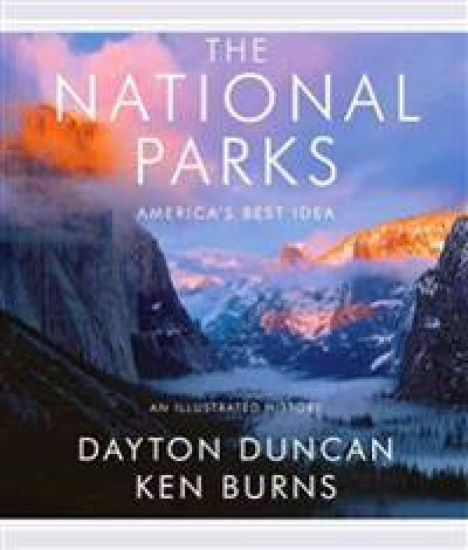
The National Parks: America's Best Idea

The National Parks: America's Best Idea

Dayton Duncan; Kenneth Burns

Knopf Publishing Group
2009
sidottu
The companion volume to the twelve-hour PBS series from the acclaimed filmmaker behind The Civil War, Baseball, and The War. America's national parks spring from an idea as radical as the Declaration of Independence: that the nation's most magnificent and sacred places should be preserved, not for royalty or the rich, but for everyone. In this evocative and lavishly illustrated narrative, Ken Burns and Dayton Duncan delve into the history of the park idea, from the first sighting by white men in 1851 of the valley that would become Yosemite and the creation of the world's first national park at Yellowstone in 1872, through the most recent additions to a system that now encompasses nearly four hundred sites and 84 million acres. The authors recount the adventures, mythmaking, and intense political battles behind the evolution of the park system, and the enduring ideals that fostered its growth. They capture the importance and splendors of the individual parks: from Haleakala in Hawaii to Acadia in Maine, from Denali in Alaska to the Everglades in Florida, from Glacier in Montana to Big Bend in Texas. And they introduce us to a diverse cast of compelling characters--both unsung heroes and famous figures such as John Muir, Theodore Roosevelt, and Ansel Adams--who have been transformed by these special places and committed themselves to saving them from destruction so that the rest of us could be transformed as well. The National Parks is a glorious celebration of an essential expression of American democracy.
Scenes of Visionary Enchantment

Scenes of Visionary Enchantment

Dayton Duncan

University of Nebraska Press
2004
sidottu
Suffering from a case of "road fever" brought on by prolonged exposure to the journals of Lewis and Clark, Dayton Duncan has retraced the Corps of Discovery's route from Saint Louis to the Pacific and back again four different times during the past twenty years - to say nothing of his countless additional trips to landmarks along their route. In sweltering summer heat and in temperatures 45 degrees below zero, he watched yellow moons rise and heard buffalo thunder; navigated against the Missouri River's relentless current and stood on its surface, frozen solid overnight; canoed a dozen times through Montana's magnificent White Cliffs (Lewis' "seens of visionary inchantment"); and read the journals by candlelight in the expedition's fort on the Pacific coast. Along the way, Duncan wrote the essays that make up this book, essays that guide the reader on a journey of discovery along the trail of Lewis and Clark. More a revisiting than a retelling of the story of the Corps of Discovery, Duncan's book reintroduces us to people and places along the trail, reflects on events large and small that occurred during the expedition, and offers constant - and constantly entertaining - insights into why, two centuries later, the saga of Lewis and Clark continues to exert such a powerful hold on our national imagination. Dayton Duncan is an award-winning writer and documentary filmmaker and the author of eight books, including Out West: A Journey through Lewis and Clark's America and Miles from Nowhere: Tales from America's Contemporary Frontier, both available in Bison Books editions. His most recent book, Horatio's Drive: America's First Road Trip, is a companion volume to Ken Burns' documentary film about the first transcontinental automobile trip.
Out West

Out West

Dayton Duncan

Bison Books
2000
pokkari
One hundred and eighty years after Lewis and Clark's "Voyage of Discovery" (1804–1806), Dayton Duncan set out in a Volkswagen camper to retrace their steps. Out West is an account of three separate journeys: Lewis and Clark's epic adventure through uncharted wilderness; Duncan's retracing of the historic trail, now in various ways tamed, paved, and settled; and the journey of the American West in the years in between. Readers traveling with Duncan will encounter the people who inhabit today's West: farmers and ranchers, cowboys and mountain men, Native Americans, residents of dying small towns, city dwellers who have survived cycles of boom and bust. From the Gateway Arch in St. Louis to the Oregon coast, readers will be treated to a landscape as variously impressive as its people.
The Yosemite Valley and the Mariposa Grove of Big Trees

The Yosemite Valley and the Mariposa Grove of Big Trees

Frederick Law Olmsted; Dayton Duncan; Ken Burns

Yosemite Conservancy
1995
pokkari
When Ken Burns and Dayton Duncan visited Yosemite National Park, they both called out Fredrick Law Olmsted as a major influence and inspiration for their documentary film, "The National Parks: America's Best Idea." To celebrate Mr. Olmsted and his contributions to our National Parks, the Yosemite Conservancy, in partnership with Heyday Books, has reprinted "Yosemite and the Mariposa Grove: A Preliminary Report, 1865" with a new foreword by Dayton Duncan and Ken Burns. This seminal book is a must read for anyone interested in the National Parks and our public lands. The first eloquent expression of the need for conservation in 1865 is found in this remarkable and prescient report by Frederick Law Olmsted. No statement since has been so cogent or powerful. Pristine natural landscapes, Olmsted observed, provide people with "refreshing rest and re-invigoration." They are good -- perhaps essential -- for the soul. Which is why, he noted, that from time immemorial they have most often become the exclusive domain of any society's most privileged classes, "a monopoly, in a very peculiar manner, of a very few, very rich people." Olmsted believed a great democracy had a greater obligation: "to provide means of protection for all its citizens in the pursuit of happiness." That meant, he argued, that "the establishment by government of great public grounds for the free enjoyment of the people ...is thus justified and enforced as a political duty." Olmsted gave additional reasons for creating public parks, including that they are undeniably good for the local, state, and national economy because of the tourist business they engender. His report also included practical advice about building roads and shelters, as well as instituting regulations to zealously protect the "dignity of the scenery." All of his points are as pertinent today as they were when he first read them to his fellow Yosemite commissioners nearly 150 years ago. But in deliberately borrowing from our nation's founding document, which proclaims that the "pursuit of happiness" is among the inalienable rights of every human being, and in attaching that notion to why Yosemite (or any other future park) should not be allowed to become "a rich man's park," Olmsted infused the national park idea with its most enduring principle."