Kirjojen hintavertailu – 12 859 827 kirjaa ja 27 kauppaa
Kirjailija
Deborah Tannen
Kirjat ja teokset yhdessä paikassa: 38 kirjaa, julkaisuja vuosilta 1982–2027, suosituimpiin kuuluu HBR's 10 Must Reads on Communication (with featured article "The Necessary Art of Persuasion," by Jay A. Conger). Vertaile teosten hintoja ja tarkista saatavuus suomalaisista kirjakaupoista.
Japan and the United States are in closer contact politically and economically than ever before, yet in many ways our nations are as far from mutual understanding as ever. Misconceptions and miscommunications between East and West continue to plague this important relationship, frustrating the best efforts of both cultures to work together. Stereotypes abound: Americans see Japanese as evasive and inscrutable, while Japanese see Americans as pushy and selfish. What causes these persistent misunderstandings, and what can be done to avoid them? Fluent in both languages and at home in both cultures, Haru Yamada brings an insiders perspective and a linguists training to this difficult question, illuminating the many reasons why Americans and Japanese misunderstand one another. Social organization, she explains, shapes the way we talk. Because American and Japanese cultures value different kinds of social relationships, they play different language games with different sets of rules. In America, for instance, Aesop's fable about the grasshopper and the ants ends with the ants scorning the foolhardy grasshopper. In Japan, however, the story has a very different ending: the ants invite the grasshopper in to share their winter meal, as they appreciate how his singing spurred them on during their summer labors. In the difference between these two endings, argues Yamada, lies an important lesson: Americans, because of their unique political history, value independence and individuality, while Japanese value mutual dependency and interconnectedness. The language of both cultures is designed to display and reinforce these values so that words, phrases and expressions in one language can have completely different connotations in another, leading to all manner of misunderstanding. Yamada provides numerous examples. In Japan, for instance, silence is valued and halting speech is considered more honest and thoughtful than fluid speech, while in America forthright, polished speech is valued. Likewise, the Japanese use word order to express emphasis, while Americans use vocal stress: a listener unaware of this difference may easily misunderstand the import of a sentence. In a lucid and insightful discussion, Yamada outlines the basic differences between Japanese and American English and analyzes a number of real-life business and social interactions in which these differences led to miscommunication. By understanding how and why each culture speaks in the way that it does, Yamada shows, we can learn to avoid frustrating and damaging failures of communication. Different Games, Different Rules is essential reading for anyone who travels to or communicates regularly with Japan, whether they are scientists, scholars, tourists, or business executives. But as Deborah Tannen notes in her Foreword to the book, even those who will never travel to Japan, do business with a Japanese company, or talk to a person from that part of the world, will find the insights of this book illuminating and helpful, because the greatest benefit that comes of understanding another culture is a better and deeper understanding of one's own.

"Required reading...sharp and insightful...lively and straightforward...a novel and sometimes startling analysis of workplace dynamics."--New York Times Book Review In her extraordinary international bestseller, You Just Don't Understand, Deborah Tannen transformed forever the way we look at intimate relationships between women and men. Now she turns her keen ear and observant eye toward the workplace--where the ways in which men and women communicate can determine who gets heard, who gets ahead, and what gets done. An instant classic, Talking From 9 to 5 brilliantly explains women's and men's conversational rituals--and the language barriers we unintentionally erect in the business world. It is a unique and invaluable guide to recognizing the verbal power games and miscommunications that cause good work to be underappreciated or go unnoticed--an essential tool for promoting more positive and productive professional relationships among men and women.
THE WORLD'S MOST FAMOUS LINGUIST OFFERS A COMPLETELY ORIGINAL ANALYSIS OF THE WAY WE COMMUNICATE--AND A REVOLUTIONARY LANGUAGE TO LIVE BY In her #1 bestseller You Just Don't Understand, Deborah Tannen showed why talking to someone of the opposite sex can be like talking to someone from another world. Now Tannen is back with another groundbreaking book, this time widening her lens to examine the way we communicate in public--in the media, in politics, in our courtrooms, and classrooms--once again letting us see in a new way forces that have powerfully shaped our lives. The war on drugs, the battle of the sexes, political turf combat--in the argument culture, war metaphors pervade our talk and influence our thinking. We approach anything we need to accomplish as a fight between two opposing sides. In this fascinating book, Tannen shows how deeply entrenched this cultural tendency is, the forms it takes, and how it affects us every day--sometimes in useful ways, but often causing damage. The Argument Culture is a remarkable book that will change forever the way you perceive--and communicate with--the world.
Japan and the United States are in closer contact politically and economically than ever before, yet in many ways our nations are as far from mutual understanding as ever. Misconceptions and miscommunications between East and West continue to plague this important relationship, frustrating the best efforts of both cultures to work together. Stereotypes abound: Americans see Japanese as evasive and inscrutable, while Japanese see Americans as pushy and selfish. What causes these persistent misunderstandings, and what can be done to avoid them? Fluent in both languages and at home in both cultures, Haru Yamada brings an insiders perspective and a linguists training to this difficult question, illuminating the many reasons why Americans and Japanese misunderstand one another. Social organization, she explains, shapes the way we talk. Because American and Japanese cultures value different kinds of social relationships, they play different language games with different sets of rules. In America, for instance, Aesops fable about the grasshopper and the ants ends with the ants scorning the foolhardy grasshopper. In Japan, however, the story has a very different ending: the ants invite the grasshopper in to share their winter meal, as they appreciate how his singing spurred them on during their summer labors. In the difference between these two endings, argues Yamada, lies an important lesson: Americans, because of their unique political history, value independence and individuality, while Japanese value mutual dependency and interconnectedness. The language of both cultures is designed to display and reinforce these values so that words, phrases and expressions in one language can have completely different connotations in another, leading to all manner of misunderstanding. Yamada provides numerous examples. In Japan, for instance, silence is valued and halting speech is considered more honest and thoughtful than fluid speech, while in America forthright, polished speech is valued. Likewise, the Japanese use word order to express emphasis, while Americans use vocal stress: a listener unaware of this difference may easily misunderstand the import of a sentence. In a lucid and insightful discussion, Yamada outlines the basic differences between Japanese and American English and analyses a number of real-life business and social interactions in which these differences led to miscommunication. By understanding how and why each culture speaks in the way that it does, Yamada shows, we can learn to avoid frustrating and damaging failures of communication. Different Games, Different Rules is essential reading for anyone who travels to or communicates regularly with Japan, whether they are scientists, scholars, tourists, or business executives. But as Deborah Tannen notes in her Foreword to the book, even those who will never travel to Japan, do business with a Japanese company, or talk to a person from that part of the world, will find the insights of this book illuminating and helpful, because the greatest benefit that comes of understanding another culture is a better and deeper understanding of one's own.

Deborah Tannen confirms that what is true in the bedroom is also true in the boardroom ... men and women speak different languages' ObserverReissued to coincide with her new book The Argument Culture.
In GENDER AND DISCOURSE best-selling and highly respected linguist Deborah Tannen has gathered together five of her essays on language and gender to elaborate the theoretical and empirical framework that underlies her best-selling book, YOU JUST DON'T UNDERSTAND. In an informative introduction, Tannen discusses her field of linguistics, describes the research methods she typically uses, and addresses the controversies associated with her field as well as some misrepresentations of her work. The essays themselves cover a wide range of topics. In one, she analyses a number of conversational strategies-- such as interruption, topic raising, indirectness, and silence--and shows that, contrary to earlier work on language and gender, no strategy is linked inflexibly to dominance or powerlessness in conversation. Interruption (or overlap) can be supportive as well as dominant; silence and indirectness can express control as well as powerlessness. The interactional context, the participants' individual styles, and the interaction of their styles, Tannen shows, all influence the balance of power. In these essays, she peels back the layers of complexity and strategy underlying even the most basic of conversational interactions to reveal a world where much more than the literal meaning of words is being communicated. Readers interested in a deeper and more detailed understanding of Tannen's work will find this volume fascinating. It will be sure to interest anyone curious about the crucial yet often unnoticed role that language and gender play in our daily lives.
Deborah Tannen's You Just Don't Understand has been on the New York Times Best Seller list for more than three years (in cloth and paper) and has sold over a million and a half copies. Clearly, Tannen's insights into how and why women and men so often misunderstand each other when they talk has touched a nerve. For years an internationally known and highly respected scholar in the field of linguistics, she has now become widely known for her work on how language both reflects and perpetuates the relationships between men and women. Her life work has demonstrated how close and intelligent analysis of conversation can reveal the extraordinary complexities of social relationships--including relationships between men and women. Now, in Gender and Discourse, Tannen has gathered together five of her scholarly essays--which provide a theoretical backdrop to her bestselling books--and an informative introduction which discusses her field of linguistics, describes the research methods she typically uses, and addresses the controversies surrounding her field as well as some misunderstandings of her work. (She argues, for instance, that her cultural approach to gender differences does not deny that men dominate women in society, nor does it ascribe gender differences to women's "essential nature.") The essays themselves cover a wide range of topics. In one, she analyses a number of conversational strategies--such as interruption, topic raising, indirection, and silence--and shows that, contrary to much work on language and gender, no strategy leads inflexibly to dominance or submissiveness in conversation--interruption (or overlap) can be supportive, silence and indirection can be used to control. It is the interactional context, the participants' individual styles, and the interaction of their styles, Tannen shows, that result in the balance of power. She also provides a fascinating analysis of four groups of males and females (second-, sixth-, and tenth-grade students, and 25 year olds) conversing with their best friends, and she includes an early article co-authored with Robin Lakoff that presents a theory of conversational strategy, illustrated by analysis of dialogue in Ingmar Bergman's Scenes From a Marriage. Readers interested in the theoretical framework behind Tannen's work will find this volume fascinating. It will be sure to interest anyone curious about the crucial yet often unnoticed role that language and gender play in our daily lives.
Her international bestseller, the book that shows us at last, why we find it so difficult to talk to the opposite sex. Reissued to coincide with her new book The Argument Culture.
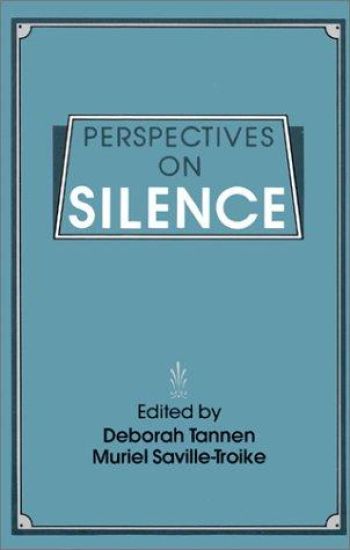
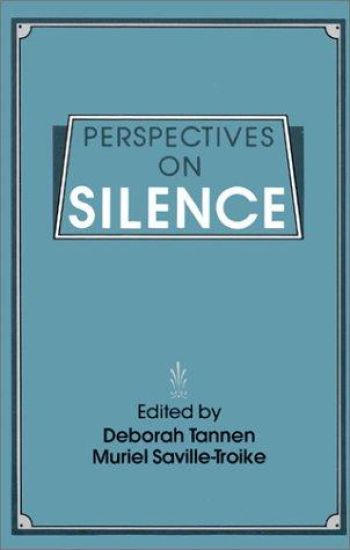
This book focuses attention on a relatively neglected component of communication-silence-in order to present current research from a number of disciplines and also to stimulate further research on the subject. Silence is often viewed as an out-of-awareness phenomenon against which talk is perceived. By reversing polarities and treating silence as a figure to be examined against talk, we are given a heightened awareness of the universal aspects of human behavior while emphasizing its complex nature as a cultural phenomenon.
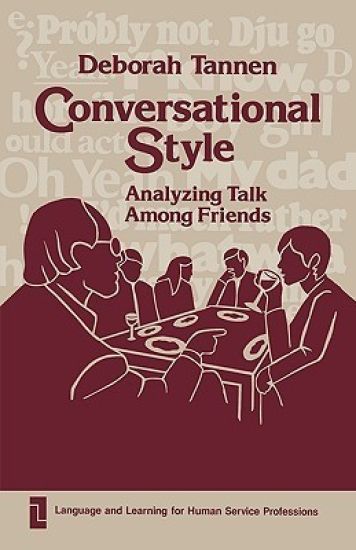
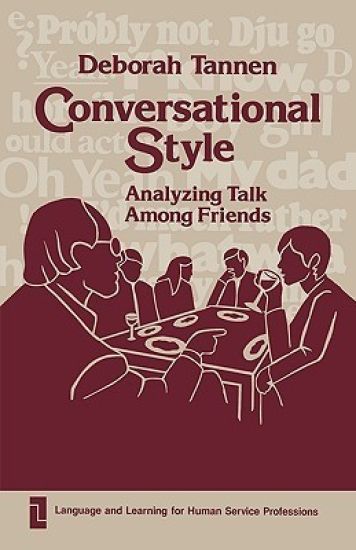
This book provides a basic approach to the linguistic analysis of conversation, building toward a theory of the aesthetics of conversation by analyzing spontaneous talk among friends. It sheds light on such issues as pacing, turn-taking, storytelling, and humor, showing the effects on interaction when participants' conversational styles differ. Its readability makes it suitable for use as a text in discourse analysis at all levels.