Kirjailija
Demosthenes
Kirjat ja teokset yhdessä paikassa: 127 kirjaa, julkaisuja vuosilta 1884–2026, suosituimpiin kuuluu The Public Orations of Demosthenes, Volume 1. Vertaile teosten hintoja ja tarkista saatavuus suomalaisista kirjakaupoista.
127 kirjaa
Kirjojen julkaisuvuodet: 1884–2026.
The four private speeches contained in this collection were functional artefacts whose object was to persuade a jury numbered in hundreds by manipulating both the facts of the case and the prejudices, beliefs and attitudes of the Athenian man-in-the-street. It is as vehicles of persuasion that Dr Carey and Dr Reid seek primarily to treat the speeches, using their commentary to shed light on how well the speeches perform their function. The speeches have also been chosen for their value as documents of Athenian law, commerce and private life. The commentary explains as far as possible any obscurities in these fields and also deals with matters of linguistic interest. While intended mainly for undergraduates and students in the upper forms of schools, the book will be of interest to all classical scholars. The introduction, which provides a brief survey of the Athenian legal system and the trade of the speechwriter, requires no knowledge of Greek and should interest students of classical culture and literature in translation.
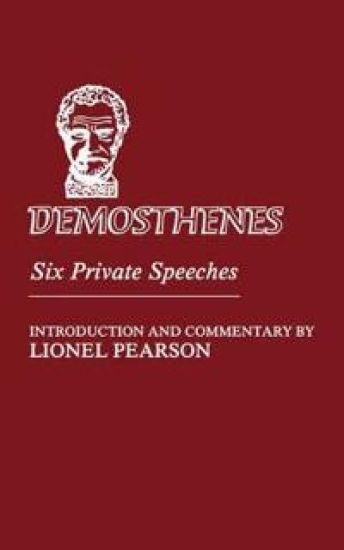
Demosthenes: Six Private Speeches
Demosthenes; Helen F. North
Oxford University Press Inc
1972
nidottu
This work has been selected by scholars as being culturally important, and is part of the knowledge base of civilization as we know it. This work was reproduced from the original artifact, and remains as true to the original work as possible. Therefore, you will see the original copyright references, library stamps (as most of these works have been housed in our most important libraries around the world), and other notations in the work. This work is in the public domain in the United States of America, and possibly other nations. Within the United States, you may freely copy and distribute this work, as no entity (individual or corporate) has a copyright on the body of the work. As a reproduction of a historical artifact, this work may contain missing or blurred pages, poor pictures, errant marks, etc. Scholars believe, and we concur, that this work is important enough to be preserved, reproduced, and made generally available to the public. We appreciate your support of the preservation process, and thank you for being an important part of keeping this knowledge alive and relevant.
The Public Orations of Demosthenes
Demosthenes; Arthur Wallace Pickard-Cambridge
Xpresspress
2026
Nidottu
The Public Orations of Demosthenes
Demosthenes; Arthur Wallace Pickard-Cambridge
Xpresspress
2026
Nidottu
A oração da coroa, precedida de um estudo sobre a civilisação da Grecia por J.M. Latino Coelho
Demosthenes
Antigonos Verlag
2024
pokkari
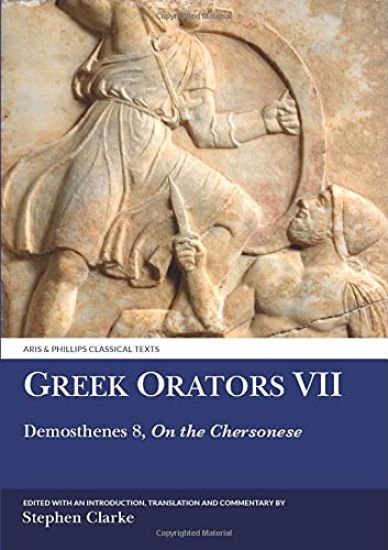
Demosthenes’ oration On the Chersonese is a masterpiece of rhetorical brilliance and contains some of the best examples of his skill as a political orator, coming as one of his final surviving speeches in the corpus. It was delivered to the Athenians in 341 BC, at a time of turbulent events when Athens was coming under increasing pressure resulting from the actions of Philip of Macedon. The Chersonese was a region of great importance for Athens. At the time of the speech, Philip was in the middle of an extensive military and diplomatic campaign in Thrace that would threaten the security of the Athenian grain trade from the Black Sea. The resulting pressure in the Chersonese, however, was seen by Demosthenes as an attempt by Philip to weaken Athens as a prelude to taking the whole of Greece. In this context he argued in the speech that the general Diopeithes, who had been sent out to the Chersonese in 346 with a naval force, be supported in the face of protest from Philip regarding Diopeithes’ actions in the wider area. He focuses on Athenian relations with Philip in this crucial northern region and why Philip was a threat to Athenian interests in the area. This edition with Greek text, translation and commentary contains the first detailed commentary on this speech. The introduction explains the historical background in some detail, as well as examining Demosthenes’ deliberative oratory, the structure and style of the speech, and relationship to the speeches that followed, including the famous Third Philippic. The commentary focuses on all political, military, social and religious references presented by Demosthenes, as well as oratorical aspects.
This book has been considered by academicians and scholars of great significance and value to literature. This forms a part of the knowledge base for future generations. So that the book is never forgotten we have represented this book in a print format as the same form as it was originally first published. Hence any marks or annotations seen are left intentionally to preserve its true nature.
The Olynthiacs and the Philippics of Demosthenes
Demosthenes; Charles Rann Kennedy
Hansebooks
2020
nidottu
The Oration of Demosthenes Against Meidias. Edited for use in Schools and Colleges
Demosthenes
Creative Media Partners, LLC
2019
pokkari
Demosthenous logoi eklektoi = Demosthenis selectæ orationes Ad codices MSS recensuit, textum, scholiasten, & versionem castigavit, notis insuper illustravit Ricardus Mounteney, Præfiguntur Observationes in commentarios vulgò Ulpianeos
Demosthenes
Gale Ecco, Print Editions
2018
sidottu
The 18th century was a wealth of knowledge, exploration and rapidly growing technology and expanding record-keeping made possible by advances in the printing press. In its determination to preserve the century of revolution, Gale initiated a revolution of its own: digitization of epic proportions to preserve these invaluable works in the largest archive of its kind. Now for the first time these high-quality digital copies of original 18th century manuscripts are available in print, making them highly accessible to libraries, undergraduate students, and independent scholars. Western literary study flows out of eighteenth-century works by Alexander Pope, Daniel Defoe, Henry Fielding, Frances Burney, Denis Diderot, Johann Gottfried Herder, Johann Wolfgang von Goethe, and others. Experience the birth of the modern novel, or compare the development of language using dictionaries and grammar discourses. ++++The below data was compiled from various identification fields in the bibliographic record of this title. This data is provided as an additional tool in helping to insure edition identification: ++++Cambridge University LibraryN009786The first three words are transliterated from the Greek. The Greek text is followed by the Latin translation of H. Wolfius. The 'Observationes' signed: J. C., i.e. John Chapman, D. D. Archdeacon of Sudbury. Includes the 'Hypotheses' of Libanius. With two final advertisement leaves. Londini: apud J. Pote, J. Rivington et Filios, T. Caslon, necnon Fielding & Walker Socios, 1778. xlvii, 1],380, 4]p., plate: map; 8
All the Orations of Demosthenes, Pronounced to Excite the Athenians Against Philip King of Macedon. Translated Into English; Digested and Connected, so as to Form a Regular History of the Progress of the Macedonian Power
Demosthenes
Gale Ecco, Print Editions
2018
sidottu
The 18th century was a wealth of knowledge, exploration and rapidly growing technology and expanding record-keeping made possible by advances in the printing press. In its determination to preserve the century of revolution, Gale initiated a revolution of its own: digitization of epic proportions to preserve these invaluable works in the largest archive of its kind. Now for the first time these high-quality digital copies of original 18th century manuscripts are available in print, making them highly accessible to libraries, undergraduate students, and independent scholars. Western literary study flows out of eighteenth-century works by Alexander Pope, Daniel Defoe, Henry Fielding, Frances Burney, Denis Diderot, Johann Gottfried Herder, Johann Wolfgang von Goethe, and others. Experience the birth of the modern novel, or compare the development of language using dictionaries and grammar discourses. ++++The below data was compiled from various identification fields in the bibliographic record of this title. This data is provided as an additional tool in helping to insure edition identification: ++++British LibraryT138463The two final leaves contain the 'Conclusion'. London: printed for W. Johnston, 1756. 4], ix-xxiii, 7],172, 4]p., plate: map; 4
Demosthenous kai Aischinou enioi logoi eklektoi. Graece et latine. In duobus tomis. ... Edidit Ioannes Taylor, ... of 2; Volume 1
Demosthenes
Gale Ecco, Print Editions
2018
sidottu
The 18th century was a wealth of knowledge, exploration and rapidly growing technology and expanding record-keeping made possible by advances in the printing press. In its determination to preserve the century of revolution, Gale initiated a revolution of its own: digitization of epic proportions to preserve these invaluable works in the largest archive of its kind. Now for the first time these high-quality digital copies of original 18th century manuscripts are available in print, making them highly accessible to libraries, undergraduate students, and independent scholars. Western literary study flows out of eighteenth-century works by Alexander Pope, Daniel Defoe, Henry Fielding, Frances Burney, Denis Diderot, Johann Gottfried Herder, Johann Wolfgang von Goethe, and others. Experience the birth of the modern novel, or compare the development of language using dictionaries and grammar discourses. ++++The below data was compiled from various identification fields in the bibliographic record of this title. This data is provided as an additional tool in helping to insure edition identification: ++++Harvard University LibrariesN028841The Latin translation is by Hieronymus Wolf. The first six words of the title are transliterated from the Greek. A reissue of 'Demosthenous, Aischinou, Deinarchou kai Demadou ta sozomena', 1748-57, with cancel titlepages. Cantabrigiae: typis academicis. Apud Johannem Woodyer, 1774. 2v., plates; 4