Kirjojen hintavertailu – 12 903 724 kirjaa ja 27 kauppaa

Kirjailija

Dena Ringold

Kirjat ja teokset yhdessä paikassa: 7 kirjaa, julkaisuja vuosilta 1996–2017, suosituimpiin kuuluu From Mines and Wells to Well-Built Minds. Vertaile teosten hintoja ja tarkista saatavuus suomalaisista kirjakaupoista.

7 kirjaa

Kirjojen julkaisuvuodet: 1996–2017.

From Mines and Wells to Well-Built Minds

From Mines and Wells to Well-Built Minds

Benedicte de la Briere; Deon Filmer; Dena Ringold; Dominic Rohner; Karelle Samuda; Anastasiya Denisova

World Bank Publications
2017
nidottu
Sub-Saharan Africa's natural resource-rich countries have poor human development. This report shows how these countries should tackle the governance challenges in delivering services, invest in early child development, and use the cash generated by resource rents to support citizen investments in human capital.
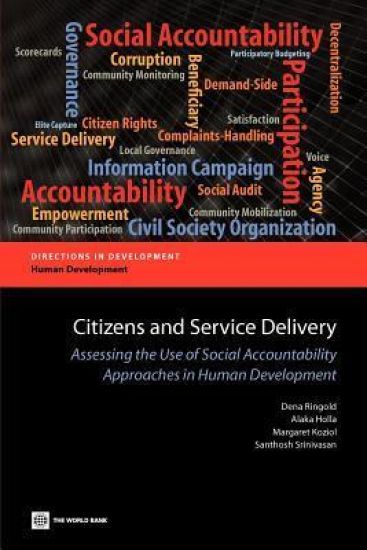
Citizens and Service Delivery

Citizens and Service Delivery

Dena Ringold; Alaka Holla; Margaret Koziol; Santhosh Srinivasan

World Bank Publications
2011
nidottu
In many low and middle income countries, dismal failures in the quality of public service delivery such as absenteeism among teachers and doctors and leakages of public funds have driven the agenda for better governance and accountability. This has raised interest in the idea that citizens can contribute to improved quality of service delivery by holding policy-makers and providers of services accountable. This proposition is particularly resonant when it comes to the human development sectors – health, education and social protection – which involve close interactions between providers and citizens/users of services. Governments, NGOs, and donors alike have been experimenting with various “social accountability” tools that aim to inform citizens and communities about their rights, the standards of service delivery they should expect, and actual performance; and facilitate access to formal redress mechanisms to address service failures. The report reviews how citizens – individually and collectively – can influence service delivery through access to information and opportunities to use it to hold providers – both frontline service providers and program managers – accountable. It focuses on social accountability measures that support the use of information to increase transparency and service delivery and grievance redress mechanisms to help citizens use information to improve accountability. The report takes stock of what is known from international evidence and from within projects supported by the World Bank to identify knowledge gaps, key questions and areas for further work. It synthesizes experience to date; identifies what resources are needed to support more effective use of social accountability tools and approaches; and formulates considerations for their use in human development. The report concludes that the relationships between citizens, policy-makers, program managers, and service providers are complicated, not always direct or easily altered through a single intervention, such as an information campaign or scorecard exercise. The evidence base on social accountability mechanisms in the HD sectors is under development. There is a small but growing set of evaluations which test the impact of information interventions on service delivery and HD outcomes. There is ample space for future experiments to test how to make social accountability work at the country level.
Social Assistance in the New EU Member States

Social Assistance in the New EU Member States

Dena Ringold; Leszek Kasek

World Bank Publications
2007
nidottu
This study analyzes the performance of social assistance and family benefit programs in eight new member states of the European Union from the perspective of fiscal impact and effectiveness. It is based on household survey data for six countries, as well as budget data and information on program design collected at the national level. It finds that, although social assistance programs in the new member states are small in terms of coverage and expenditure levels (reaching 2 to 5 percent of the population), the programs are an important safety net for the poor. Programs are relatively well targeted, with between 30 and 60 percent of resources going to the poorest quintile of the population. For those who receive them, benefits can make up as much as 37 percent of average consumption of the poor.
Roma in an Expanding Europe

Roma in an Expanding Europe

Dena Ringold; Mitchell A. Orenstein; Erika Wilkens

World Bank Publications
2004
nidottu
This work brings together original sociological research, evaluation of programmes and a comparative cross-country household survey on ethnicity and poverty. It finds that Roma poverty is multi-faceted and can only be addressed by a comprehensive policy approach that attends to all dimensions of Roma social exclusion. It proposes an inclusive policy approach which would expand and promote Roma involvement and participation in mainstream society, while maintaining cultural and social identity and autonomy. Policy mechanisms include those which make existing policies more accessible to Roma and identifying areas where targeted initiatives are needed.
Poverty and Ethnicity

Poverty and Ethnicity

Ana Revenga; Dena Ringold; William Tracy

World Bank Publications
2002
nidottu
In many countries in Central and Eastern Europe, Roma are the main poverty risk group. Unfortunately, information on their living conditions and the characteristics of their poverty are scant, fragmented, and often anecdotal. Poverty and Ethnicity analyzes data, from a new cross-country household survey, conducted by the Center for Comparative Research at Yale University in the United States. This survey, the first of its kind, addresses the ethnic dimension of poverty across countries, covering Roma in Hungary, Bulgaria, and Romania and evaluates the welfare of Roma from a quantitative perspective.
Roma and the Transition in Central and Eastern Europe

Roma and the Transition in Central and Eastern Europe

Dena Ringold; World Bank

World Bank Publications
2000
nidottu
The situation of the Roma (or gypsies) in Central and Eastern Europe is one of the most challenging issues to emerge during the transition from socialism. As the socialist regimes collapsed and a free market economy was introduced, economic opportunities increased. However, job security and housing deteriorated. While political participation throughout the population surged, so did ethnic tension, which put the Roma, an already threatened minority, at even greater risk. Since they have always been mobile, the Romas do not constitute a large number in any one country, but as the Iron Curtain fell, their correspondence across borders swelled and attracted interest in their plight. 'Roma and the Transition in Central and Eastern Europe' discusses issues facing Roma in the countries of Central and Eastern Europe, particularly in Hungary, Bulgaria, Romania, the Czech and Slovak Republics. It provides the historical context and background, presents the available evidence on welfare status and living conditions, looks at issues surrounding access to social services, and discusses the policy implications concerning Roma.